
People ask me what language coaching is like and how it differs from teaching, especially if they’ve only ever experienced English through classes, courses, or lessons.
Most of us only know learning as something structured, corrected, and measured.
But coaching feels different.
To explain it, I want to start by sharing a real story
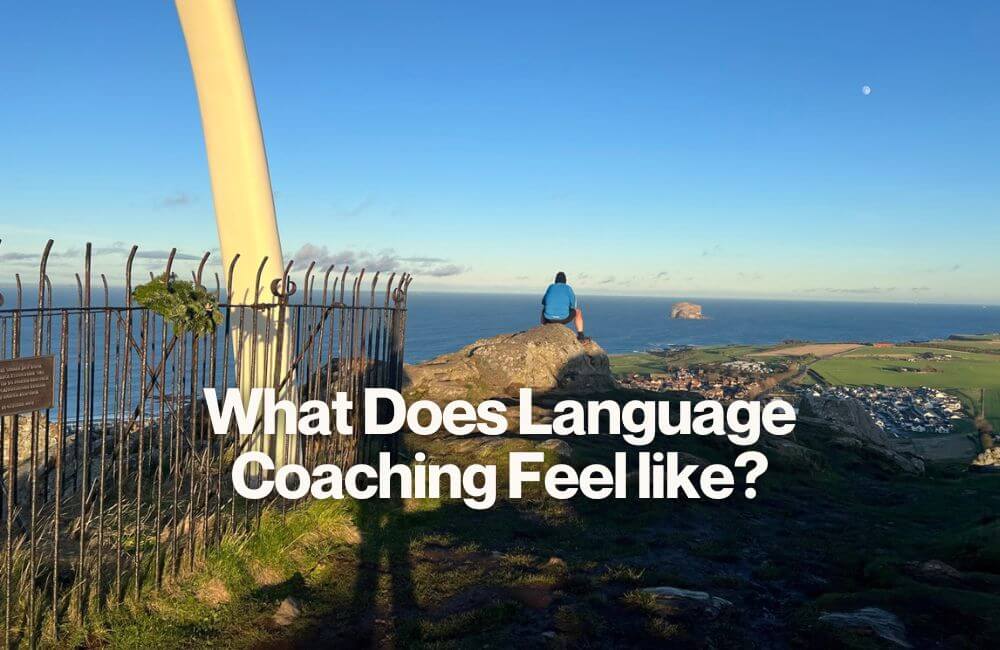
A Story from a Hill in Scotland
This New Year’s Eve, I helped a woman with a small baby at the top of North Berwick Law.
I’m not writing this as a virtue signalling post.
I’m telling this story because this is how I work.
I meet people where they are. I respect the path they’ve chosen. I enable them to succeed.
The young woman and baby had got all the way to the top of the hill by themselves, no problem, but it was muddy and slippy and steep and windy at the top.
Anyone could appreciate how she might be feeling and I like to think most people would offer a hand.
The top was precarious. I was ahead, so I knew the difference in wind between nearly at the top and on the summit.
I read her concern and offered help.
I planted my boots firmly into the rocks, held out my hand, and she gladly took it.
I left her alone, but with my protective eye on her. She needed assistance again, and I helped again.
We began talking as we walked.
We descended the hill together, quite often hand in hand.
She never told me her name or her baby’s name or her job.
I didn’t question her as some might.
She shared why she was walking the frosty hill. She lived in Denmark. She told me about the culture of cycling everywhere in Denmark, and of being healthy. How her colleague with her to go for swim in the sea before sitting at their desks. She saunas regularly.
These are things that when we do them here, we are the weirdos.
She loves that it’s normal. That’s the life she has chosen for her child.
She wanted to take her new baby up the hill to share the Scotland she loves.
On our way down, I told her my story about walking with my young daughter.
How we went up the hill fine, but decided to take a different route back. How the path disappeared and how my 6 friends all ended up passing the pram with my baby in it to one another over rocks and ice. It was January then, too. (They still remind me of it) I shared the story to help her feel okay about receiving help, but it really wasn’t a problem.
I feel she’s someone who can accept help with grace.
And she’d do exactly the same. It’s normal.

Language Coaching is Creating Space
As a language coach, most of the time, I leave people alone to talk, because I know they’re already capable.
I don’t teach English anymore. I’m more of a guide for people who have already come quite far with it — people who just need a touch of support to make their experience feel safe, and exhilarating.
People who want to review what they know and use it to explore being themselves (not just their work selves) in English.
I intervene only in the rare moments it’s critical. Otherwise, I help with the lightest touch. Most of the time, it feels like I’m by your side — and on your side — while memorable moments unfold and conversations flow with ease.
The result of my coaching isn’t doubting whether you can do it, or feeling rescued.
It’s knowing you did it — and feeling proud of it.
And then immediately starting to think about which mountain you want to go up next.
An English Coaching Holiday Walking in Scotland
This isn’t really a blog about mountain climbing.
But walking — including climbing hills — is part of how English unfolds on my coaching holidays in Scotland.
We spend time outside, moving through landscapes together, letting conversation emerge as it does when the body is engaged and the pace is human.
Just as it did with this woman.
One of our holidays is even built around a local walking festival — a celebration of Scotland’s history of cattle drovers, where we follow ancient paths together. It’s social, welcoming, and a wonderful way to experience Scotland outdoors.
Further Information
Walking Guides
Walking on our English language holidays
Walking is a central part of our English language holidays in Scotland, creating space for conversation, reflection, and shared experience.
If you’d like to understand how walking fits into our approach — from mixed abilities and local knowledge to why movement supports confident, real-world English — you can explore it in more detail here:
→ Walking in Scotland on our English language holidays
