
“Will my English really improve if we’re just talking?”
Sometimes people ask whether a language coaching holiday is really an effective way to improve English.
After all, there are no classrooms, no desks, and much of the day seems to involve simply talking.
So is it a lighter option? Just a pleasant week of conversation, in which you pick pleasure over progress?
The short answer is no.
In a high-quality coaching holiday — led by trained language experts, not simply “native speakers” — the conversations may feel spontaneous, but they are not random.
In this blog, I lift the hood on the process and show what is really happening during a day of English coaching in Perthshire.
Walking the Birks of Aberfeldy
What you see
Two people in glorious nature, walking beside the river, talking as they go.
What’s really happening
As we walk, I’m sharing advice from 20+ years of teaching about how he can continue improving his English when he returns home and still meet his goals.
We talk through the four skills: reading, listening, writing and speaking, and what works best for each. We discuss rhythm, how to avoid fossilising errors, and how to assess progress independently.
Walking and talking naturally creates processing time. The results are different — often better thought through and more resonant than if the same conversation happened at a desk. The feeling of building a learning plan becomes one of calm anticipation rather than pressure.
Expressing your goals out loud is powerful.
Language benefit
Alongside beginning to build a learning plan he will actually use, my client is describing his everyday routines and practising planning language — explaining systems and using conditional structures such as:
“If I read for twenty minutes each morning…”
“When motivation drops, I can…”
Visiting the Watermill Bookshop, Aberfeldy
What you see
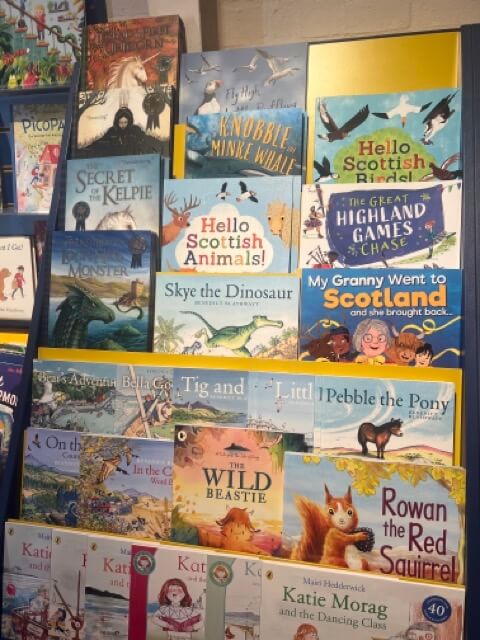
Two people browsing the shelves of an independent bookshop with a superb collection of fiction, memoir, health and wellbeing, and books about outdoor Scotland.
We pick up books, read the back covers, and talk about what we like to read.
By coincidence, a lute player is performing in the café downstairs. (It persuades us to stop for a coffee too.)
What’s really happening
We are choosing a book that my client can continue reading after the holiday — something that matches both his English level and his interests.
Choosing the right book matters enormously. A book that is too difficult quickly becomes frustrating. One that is well matched becomes an English companion for months.
I have a skill for matching people with books. It’s a mix of expertise and intuition. I only share books I know and love; they don’t have to be difficult to be valuable.
To change the rhythm, we pop into the children’s section to look at the different ways Scotland is represented.
Language benefit
Aside from gaining an ingredient for his learning plan, we are rehearsing:
-
expressing opinions
-
explaining preferences
-
making predictions
Language such as:
“I usually enjoy books that…”
“This one might be too difficult.”
“I think I would enjoy this author.”
Taking the Scenic Route: The Fortinghall Yew
What you see
Two people deciding to take the scenic route back to Crieff.
The road winds out of Aberfeldy. As we drive, the landscape changes. The wide arable fields of south Perthshire give way to steeper hillsides and a mountainous Highland landscape. There are still snow-covered peaks.
We pass stone circles standing quietly in fields.
We visit a yew tree thought to be the oldest in Europe — around 5,000 years old (roughly the same age as those stone circles). The pathway to the tree becomes a kind of timeline, leading us past the Vikings, Romans, Picts and Scots who all claimed this landscape.
Nearby is a red phone box that still works.
After the profound encounter with the tree, it feels good to mess around taking photos.
What’s really happening
It’s important to me that my guests develop a sense of the geography of place.
This short drive shows the transition in Perthshire’s landscape: from a small Highland town surrounded by arable farmland to the mountainous hillsides where the land is used very differently and traditional ways of life developed.
The stone circles and the ancient yew tree naturally lead us into conversations about deep time — about the people who lived here thousands of years ago and how communities once survived in these landscapes.
The working phone box then brings the conversation back to much more recent history: life before mobile phones, when these boxes were lifelines for rural communities.
A landscape always gives us something real to talk about.
Language benefit
Moments like this naturally invite:
-
storytelling
-
comparing past and present
-
speculating about what we see
Language such as:
“Villages used to rely on phone boxes like this.”
“That stone circle must have been important to the people who lived here.”
“Winters here would have been hard.”
Unscripted
The spontaneous real-world English conversations we had along the way.
What you see
Two people chatting with people they meet along the way.
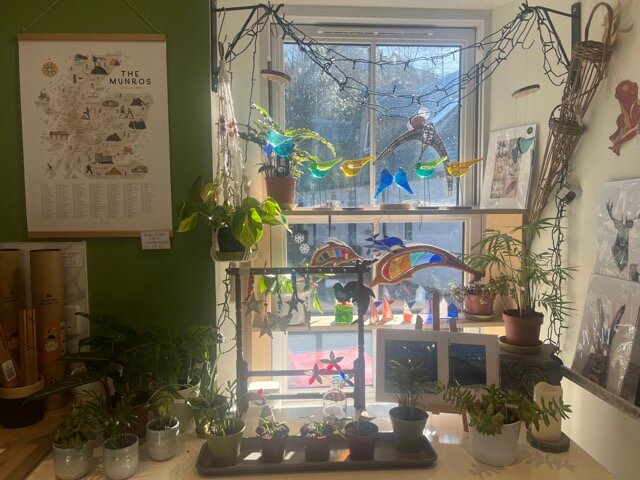
Earlier in the day, we spoke with a shopkeeper in Aberfeldy whose shop is filled with artist editions and houseplants paired with handmade ceramic pots. He tells us about his childhood in Asia and the languages he grew up speaking.
Later, beside the ancient yew tree, we meet a couple who tell us they first met here more than fifty years ago.
What’s really happening
These are some of the richest language moments of the day.
Real stories appear — unscripted — and the conversation naturally turns towards memory, identity and experience.
My client is no longer practising English in an artificial setting. He is listening to real stories, responding with curiosity, and asking his own questions.
These encounters also allow me to gently guide the conversation so that my client participates fully, helping him shape questions and responses when needed.
Language benefit
Every person’s story can inspire. And every real-world conversation is an invitation to tell part of your own story. They help build your identity as an English user.
Conversations like this naturally build listening skills (with me on hand to support when needed) and the ability to keep conversations flowing.
We practise:
-
asking follow-up questions
-
describing personal experiences
-
reacting to unexpected information
Language such as:
“What was it like growing up there?”
“How do you stay in touch now?”
“Do you miss it?”
Simple questions inviting deep connection.
So, Is a Language Coaching Holiday a “Lite” Option?
If you only see one part of my holidays, you might mistake them for ‘just talking’.
But underneath the guided walks, landscapes, visits and chance encounters is a carefully guided sequence of conversations, each one drawing out different kinds of English to make a whole.
Such conversations may feel spontaneous, but they are not random.
Any holiday can give you nice memories of Scotland.
Our goal is so much more.
More than ‘just’ a week of English practice.
More than a clear plan and system to keep your English moving forward.
We aim for you to feel like you belong here speaking English, Your language skills may just be catching up.
If you’d like to see what these coaching holidays look like in practice, you can explore them here:
→ Blue Noun English Language Holidays in Scotland
And if you’re curious about the philosophy behind this approach, you can read more about real-world English learning here:
→ Learn How We Teach English Through Real Situations
Our Guides to Find Your Next Step
What's the Next for My English?
A supportive space to find your next step
Help Choosing a Language Holiday
Choosing the right English language holiday can be confusing.
Check out our guides to help you ask better questions and invest well.