
I first wrote this blog in 2021.
At the time, I was looking around Crieff at some of the remarkable environmental and community initiatives happening here and wondering why we weren’t making more of them.
Some were genuinely pioneering. This small Perthshire town was trying things long before similar ideas became commonplace elsewhere.
I thought they were part of what made Crieff worth visiting.
I still do.
Today, they are also part of how Blue Noun practises regenerative tourism in Perthshire.
People come to us from Germany, Norway, Japan and around the world to develop their English while discovering Scotland.
Of course, that also means castles, landscapes, historic towns, wildlife and good Scottish food: they are all ways into place.
But discovering a place also means discovering what people are doing there, uniquely.
In Crieff, that might mean encountering a community garden finding ways to share surplus food, a reuse organisation keeping useful materials out of landfill, or Scotland’s first woodland cemetery.
And frankly, places like this are often richer in conversation opportunities than standard tourist options.
These aren’t tourist attractions in any conventional sense. They are something better: ways into the place.
They give us rich things to talk about, too. We can explore why an initiative exists, how it works and whether anything similar happens in a guest’s own country. An idea that started in a small Perthshire community can be noticed by someone from another part of the world, talked about, remembered — perhaps even taken home and planted somewhere new.
That is one small way tourism can give something back.
Blue Noun practises regenerative tourism in other ways too, but this particular story belongs to Crieff. It is about what this town makes possible — and why I think some of its best ideas deserve to travel.
Back in 2021, writing about one brilliantly simple local initiative, I ended up saying:
“Seriously. Tell the world. It’s beautiful.”
It turns out I meant it quite literally.
From Ecotourism to Regenerative Tourism
This article was originally written in the run-up to COP26 in Glasgow, when conversations about reducing the environmental impact of tourism were everywhere.
I used the word ecotourism then.
The conversation has moved on, and so has my thinking.
Reducing the harm caused by tourism matters, but I’m interested in a bigger question now: can tourism actively contribute to the places where it happens?
Can it support local businesses, create meaningful encounters between visitors and residents, strengthen local culture and community, and give visitors reasons to spend time — and money — in places they might otherwise pass through?
For Blue Noun, regenerative tourism isn’t one single practice. What follows is one example of what it can look like: sharing the pioneering ideas and initiatives that Crieff has already created with visitors from around the world.
Crieff Needs a New Tourism Story
Crieff needs visitors.
We need people walking along our High Street, buying lunch, going into independent shops, staying overnight, discovering local businesses and giving them reasons to keep going.
And Crieff has been talking for years about how to make that happen.
We are in a beautiful part of Scotland — but beautiful scenery isn’t enough of a proposition. Scotland is full of beautiful towns, landscapes and places to stop. Many visitors still pass straight through Crieff on their way somewhere else.
I think Crieff is crying out for a tourism pivot.
Not away from the things visitors already come to Scotland for. Castles, landscapes, history, wildlife and good food absolutely belong here.
But alongside them, we have something else worth showing people.
Crieff has a remarkable history of people trying things: community projects, environmental initiatives and local solutions that have sometimes been well ahead of similar ideas elsewhere in the UK.
What if those were part of our tourism story too?
What if bringing new footfall into Crieff wasn’t only about finding new ways to sell the familiar attractions, but about helping visitors discover what is actually happening here?
Today, through Blue Noun, I get to see what happens when we actually do it.
Crieff’s Tourist Assets
There really are many good reasons to visit and live in Crieff. The problem, from a tourism point of view, is that there are wonderful small towns all over Scotland.
Since moving to Crieff, I’ve heard years of conversations about how to improve the town’s visibility to visitors, regenerate the High Street and ‘put Crieff back on the map.’
Some great things have happened. But we still need new thinking, new reasons for people to stop here and more foot traffic through the town.
One opportunity is sitting right under our noses.
Crieff is home to some remarkable environmental and community initiatives. They are part of what makes this place distinctive, yet we don’t often think of them as part of our tourism story.
The question I originally asked was whether we could boost the town’s economic development and reduce its environmental impact at the same time.
I would broaden that question now:
Can tourism bring more money and footfall into Crieff while also strengthening the things that make Crieff a remarkable place to live?
I think it can.
Crieff’s Golden Son
Of course, Crieff does have one tourist asset that most small Scottish towns can’t compete with.
Ewan McGregor grew up here.
So rather than have me tell you why Crieff is worth discovering, here’s Ewan introducing his home town.
He has an international platform, but I think most people here share his pride in this town and want to see Crieff return to prosperous days.
I think Ewan speaks for all of us in this video.
Different Ways of Seeing the Same Place
Of course, there isn’t one single story about how this landscape should be used.
Strathearn is home to farmers, landowners, conservationists, tourism businesses, environmental projects and people with very different ideas about what our land is for and how it should be managed.
For me, that complexity is part of discovering a place.
Blue Noun isn’t here to give visitors a lecture about the ‘right’ way to think about Scotland. We can meet people with different relationships to the landscape, listen to their stories and notice how differently the same place can be seen.
Sometimes one wild animal is enough to reveal all of this.
Take deer. Depending on who you are talking to, deer can lead you into conversations about wildlife, conservation, woodland regeneration, stalking, food, tourism, land ownership and the Scottish economy.
→ Monarch of the Glen — the Blue Noun Way
These aren’t abstract classroom discussion topics. They are visible in the landscape around us.
And when you start looking at a place this way, a walk through Perthshire becomes much more than beautiful scenery.
The Good News is We Have Already Started!
Crieff is already home to some remarkable social and environmental initiatives.
They solve real problems locally, but the ideas behind them can travel much further.
For visitors, they are another way to discover Crieff: to meet the people who live here, understand what matters to the community and encounter ideas they might never find on a conventional tourist itinerary.
Here are three examples.
#1: Surplus Food at Crieff Community Garden
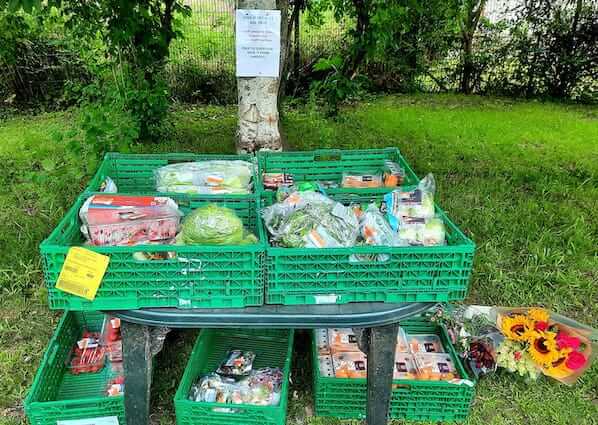
One brilliantly simple Crieff initiative began with a problem: too much surplus fresh food.
Crieff Food Bank was receiving surplus fruit and vegetables from the local Co-op, but sometimes there was simply too much to distribute.
During lockdown, Tina McRorie, who runs Crieff Food Bank, had already been taking surplus food to a phone box in nearby Muthill that had been turned into a community library and larder. It helped fresh food reach people who were self-isolating and unable to get to the shops.
Then came another local solution.
Tina approached Crieff Community Garden about taking some of the excess vegetables for its compost bins. Instead, Catriona Smith suggested putting the food out at the garden for anyone in the community to collect.
The idea was trialled. In its first four days, 24 crates of fruit and vegetables were taken home rather than going to waste.
And an important part of the idea was that the food was for everyone.
Feed your pets. Feed your tortoise. Feed yourself.
You didn’t have to demonstrate that you were in need. If nobody took the food, it was heading for waste anyway.
That simple change did several things at once: reduced food waste, put fresh food into people’s kitchens, brought people into the Community Garden and removed some of the stigma that can surround asking for help.
One anonymous note left at the stall described grandparents eating strawberries and apricots with their grandchildren in the garden while the children invented stories around its giant throne.
A supermarket had surplus food. A food bank had more than it could distribute. A community garden had space.
Put those things together, and Crieff found a better use for the food.

“You asked how the food bank has changed over the last five years well I guess we are busier than ever, so many people are struggling especially on benefits. The pandemic has hit families hard and less money has meant more need for our service.
I have been collecting the surplus food just before closing time at the Co-op since they started doing charity collections a few years ago, whilst it’s hard work the pleasure of knowing how much it helps people in our community makes it all worthwhile.”
Tina McRorie
“The initiative to hand out free fruit and vegetables at Crieff Community Garden was really spur of the moment. Tina McRorie who runs Crieff Food bank approached me to ask if Crieff Community Garden would like the excess veg from the food bank for our compost bins. I enquired further and she advised they receive far too much to hand out from the cop-op, to which I suggested we assist by having our own free fruit/veg stand at Crieff Community Garden.
We agreed to trial it, thinking if we don’t get much of a response, the veg is still saved from landfill and we’ll be able to compost it within the community garden. We started that night Monday 02/08/2021 and in the first 4 days managed to hand out 24 crates worth of fruit and veg”.
Catriona Smith, of Crieff’s Community Garden
A Simple Idea Doing Several Jobs
For any policymakers reading this, think for a moment about the fact that people are leaving their houses and walking or cycling to the garden to collect surplus fruit and veg to take home and eat.
I previously worked as an English teacher for a French government public-health agency, INPES (Institut National de Prévention et d’Éducation pour la Santé).
Seriously, a whole marketing department filled with health psychologists, nutritionists, patient groups and marketers, with the intention of getting people to move more and Eat 5 a Day.
And Tina and Catriona just nailed it.
Seriously. Tell the world. It’s beautiful.

#2: Remake Scotland — A Local Solution to a Global Problem
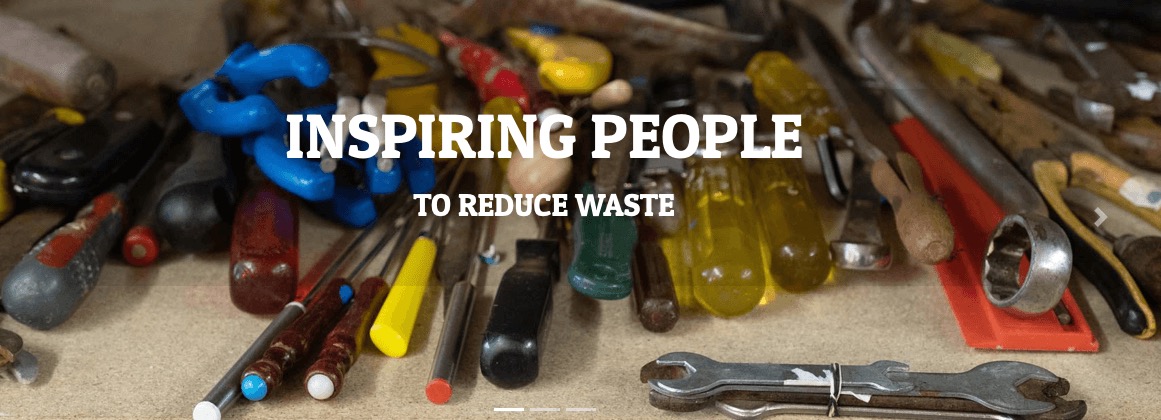
Remake Scotland is a Crieff-based charity built around a simple idea: use things for longer and keep useful materials out of landfill.
Businesses and households donate furniture, household goods, craft materials, tools and other reusable items. Some are repaired before being sold back into the community at affordable prices. Materials are reused in workshops, there are opportunities for young people to learn skills, and even a tool library — because not everyone needs to own a drill they use twice a year.
Remake describes what it does as a “local solution to a global problem.”
That’s exactly why it is interesting to share with international visitors.
Waste isn’t a Crieff problem. Repair, reuse, consumption and our relationship with possessions are questions communities everywhere are trying to answer.
But here is one small Scottish town actually trying something.
A visitor can walk through the door, see how the idea works in practice and take that conversation somewhere else.
Why isn’t there something like this in every town?
#3: Strowan Woodland Cemetery
On the outskirts of Crieff, beside the River Earn, is Strowan Woodland Cemetery — Scotland’s first eco-cemetery.
A cemetery might seem an unusual place to take a visitor.
But Strowan is beautiful, particularly in spring when the woodland floor fills with bluebells, and it is another fascinating way into this place.
It opens up conversations about how we use land, our relationship with nature, burial traditions, woodland, conservation and the choices we make at the end of life.
It also makes visible an idea that was pioneered here in Crieff.
That’s why places like Strowan belong alongside castles, landscapes, cafés, galleries and historic sites when we share Perthshire with Blue Noun guests.
They each reveal a different part of the place.
Ideas Worth Sharing
Tourism doesn’t have to mean choosing between castles and community gardens.
Both help us discover a place.
What interests me is what becomes possible when visitors are encouraged to notice more: the landscape and the people living in it, the history and the ideas being tested now, the famous attractions and the small local initiatives that tell us something about how a community works.
Crieff gives Blue Noun an extraordinary amount to share.
Our guests bring their own experiences too. A conversation about food waste, land use or reuse quickly becomes international: What happens where you live? Would this work there? What do you do differently?
Ideas move in both directions.
For me, that’s one small but important part of regenerative tourism: visitors aren’t simply consuming a destination. They are spending money locally, bringing curiosity and knowledge into the community, and taking some of its ideas back out into the world.
→ Explore the other ways Blue Noun practises regenerative tourism in Scotland.
And there is a bigger economic question here too. How can places like Crieff attract the visitors and investment they need while strengthening the things that make them good places to live?
→ Read my reflections from the 2026 Perth & Kinross Economic Summit.
Many Thanks
A huge thank you to Tina and Catarina for taking the time to answer my questions – and of course, for everything you do for our town.
And if you’re local, I’d love you to be part of what we share next.
Blue Noun is looking for Strathearn businesses, makers, growers, organisations and residents with places, skills, stories and ideas that could give our international guests another way into this remarkable part of Scotland.
Blue Noun is looking for
2027 partnerships with Strathearn businesses & residents...
Further Information
Anybody is able to access the Crieff Community Food Bank should they need to by ringing 03453011100.
Support the Crieff Community Food Bank.
Learn more about the Crieff Community Garden.
Find out about Strowan Woodland Cemetery
Related Posts: