
The Story of a Family English Holiday in Scotland
Families often think they have to choose between an enjoyable family holiday and something that actually works for their English.
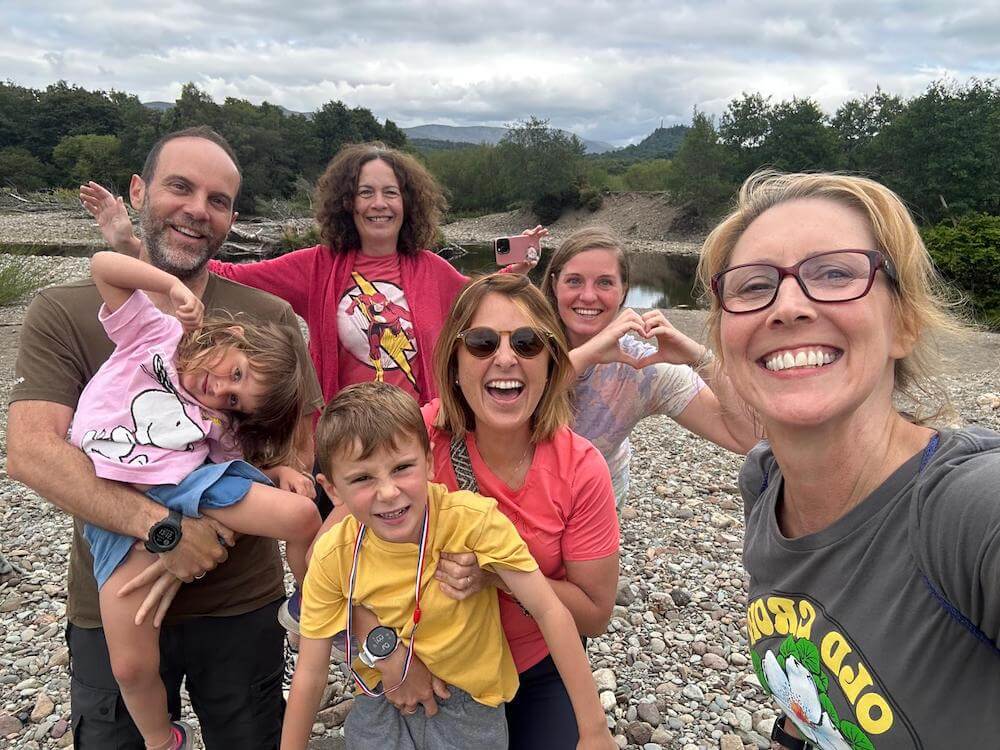
This photo was taken on the first family holiday I ran.
It took me a while to realise that with my skill set (having taught adults, children, teenagers and university students in all sorts of settings), I could create something that really works for a family as a whole, without compromising fun for language progress.
Blue Noun family holidays are for slowing down and enjoying time together, with layers of quality language support woven through, spiralling out into adventures from our base in Crieff, Scotland.
We don’t try to do too much language “work”, or fill every space with noise.
We slow down into English, and it’s powerful. It doesn’t need to feel intense to get results. It is time to stop equating struggle in a language classroom with language progress — especially on holiday.
The alternative is enjoying rich experiences that convert passive knowledge into active knowledge, and your grasp of English into something that feels substantial.
You can achieve this by using it playfully.
Visiting Scotland as a Family?
Alongside our longer family holidays, we also offer private one-day English experiences for families visiting Scotland.
These relaxed experiences can take place locally around Crieff or at carefully chosen locations further afield, helping children and parents use English naturally through shared activities, conversation, movement, and discovery.
August in Scotland
This family came in August, which is a great time to visit Scotland, as there is so much going on, especially for families.
Of course, there are the big events like the Edinburgh Festival (they went twice), but our region in Perthshire also has a lot of family activities in the summer. In terms of conversation, local is far better than crowded for language development.
Even in our town, Crieff, their visit coincided with a local arts festival, pipers playing in the square most evenings, artwork in shop windows, and a real sense of community.
I didn’t create that. They stepped straight into it and were held by it.
In this video, you can see the Tartan Shop in Crieff running demonstrations on how to wear the traditional plaid.
This is real-world English at its finest — natural, visual, tactile, and identity-building.
Blair Drummond Safari Park
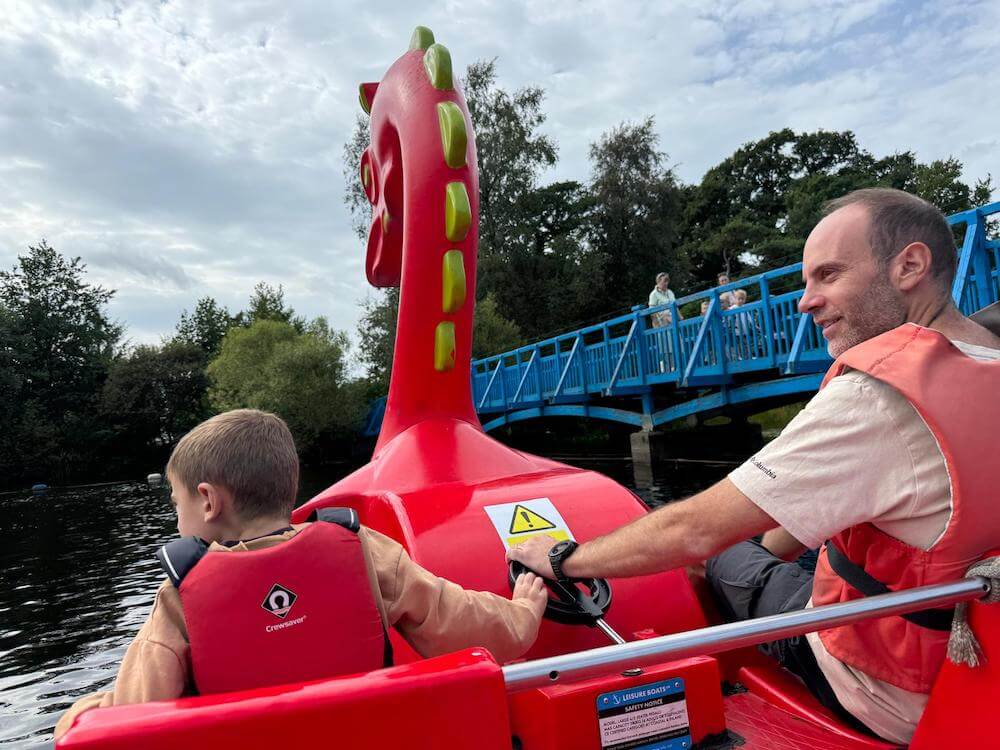
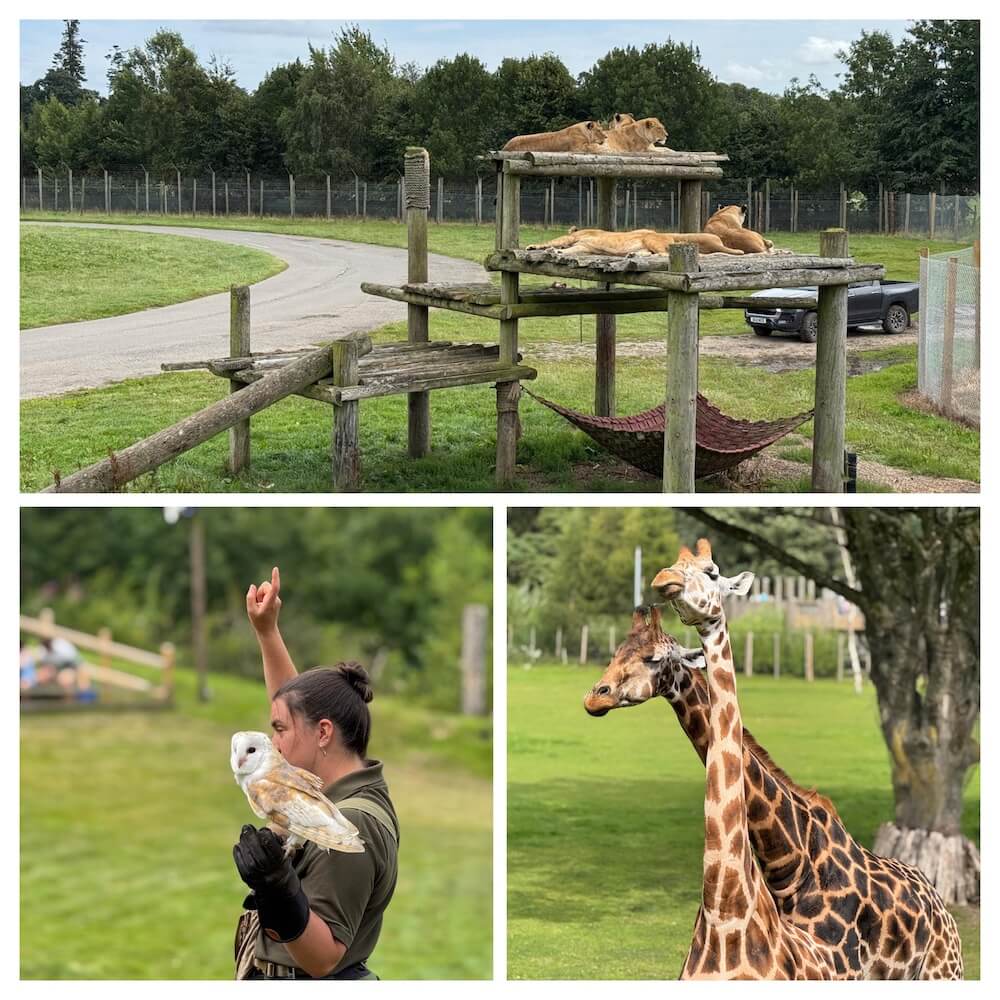
Over the two weeks, we found a rhythm that worked. We spent full days together — for example, visiting Blair Drummond Safari Park (where a day isn’t quite enough). We explored slowly, took the train around the park, and loved the bird of prey demonstration.
With a family, the parents and I all manage the timing. You can never know what is going to enchant a child, and there must be time for it.
I also stepped back deliberately at times. This family were incredibly welcoming, but it was important that they had time to regroup and rest together without me. I was a big part of the week, but not filling it.
About Professional Language Needs
Parents know there are many moments when children are happily occupied, and this creates space for meaningful conversation or focused work in a healthy way.
That’s the beauty of a holiday like this.
At the safari park, one of the children became completely focused on counting the animals (any opportunity to count — he took it). At the same time, I could walk alongside one of the parents and ask questions about their work.
Later in the week, we set up a full interview workshop, with an imaginary company, name badges, formal interview questions — the works.
Doing it seriously in practice makes it less intimidating when it’s real, meaning the language comes more naturally.
My role in a family holiday is to move between these moments — supporting each person differently, often at the same time.
You can find out more about working on your professional English on a Blue Noun holiday here.
Linking to Language in Ways that Feel Good
One afternoon by the river, storyteller Jen Newall invited us to choose a single word from a deck of cards and share why it mattered.
If you’re curious why such a simple activity works so well, you can read more here
→ Read why cards are one of my favourite language resources.
It’s Got to Feel Good for Everyone
There was a moment at the safari park where the mum asked if adults were allowed on the big slide, and then we both raced on.
Moments for fun really matter.
People often think they have to choose between enjoying a holiday and working on their English. In reality, English is happening inside moments like this, too, wrapped up in being who you want to be.
Choosing the Language Activities
Some things I planned, but the week also morphed around the family.
I didn’t know, for example, that stopping at cafés and delis would become such an important part of their experience. This was not just pleasure — it connected to their professional interests. We began visiting towns simply because they had remarkable cafés, and we talked about layout, clientele, and ambience.
They are big hiking fans, so we climbed the local mountain, Dumyat, together. If you don’t know it, Dumyat gives incredible views for its size — across Stirling Castle, the Wallace Monument, and even as far as Edinburgh on a clear day.
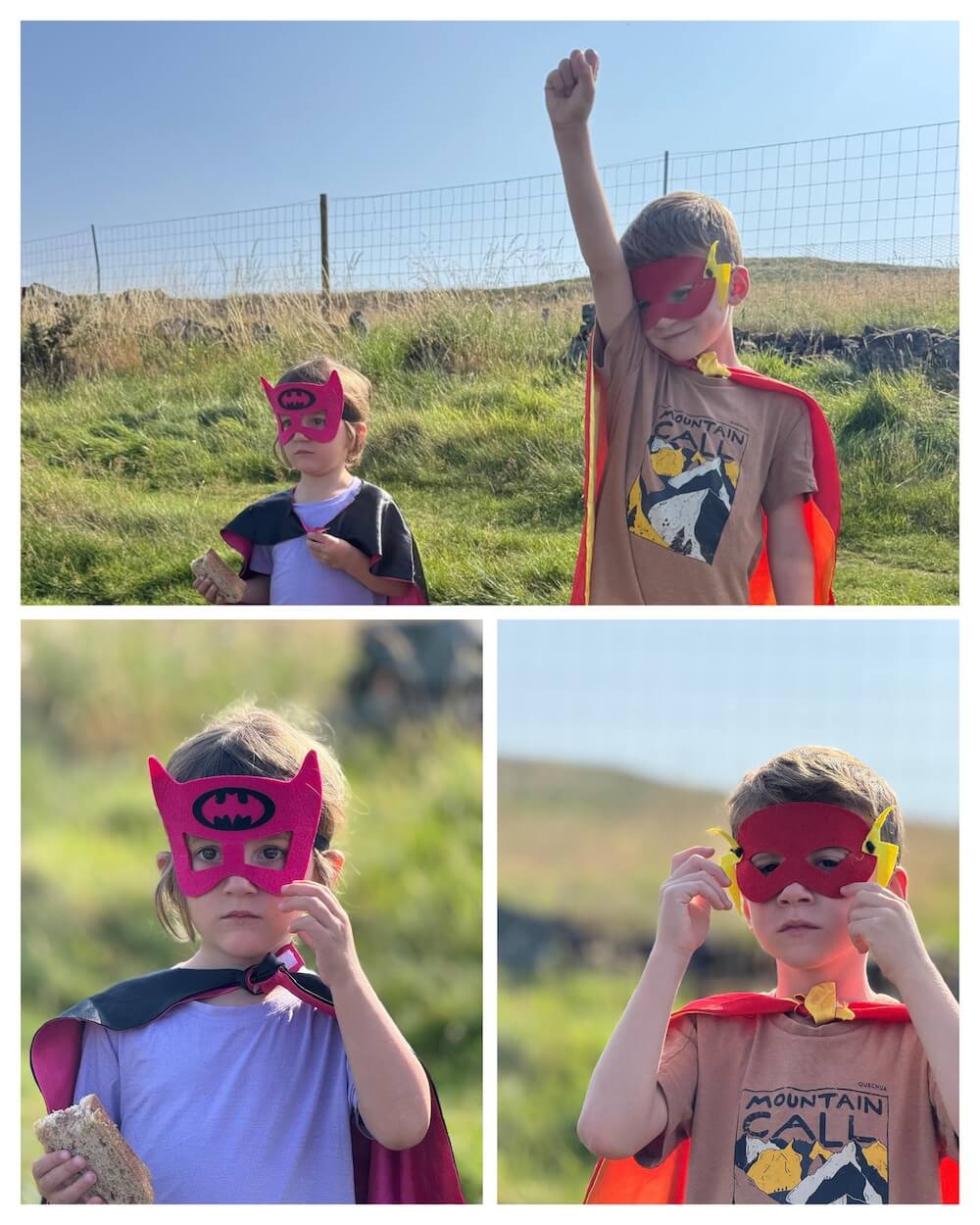
To help the kids with the hill, I gave them superhero capes and masks. I loved that they insisted on wearing them all the way up.
On the way down, the little girl fell asleep in her dad’s arms, still with the cape fluttering in the wind.
Sometimes that means following small, local moments like these. Other times, it means including a bigger visit — like a day in Edinburgh — shaped in the same way, around curiosity, energy, and what unfolds in the moment (you can read more about how we experience Edinburgh beyond the landmarks here).
Language is Built Through Lots of Tiny, Care-filled Moments
Small moments carry a lot of language power.
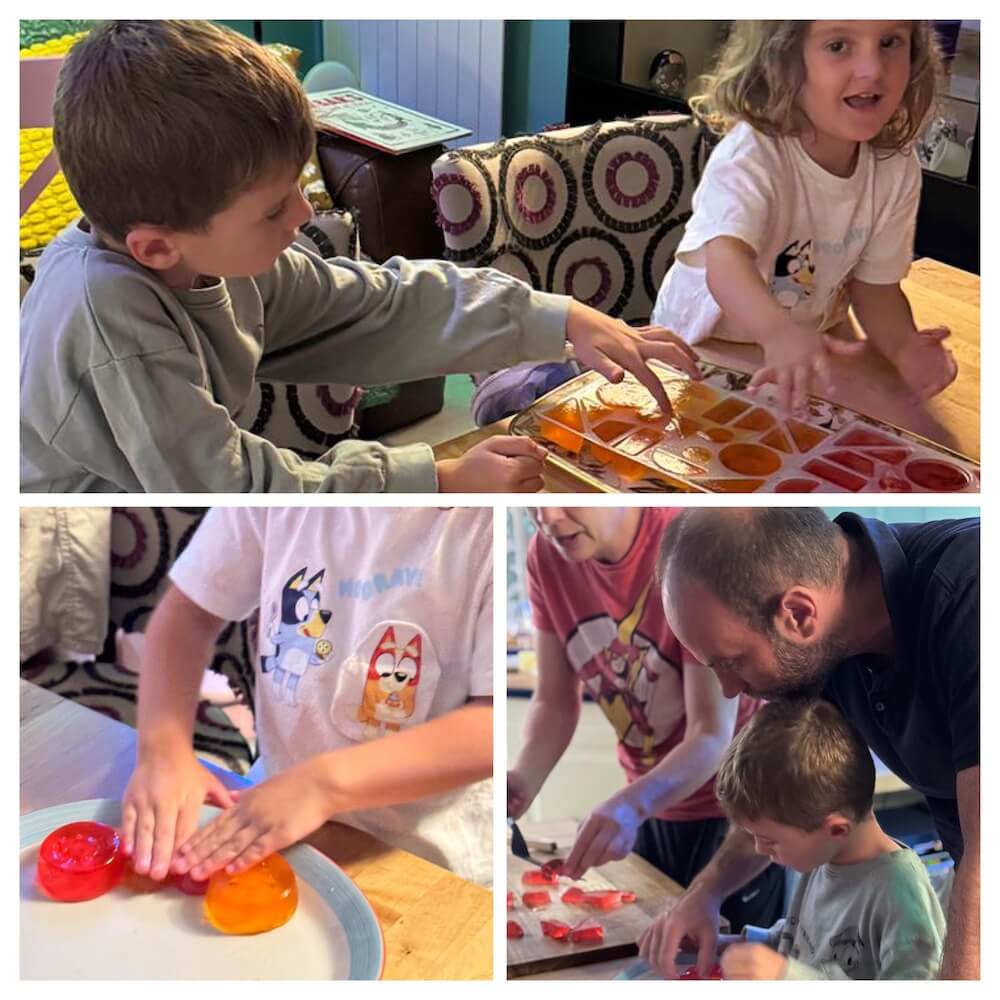
I had prepared a jelly-making activity for the children, which almost didn’t happen because we were so busy, but it was clearly important to one of them, so we made time for it.
While the jelly was setting, I was in conversation with their dad.
In the car — in the “downtime” — the youngest child (who had no English before the holiday) began shouting “sheeeep” whenever we passed a field. It became a game, and then the chorus of a song we wrote together.
Her brother (who had learned English at school) began on the first day by pointing out dogs — “brown dog”. I helped him build from there — “black and white friendly dog”.
By the end of the holiday, he would run to tell me about any dogs he had seen and bring me books to read.
These are the moments where language really takes hold — not in structured activities, but in the spaces between them (I’ve written more about how language develops in the moments between activities here).
Not Everything Goes to Plan
In the middle of the stay, we travelled north to Inverness and were hit by very strong winds.
The family were staying in a yurt and didn’t sleep well, and the dolphins we had hoped to see didn’t come close to shore.
It made me reflect on how I work. Trying to show the “best of Scotland” can actually take us away from the places I know well, where I can support people more naturally and adapt easily.
My language work is stronger when we stay closer and go deeper.
The Small Moments Carry So Much
I kept a little fluffy bag in the back seat of the car with travel toys in it. The youngest would take the teddy out during the journey, hold it the whole way, and then carefully put it back in the bag when we arrived somewhere, as if it needed to sleep while we were out. We would say “hello teddy” and “goodnight teddy” each time.
We also fell into a routine with books. On hub days, the children would choose books from my collection, and we would read together, sometimes stopping to shout out the words we recognised.
Tangible Language Progress
By the end of the two weeks, something had shifted. English was no longer something separate.
The biggest visible language transformation was with the young boy, and it happened through building his trust.
He had learned some English at school, but nothing had helped him understand that it was a real language — spoken as naturally as his own, just in a different part of the world. It sounds obvious, but children don’t know that until they experience it.
They can learn a lot, but it often sits like a game for clever kids, not as part of who they are, not as something real.
That can go on for a long time, until an experience makes it real.
Helping Families Grow Strong in English
Every family is different.
This was one version of a week, shaped by these people and what they needed at the time.
If you would like to know how I would help you and your family, do book a Zoom chat.
We do not mix family bookings with other bookings, so availability tends to fill early each year.
Further Information
Links
Pages
Learn more about my art and ELT English training
Related Blogs
Dumyat – An Easy Mountain to Climb
Poetry at Crieff Arts Festival
Song Writing Workshop
Guided River Walk with Jen



Good to Know
What’s a Hub?
Social Action Policy
Frequently Asked Questions
Free English Resources
Need to Know
Privacy Policy
Terms and Conditions

Blue Noun Language Hub
St Ninian’s Lodge,
Lodge St, Crieff PH7 4DW
01764 654377
email: ruth@bluenoun.co.uk
All photographs are by the author unless otherwise stated and permission is always obtained.
© Ruth Pringle 2026