In the last couple of weeks, French students have shown the world the absence of care they have been suffering in their education.
Unfortunately, it has taken closed schools, protests hundreds of thousands strong, and an increasingly volatile situation to make that visible.
But the wishes of the students themselves are remarkably modest.
One student, Anna, told reporters at the capital’s Place de la Nation: “Our demands are simple: better study conditions, enough teachers, decent school buildings. The authorities’ response has been catastrophic. There’s enough violence already.”
We read together, sympathetically.
In France, the young learners want enough teachers. Classrooms they can actually learn in. Buildings that work. A future in which their education leads somewhere.
This is not trouble for trouble’s sake. It is a desperate attempt to make an absence of care visible.
We looked at newspaper reports of the protests and riots today in class because I am currently teaching a mum and her 12-year-old daughter.
Mum has a lower level of English. Her daughter is intermediate and can be wonderfully chatty when she is motivated — but not everything motivates her.
Mum is a political science graduate. She is desperate to be able to speak sophisticatedly about intelligent topics in English.
I chose the French student protests topic because it is current, and both mum and daughter would have different views and experiences to share.
A Student’s Own Story
My target language was large numbers and comparisons for both of them, and I also wanted to work on R.’s fluency in expressing her own experiences.
The Guardian article included a table listing countries by average class size.
The French students are protesting with an average of 25.4 students per class.
My student, R., has 40 students in hers.
The league table compared European countries and Japan, but included no South American countries. Something I am noticing a lot while helping my Chilean clients is just how Western-centric so much of our ‘information’ is.
Another part of our connection and discussion.
Why I Care
I believe everyone working in education should be watching what is happening in France and forming opinions about it.
There are lessons here for all of us.
These are not simply other people’s problems.
I also have my own connection to French education. I lived and worked in France for ten years. I didn’t teach in lycées, but I taught art school students, often fresh out of lycée.
I feel for them and their parents.
It was a glorious sunny day — a rare gift in October in Scotland — and we had already planned to spend some of it outside.
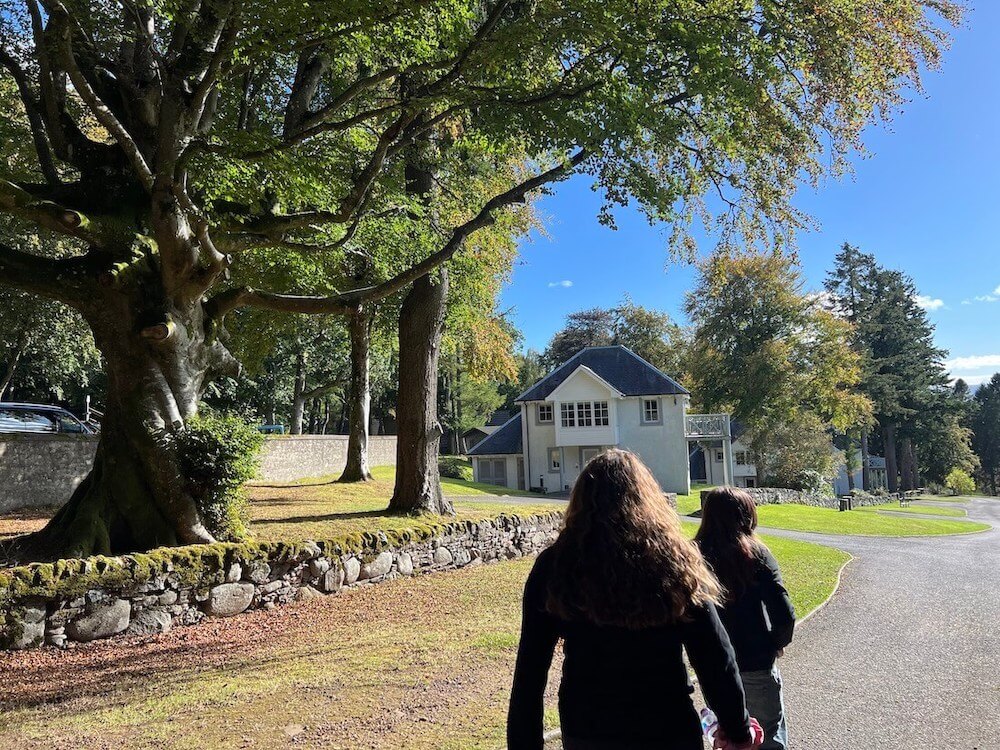
After an hour with the newspapers, we wandered out the door and up the Knock, Crieff’s summit with spectacular views.
On our walk, we compared the impressive Hydro Hotel with our visit to Comrie Croft the day before.
Both are family holiday destinations with spectacular nature as part of their offer, but they share it in very different ways.
My language guests are staying for a month in a large, beautiful two-bedroom apartment with a little private garden as part of their language holiday.
It is interesting to walk past the Hydro’s many cabins and holiday lets and compare the value. The Hydro is vast, helping hundreds of families simultaneously. Their accommodation is close to nature: great for families.
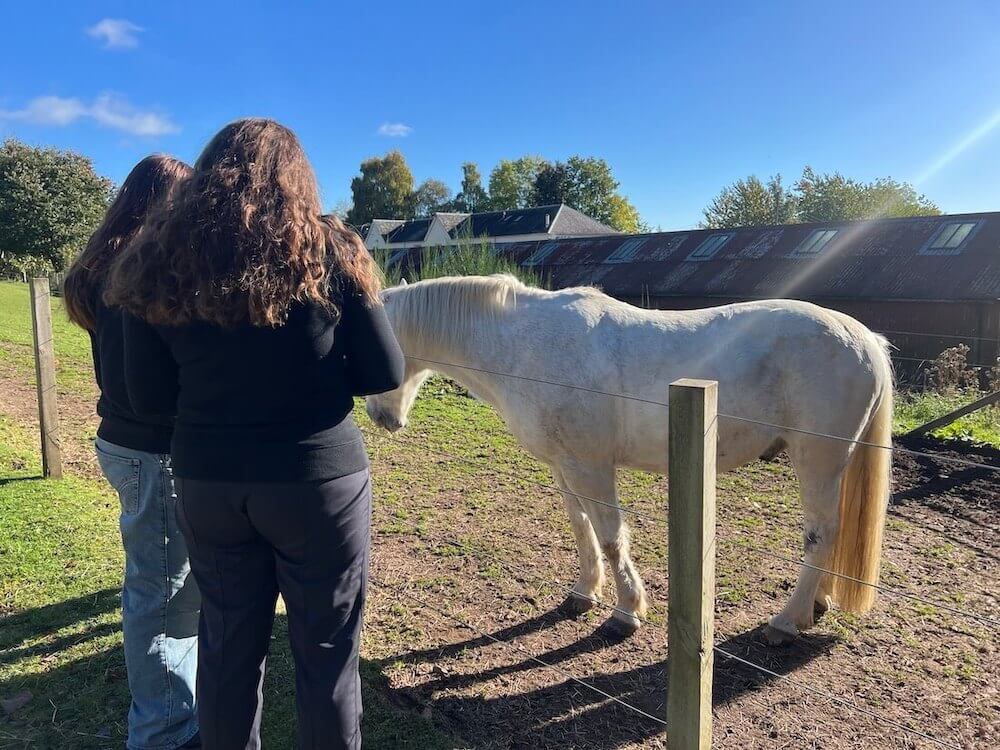
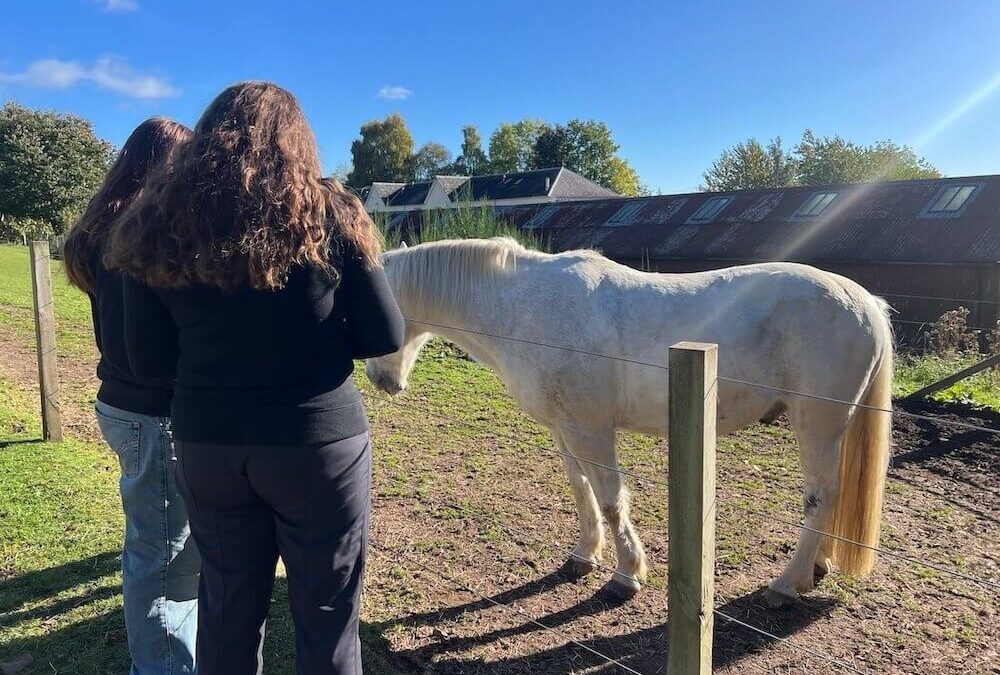
We stopped at the Riding Centre to speak to the horses and ended up having a conversation about riding lessons.
M. is really keen to try it. We spontaneously signed up for a woodland hack next week, which might be interesting, as I haven’t been on a horse in 30 years.
As I am all about exploring new ways to be with the landscapes of Perthshire, I am really keen to explore putting this one on the cards for future language holiday guests.
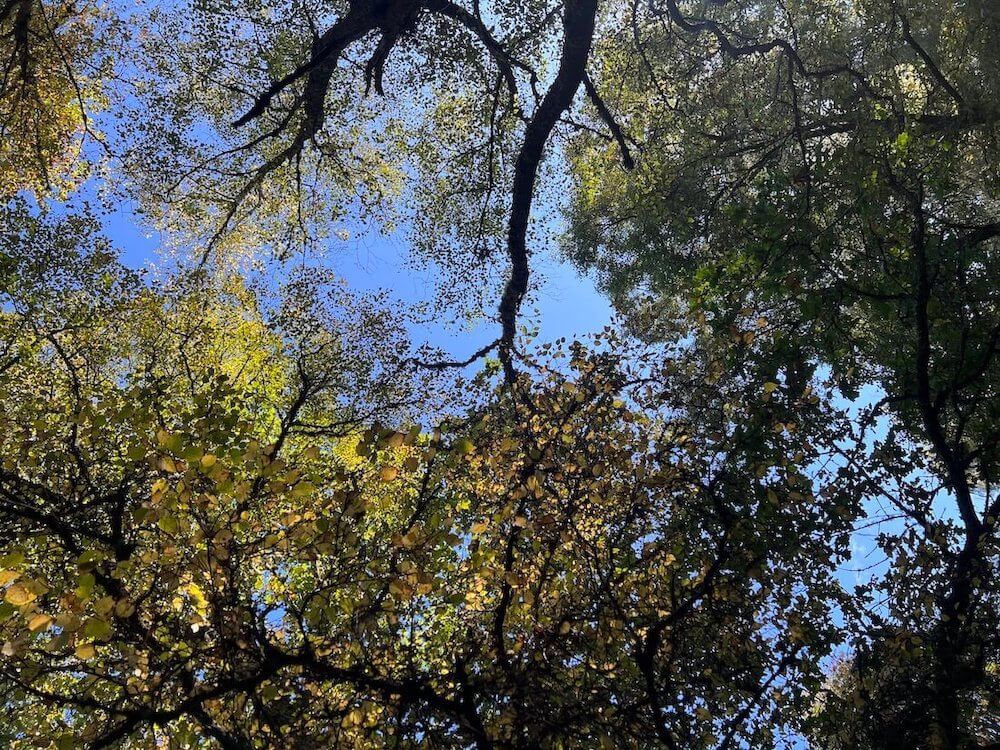
We began the ascent of the Knock gently; it’s a short walk but quite steep.
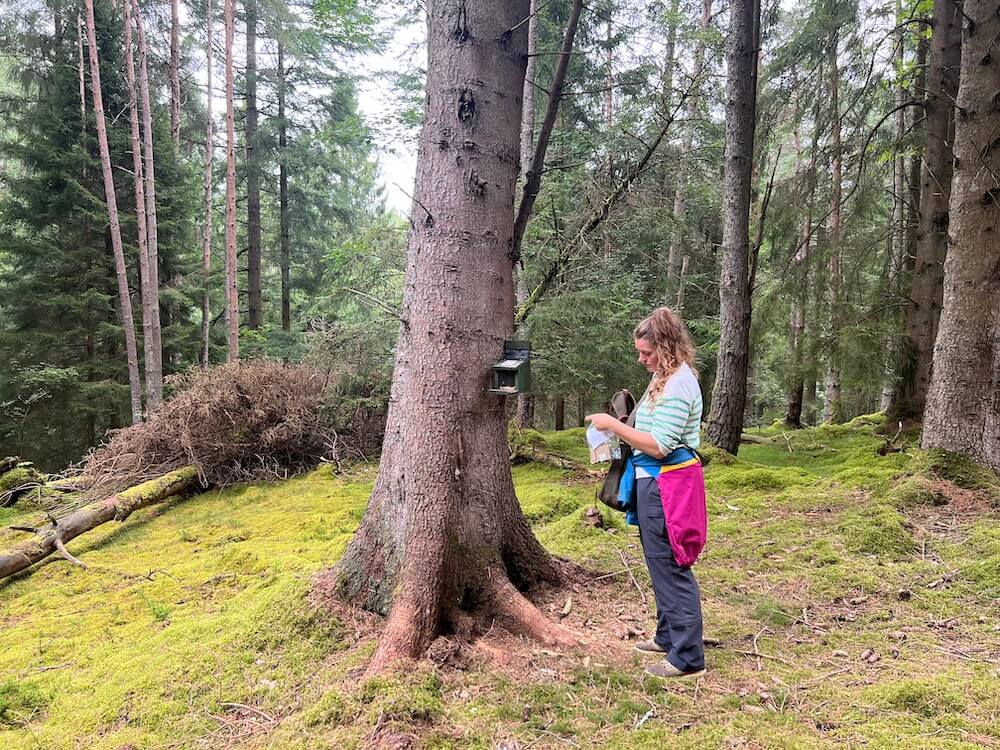
On our way, we saw our first red squirrel. I hadn’t had the full conversation about squirrels in Perthshire yet: one of my conversations that I always have with visitors.
Perthshire sits around the dividing line between Scotland’s predominantly grey-squirrel country and the areas where red squirrels still thrive. Both species are actively monitored here, and grey squirrels are controlled to protect the reds. Greys compete with reds for food, but the bigger threat is squirrelpox: grey squirrels can carry the virus without becoming seriously ill, while for red squirrels it is usually fatal. So spotting a red squirrel here isn’t just a lovely wildlife moment — sightings are useful information.
Particularly this week, as we are taking part in The Great Scottish Squirrel Survey, (5th – 11th of October) so will report our sighting on their website as we wander Perthshire woodlands.)
As we walked, I shared the citizen-science projects monitoring red and grey squirrels in Scotland.
Taking part in these projects is something we share with guests on our holidays.
A Pause for The View
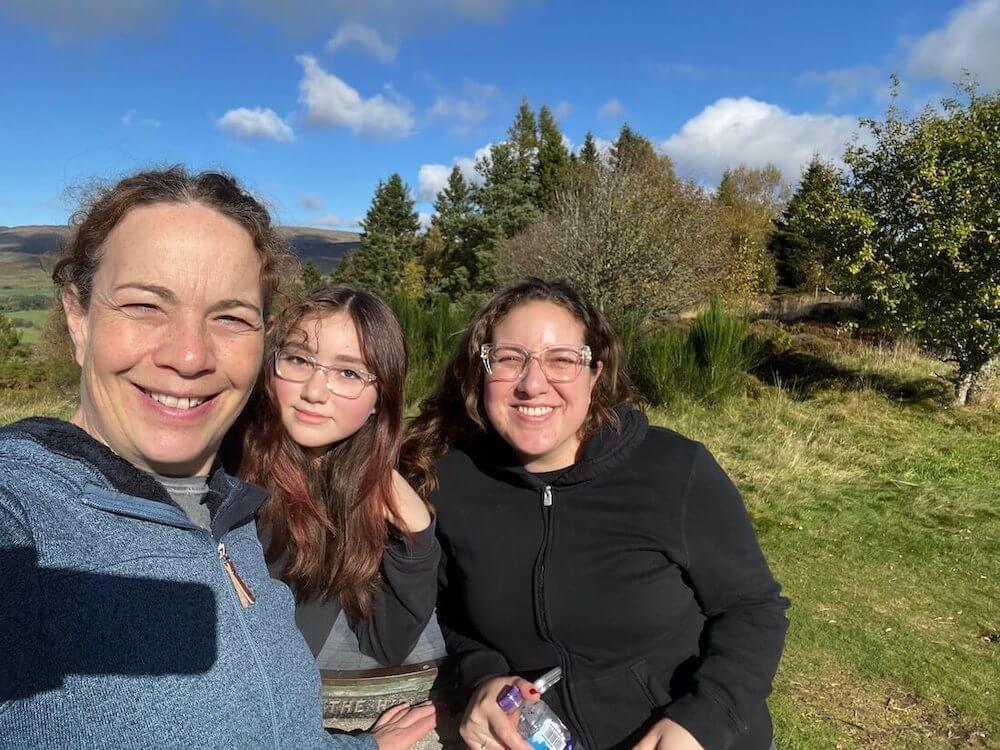
We enjoyed some time at the summit, watching the shadow of a cloud move across the nearby hillside.
Any height is a chance for my visitors to get their bearings. We used the trig point to find Loch Turret, which they visited on their first day, and Dunblane, which they visited a couple of days ago on their way to Doune Castle. We looked for the few private castles dotted across the surrounding hillsides and hoped to see deer, but none were obliging.
There was a coolness in the wind despite the warmth of the sun, so we descended the hill to the Winter Garden café at the Hydro, where we sat on the balcony in glorious, sheltered sunshine.
It was a perfectly enjoyable day.
Which shouldn’t be a remarkable thing to say about a day spent learning English.
But for some reason, people think language learning needs to feel hard, uncomfortable and stressful for it to be effective.
I spent ten years teaching English in classrooms, helping people navigate grammar-first learning from books and worksheets. I know that system well.
→ Learn More About My ESOL Training and Experience
Language learning already comes with so much ‘need to’. People wake up thinking, I need to work on my English. Very few wake up excitedly thinking, I can work on my English today.
I left classroom language teaching 10+ years ago.
Now every day feels like a mini adventure.
I wake up excited to get started, a feeling I had teaching art and design courses, but wholly lost teaching language within classrooms and prescribed courses and systems, where it was all ‘need to’ and ‘must’ — and no ‘want to’.
I’m delighted in my work, and it communicates to my clients, helping them feel excitement about being here and using English.
Because I help all kinds of different language needs and levels, individuals, couples and family groups, every day is different. Every conversation is different.
In case that doesn’t sound specialist, there are very few language trainers who can hold a week without coursebooks. My uniqueness is this very flexibility and adaptability in holding space and conversations.
The Four Stems of Language Learning
I spent 10 years in language classrooms helping people navigate English learning grammar-first from books and worksheets. Part of the same systems rushing learners forward under pressure that I now help my guests rebalance from.
Pressurised classroom learning is the most common way to learn a language, but it’s not the only way, and it leaves gaps and seeds fears.
I don’t mean gaps in vocabulary.
I mean gaps in confidence, gaps in reactivity, gaps in feeling connected to the language.
Most people have spent years in the classroom, without the conversation time that a healthy language learning mix needs.
→ The Four Stems of Language Learning: (and why you need them all)

Closing the Gaps Language Education Leaves Behind
I truly believe that caring can close those gaps.
It’s hard to learn in a system without it.
French lycée students are unfortunately currently at one extreme of lacking it.
My holidays are at the other extreme, being wholly built around it.
There are things language education can learn from great hospitality. But its business models cannot simply be borrowed from hotels and holiday resorts.
A hotel can create an exceptional experience and fill its rooms with different people, over and over again.
Language learning is different.
There isn’t an empty room to fill, rinse and repeat.
The experience itself needs to adapt and react to the person who arrives.
Large language-school holidays deliberately standardise what they offer. It keeps costs down and allows the same programme to be sold to more people. The learner arrives and is fitted into the service that already exists.
That can deliver an average service efficiently to a lot of people.
But exceptional language education works the other way around.
It starts with the person. It adapts and reacts to who they are, what they care about, what English they already have and what they want to be able to do with it.
You don’t build the programme and then find people to fill it.
At Blue Noun, we ask what can happen when we build around the people who arrive.