
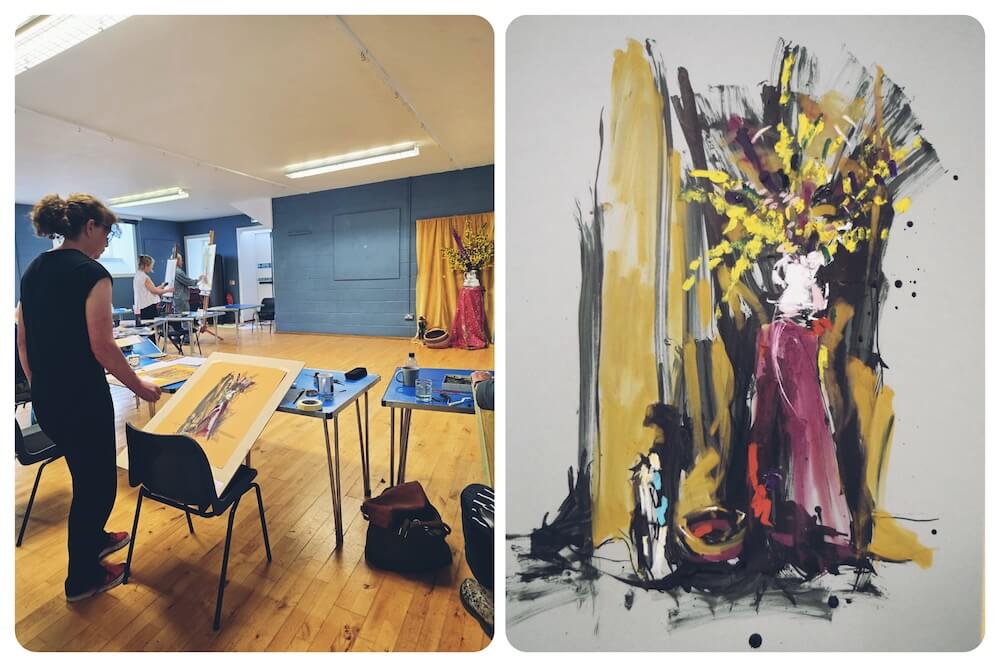
How it Began
We were eating fish and chips in my dad’s summerhouse when I asked how she felt about making art and taking an art class.
Often, the people who end up here with me have a creative hobby in some form or other. They turn up and take a superb camera out of their bag, or they tell me they love watercolour painting wildflowers.
But I. categorically said no, never. Nothing.
My holidays walk a line between putting you in situations that you wouldn’t ordinarily find yourself in, sharing deep experiences of community, and inviting you to be a version of yourself that you wouldn’t ordinarily get to.
But the line cannot tip into feeling exposed or uncomfortable or wishing you weren’t there.
I knew there was a superb art class waiting to be taken, only would it make my guest feel good?
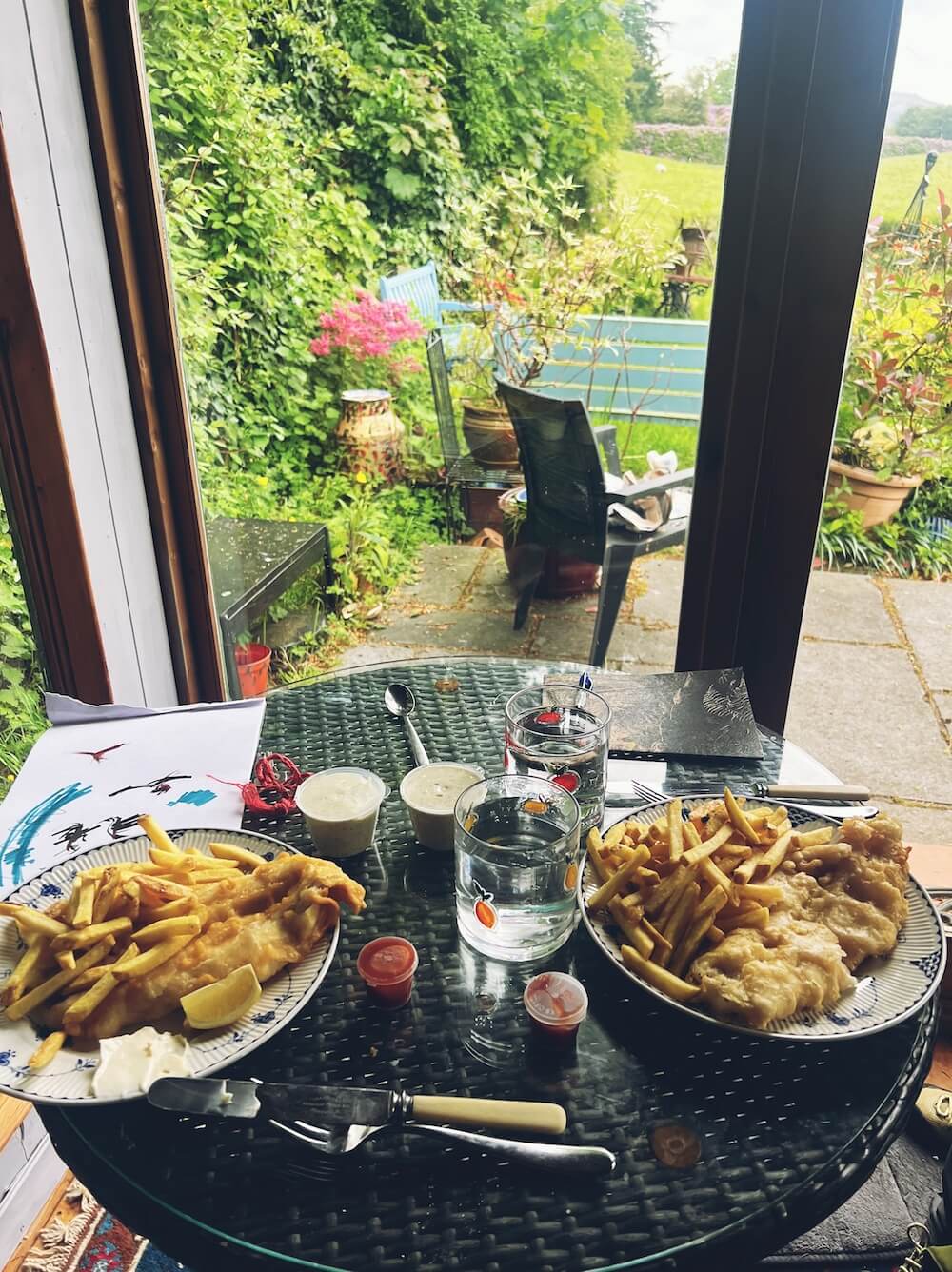
The Right Choice?
We sat watching the view, then the shepherd appeared and we could see him attempting to count sheep, visibly pointing, but without a dog, we could see a sheep sneak around behind him each time. He needed to resume counting five times.
I wasn’t sure, so I texted Liz Kemp, the artist running the class, for a bit more information.
Would a beginner artist feel comfortable here?
She replied that it was PERFECT for a beginner. It wasn’t a typical drawing class but an introduction to a range of materials. She would be demonstrating them first, then letting people try them. The others in the class were a mix of experienced and curious. Many of them would be trying the materials for the first time. It wasn’t about results; it was about learning what was possible.
I communicated this to I. and she said, yes, let’s try it.
A Gentle Way in
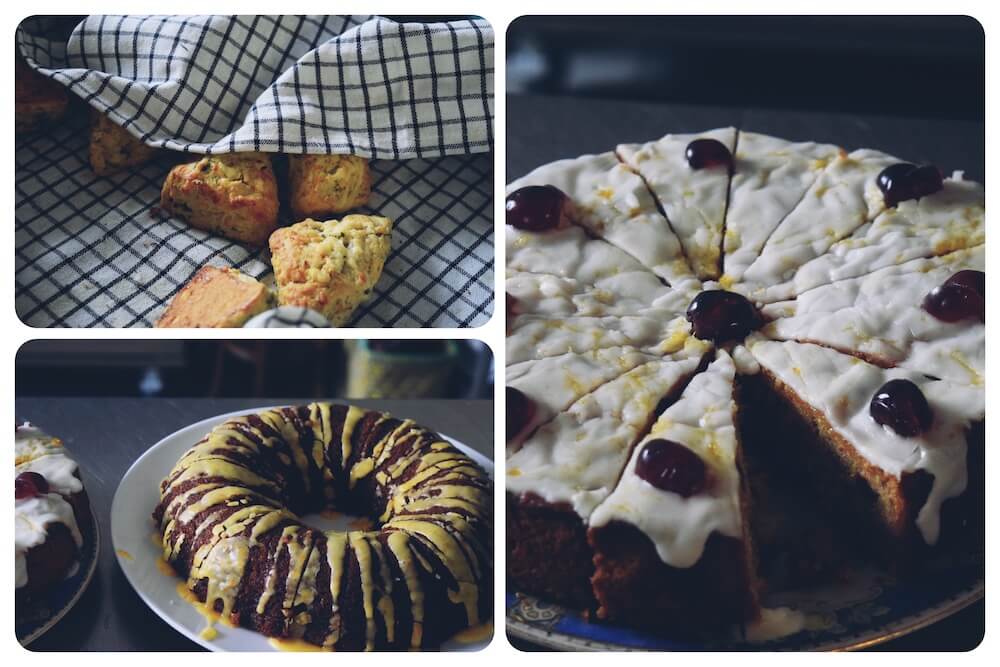
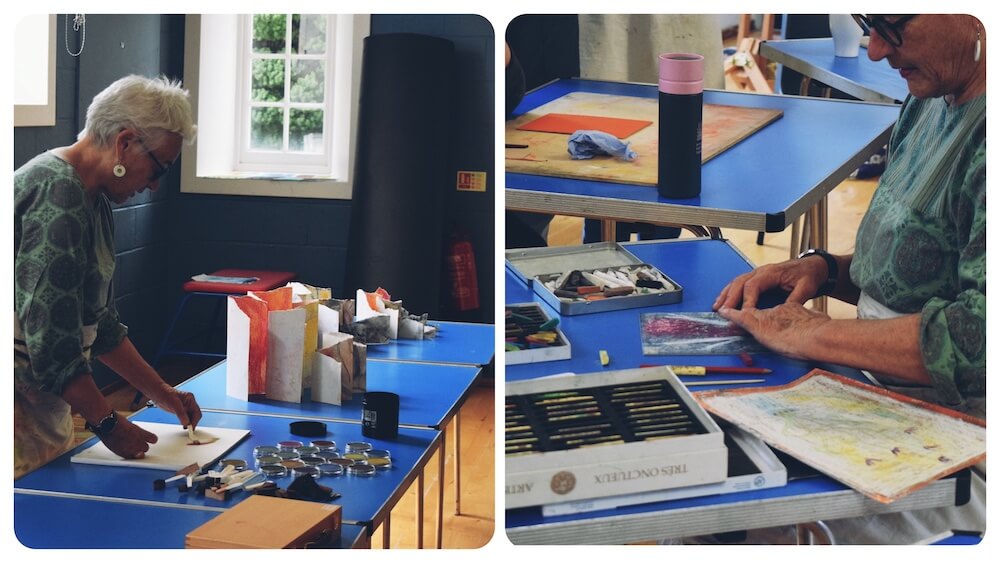
The workshop started with teas, coffees and delicious home baking. Liz described it as ‘studio style’ – this means it’s all laid out and you help yourself as and when. Apart from lunch, there are no formal breaks – this keeps everyone working to the rhythm they need.
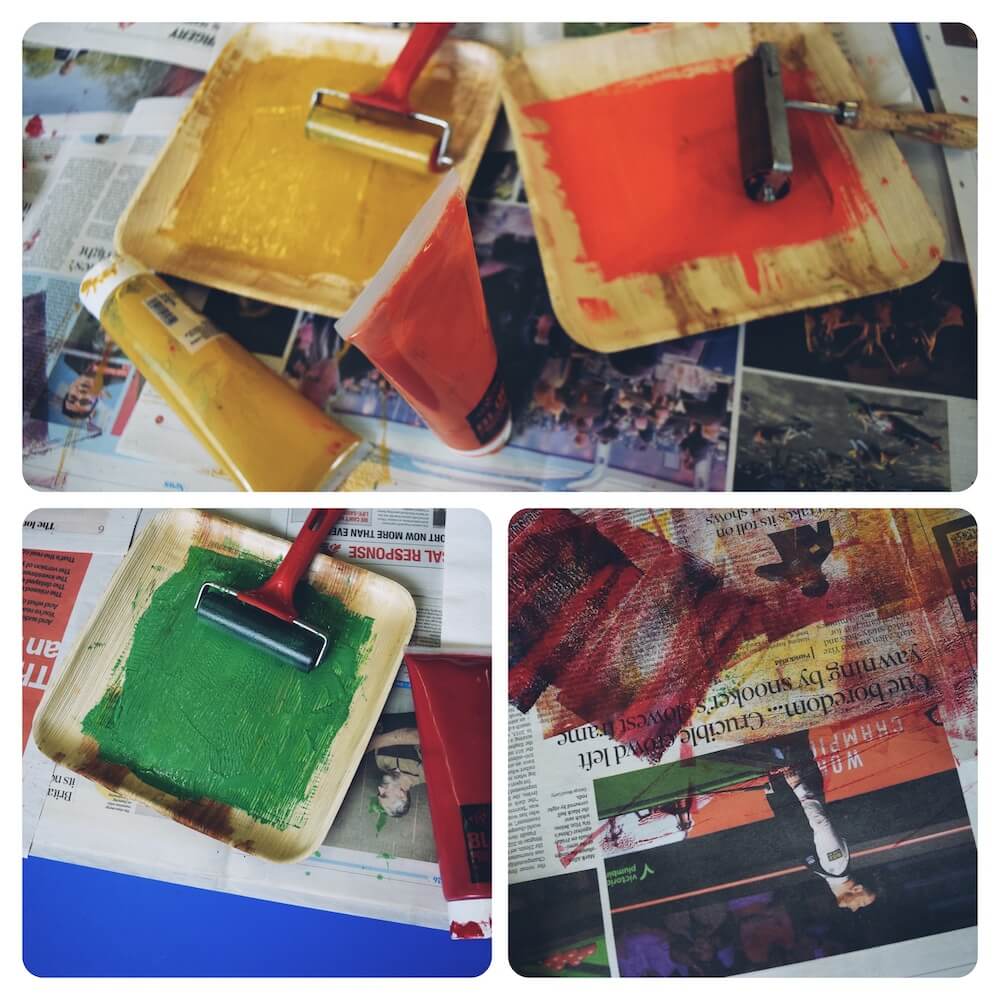
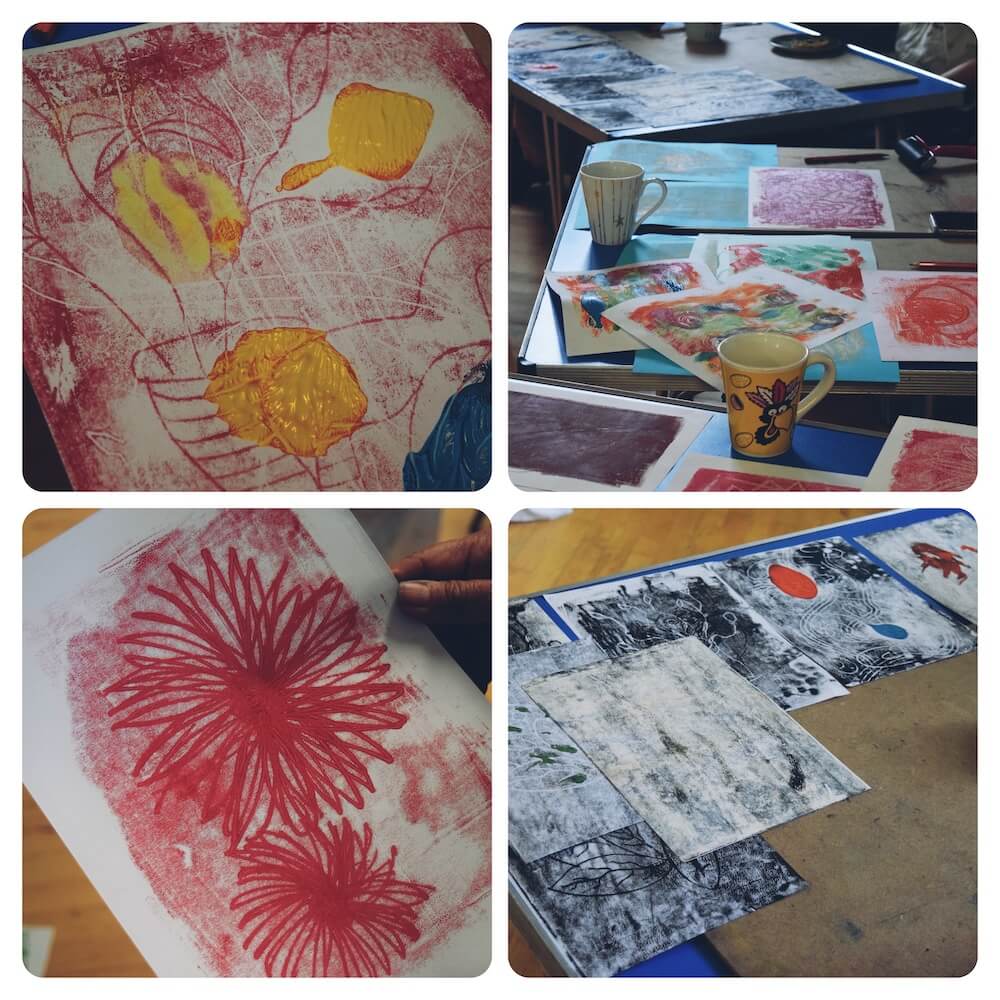
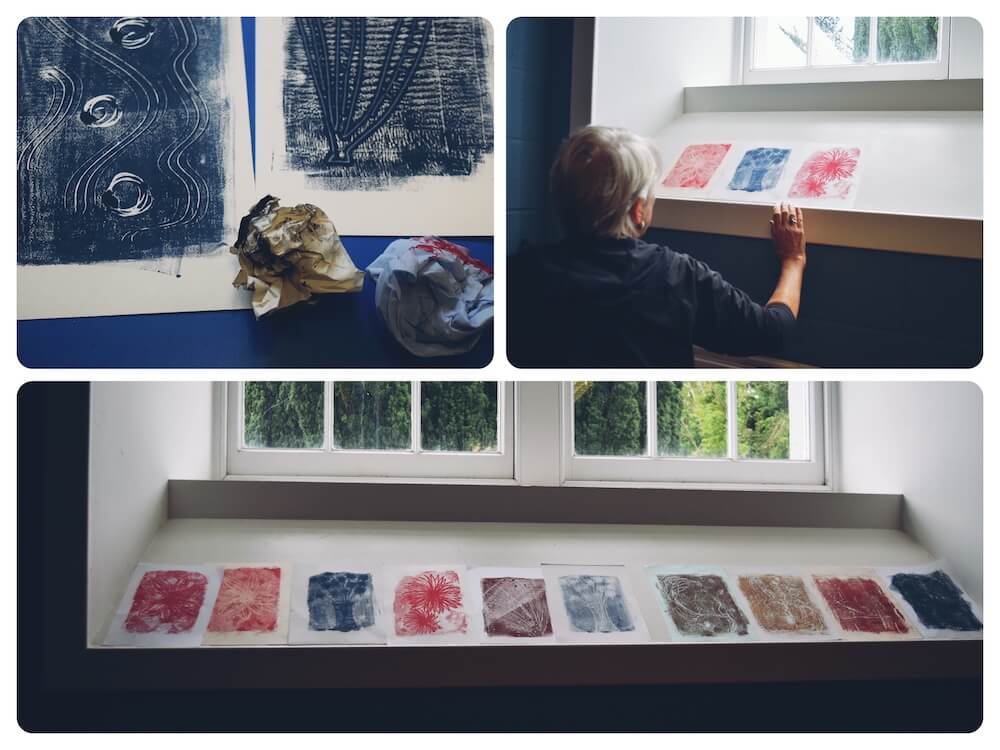
Liz began with a mono print demonstration. Mono print is great, it’s quick and it delivers slightly surprising results. You can accidentally get lovely results – or think you have a fabulous drawing and discover the ink has eaten it a bit, and what you get is the feeling of wanting to try something a bit different on the next one – perhaps press harder, or use a blend of ink colours or a different colour of paper.
The possibilities spiral into infinity quite quickly, especially as all around you, you can see others using different techniques and getting lovely results.
It’s tactile, quick, a little messy. It’s a fantastic first activity for someone unused to art making – who perhaps has only done drawing with a pencil before. It’s so much more interesting, but not really technically harder, if the inks are all set up for you.
At the same time as monoprinting, we each created a board with ink on it, which sat drying by the door.
Building Layers
The next exercise was a journey into texture. Liz explained she studied sculpture at art school and, for her, drawing was really constructed, built up with layers.
This is also great for beginners (and more experienced people), as we are learning what to do if things go wrong.
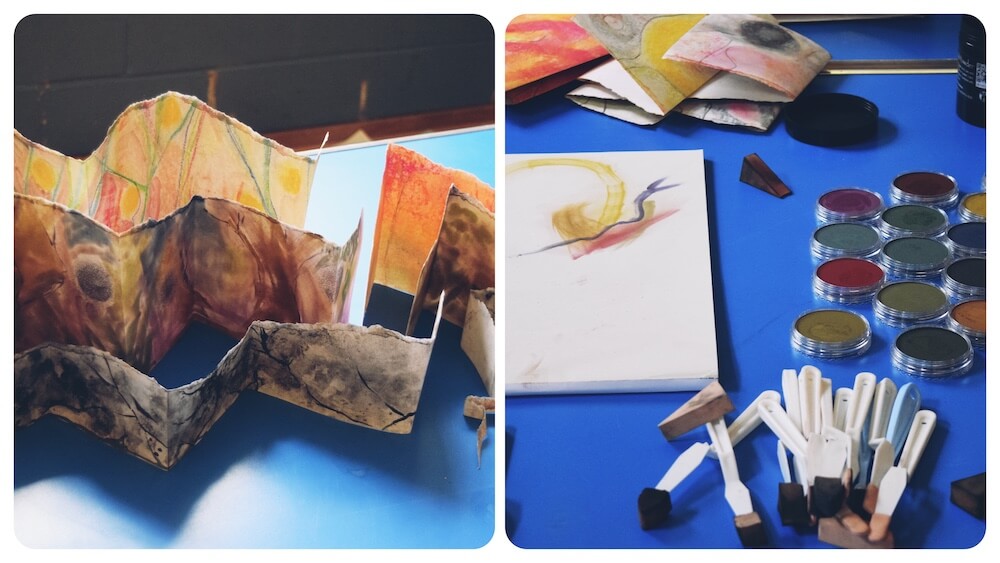
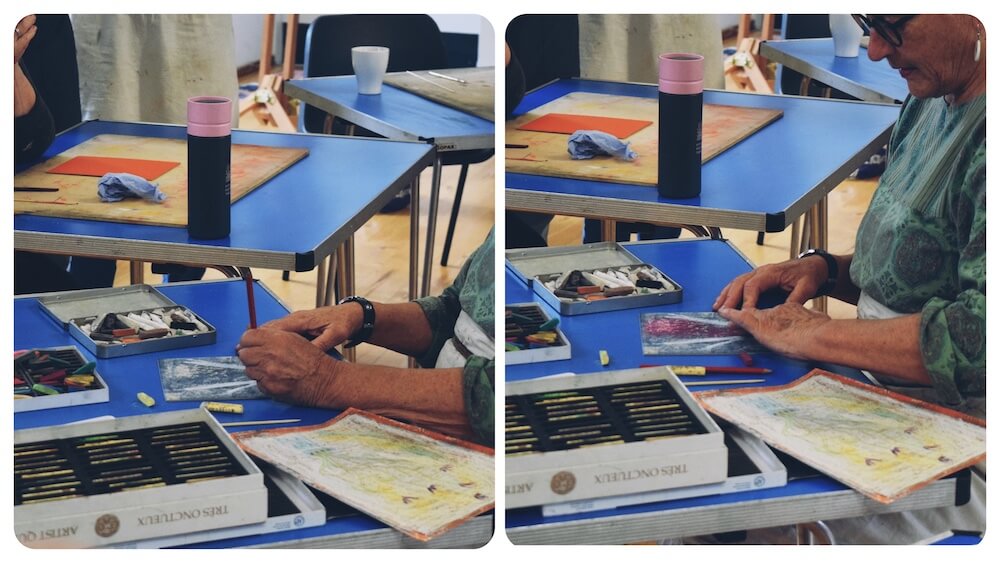
Onto the coloured board, we used a mix of oil pastel, inks and chalks. It was a mystery to know how the oil would repel the ink and push lines into one another. Nothing you can control perfectly, but what you can learn is how to respond to the new result. Does it need more of one thing, or less of something?
She showed us that we can always scrape away at our drawing to reveal the coloured ground. We could, if we wanted to, keep starting again, but not to! We are gaining the skills to correct, to rework and not to give up if there’s a mistake (something many people do in drawing – and of course, there are so many parallels for language learning too).
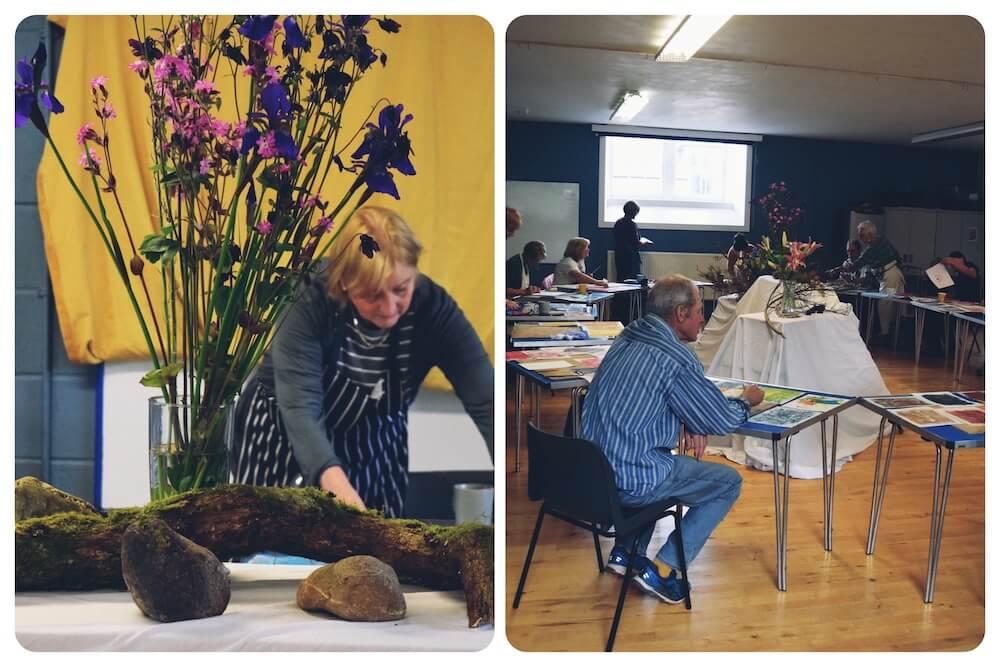
We could draw from our imagination, or if we preferred there were a range of objects to either select or draw in their place in a long, loose still life. I chose to draw a wooden sculpture in the form of two dancers. I. drew the flowers.
Finding the Creative Zone
Liz had done a demonstration earlier. She said it was hard to be creative – to be in the zone – with so many people watching. I wondered if it would be the same for me. Despite Liz reminding us it’s not about perfect results, it’s about process, we do want to feel proud of our achievements. I wanted I. to feel proud of hers.
That feeling – I did this! I can do this! – translates into language confidence.
An Invitation to Experiment
Liz then wanted us to try different pastel and powder materials. The combination of all these experiences we would then carry into the afternoon, when we had a couple of hours without instruction, but with a fresh still life set up in front of us.
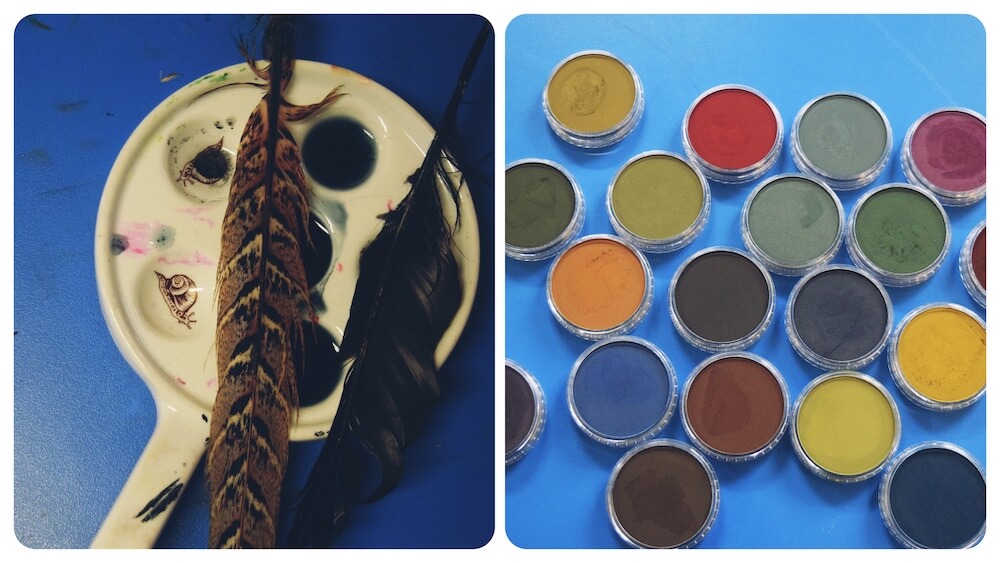
One thing she had brought in for us to try were Pan Pastels, something I’d never even heard of before. You apply them with a sponge and they go onto the paper like paint – but with the soft blend of pastel. You can get sharp lines or fill smooth colour. A beautiful material to use – and again: instant results.
We also tried charcoal dust and soft pastels. We were now introduced to the possibilities of mark making.
“Think about texture,” she reminded us.
As an artist, I am quite line-aware. I don’t tend to build up many layers and work into them, so I took that as my challenge and launched in with the inks.
The feeling in the room was laid-back. Many were Liz’s evening class students, so they knew each other and asked questions about how they made a particular mark. They were generous with compliments and kind with sharing materials. There was a lot of chat and laughter in the background, making the room feel at ease.
We wandered up the River Earn at lunchtime and sat eating our sandwiches on an old log. There was evidence of beavers in the river, so we watched just in case.
In the afternoon, I let the class hold I. as I got launched into two big ink and pastel sketches. I work fast and messily, dipping feathers and fingers into ink. It’s an exciting energy to put into the room. I., beside me, laughed a little, but certainly tried working fast and large and carefree as a result of the messy person beside her.
Did she enjoy her day? She loved it.
She sent photos of her drawings to her family back home (and I haven’t seen her take many photos).
We carefully wrapped our pictures in newsprint and took them back to Blue Noun, where we left them. It was threatening to rain and she didn’t want them getting damaged.
Not bad for someone who never makes art!
A Blue Noun Field Note
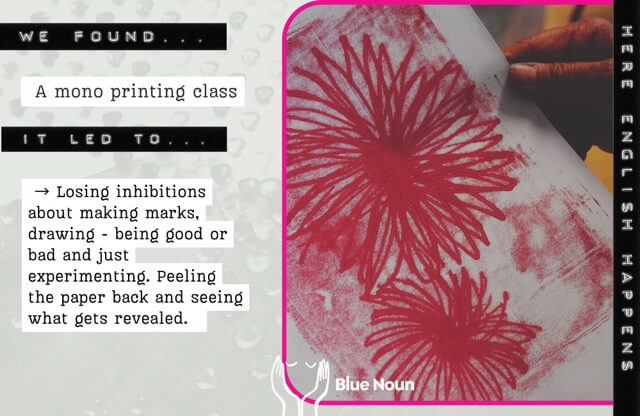
I make Blue Noun Field Notes to capture some of the small things I notice while working with guests — particularly the things that aren’t obvious from looking at what we’re doing.
This one came from the monoprinting workshop in this post.
What stayed with me was the invitation to stop worrying about making good or bad marks and simply experiment. Make the mark. Peel back the paper. See what has happened.
That’s an art-making experience, but it’s also remarkably close to what I want people to experience with their English: less judgement, more curiosity, and enough permission to find out what happens when you have a go.
Further Information
If you are local to Comrie and Crieff, Liz runs regular art workshops on a Thursday evening.