
A Day With Ruth Pringle
From Past Guests — 7 Photos That Show What It’s Like to Learn English With Me
These photos were taken by people who joined my English holidays or workshops.
They’re photos of me, taken during the week, as things are actually happening. Small moments from the week .
If you’re new to learning English with me, Ruth Pringle, this page is the simplest way to understand it — whether that’s on an English holiday or in a single day of coaching added to your stay in Perthshire.
Not through a description, but through experience.
Seven moments from a week that doesn’t follow a language school script — but is carefully shaped around attention, curiosity, and how you feel using English.
A Mosaic Workshop Where English Flows Naturally
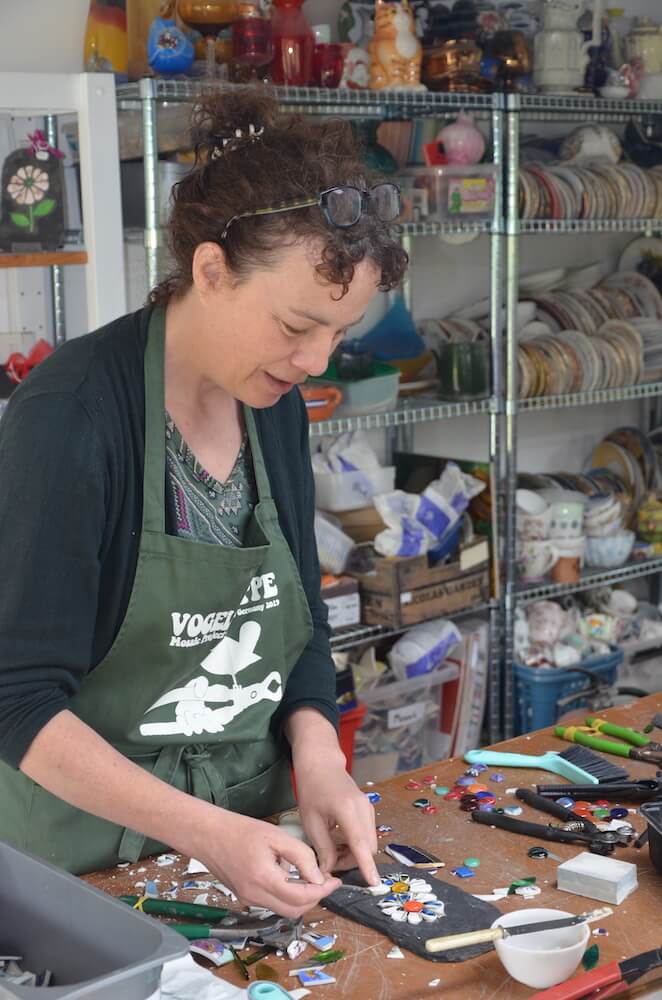
This photo was taken during a private mosaic workshop with artist Katy Galbraith.
Katy welcomed us into her studio and introduced the tools and techniques she uses to shape fragments of tile and broken crockery into something new.
Craft workshops are a regular part of my holidays.
When your hands are busy making something, language anxiety drops away. If you’ve ever been part of a crafting group, you’ll recognise the shift — conversation flows differently.
You’re still listening, asking questions, and responding to what’s happening around you. English is active the whole time, but it doesn’t feel forced.
There’s no pressure to fill silence. Just observations to share, and stories that emerge naturally.
→ Discover How and Why We Share Craft Workshops on Our English Coaching Holidays
A Jelly-Making Family Activity
Last year, I opened Blue Noun to families.
I usually work with solo professionals or very small groups of adults, but I’ve spent a lot of time thinking about what makes the best conditions for language development — what to keep from classroom models, what to adapt, and what to leave behind.
In that process, I realised that some people don’t want to step away from their family life to learn English.
They want to spend time with their children, and at the same time give them an early, natural experience of English.
So I designed a holiday that works around that.
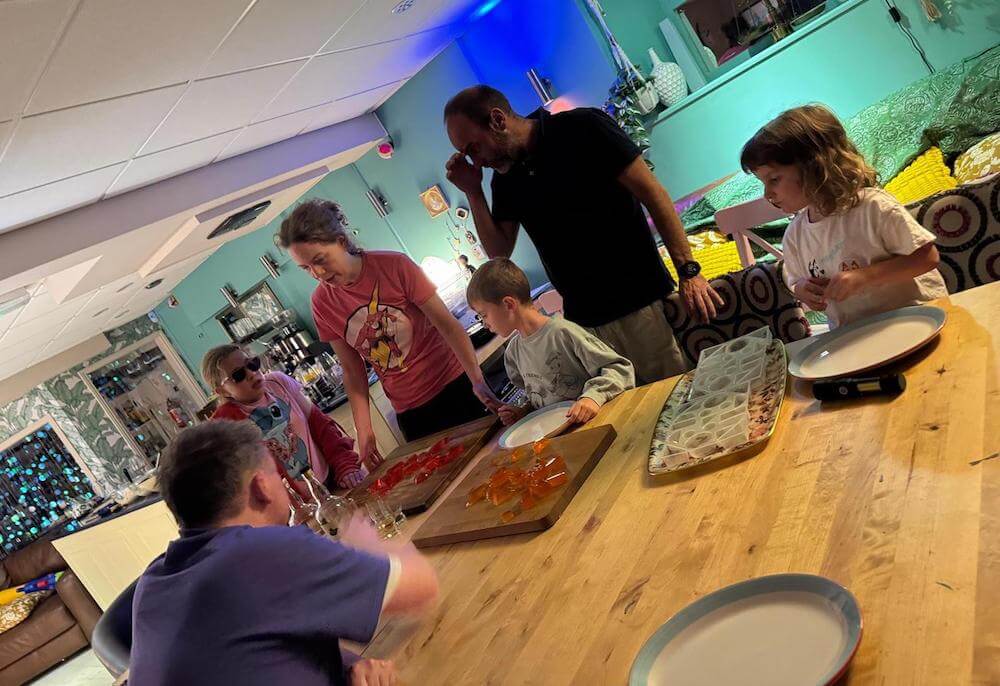
On this day, we were making a jelly train.
Some activities are more child-focused, like this one. Others are shared workshops that everyone can enjoy. There’s also cooking together, exploring together, and plenty of time outside.
The rhythm of the week follows the children.
And I place the language work into those spaces, so it builds naturally without ever feeling heavy.
Every Meal is a Story
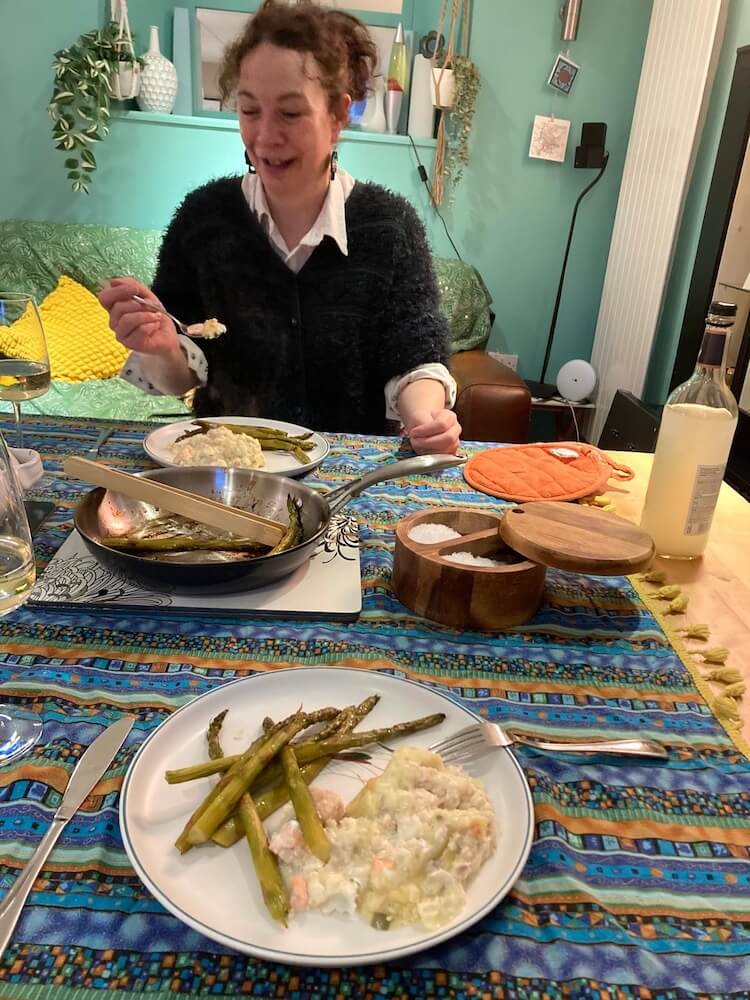
This photo was taken over lunch — a fish pie made with fresh local ingredients.
Food and drink are a real part of how I share Scotland.
And I don’t just mean a token haggis, although we do that too, because it tells a particular story.
I mean conversations with makers, producers, and growers. Selecting cheese and fish at a market. Knowing what’s in season, what my guests enjoy, and what flavours might be new to them.
There’s quite an international mix in what I cook.
But this one is a traditional fish pie.
My guest that week was from Andorra, not exactly known for straight-off-the-boat seafood, so we took advantage of our local fish merchant, and the van that drives from the docks of Anstruther into Crieff every Friday.
I’m a good cook. A less talented baker.
I tend to focus on savoury.
But it’s not about being cooked for all week.
The meals work best when people join me in the kitchen. Sharing techniques, showing me favourite recipes, working out together what to make with what we have.
Food is such a simple way of sharing.
You don’t just hear mine. You share yours too.
Sharing Scotland Egg by Egg
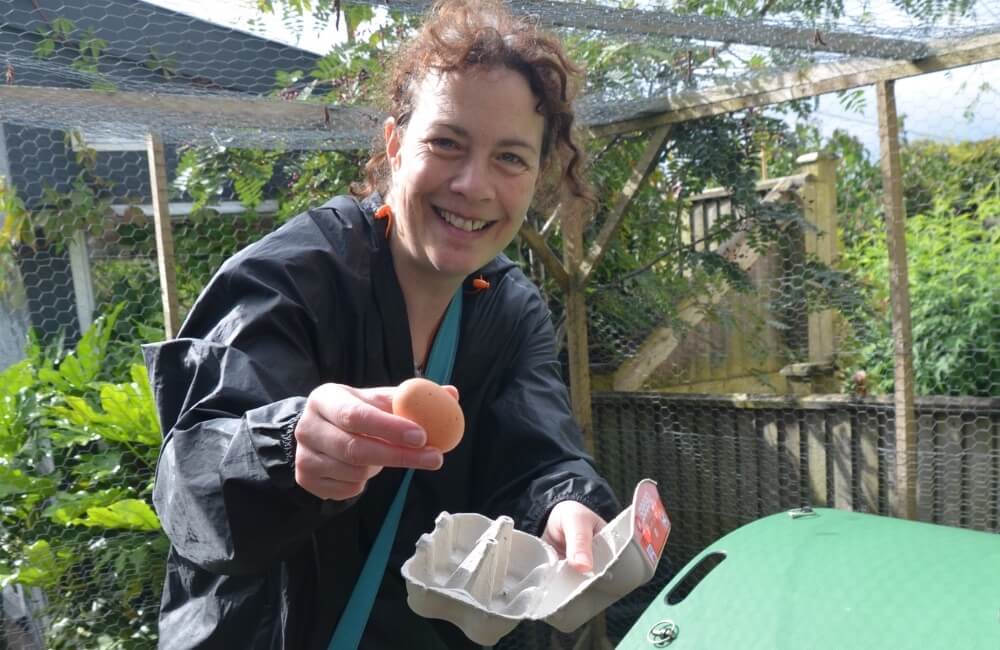
Most people eat eggs. They’re so common that we rarely think about them.
But the simple egg comes up again and again during the week.
We often meet a farmer, or pass through places where you can see how the Scottish landscape supports egg production — from small flocks of hens roaming freely near a bridge, to larger sheds set into less useful agricultural land.
You start to notice the differences.
And unless you’ve ever reached into straw and found a warm egg, it’s easy to miss part of that story.
It’s not a big moment, but there’s a surprising amount of joy in it.
These are the kinds of small, in-between moments that shape the week — the space around the activities, where things settle and conversations begin.
How we choose to buy eggs, and how we cook with them, tells a story.
It’s one of those everyday things that opens up conversation — about food, farming, habits, and where things come from.
And it’s a perspective you take home with you.
Friends of Blue Noun
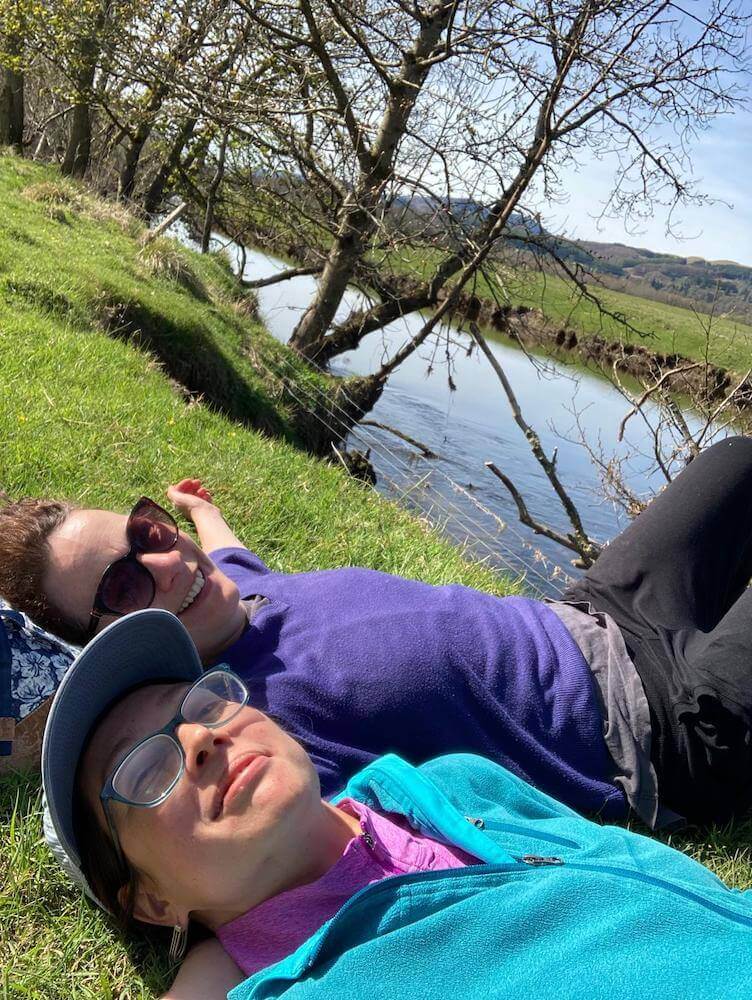
Although I’m no longer this lady’s English teacher, we meet up for a walk or a cycle at least once a month.
Lena is also part of our wider holiday team — someone you might meet during your week. She moved to Crieff from Kyiv four years ago.
So when she joins us for a meal, a workshop, or a hill walk, you don’t just hear another Scottish perspective on Scottish culture. You get another way of seeing it.
Here in Crieff, we are so spoiled by the landscape around us.
I often invite guests to hop on one of our bikes and explore it. Cycling shares the local landscape perfectly. We avoid busy roads and follow the network of country lanes, noticing what’s growing in the fields and what’s living in the stone walls and hedgerows.
It’s slow travel at its best.
We don’t talk much while we are cycling. It’s not the kind of language holiday where every space needs to be filled with noise.
On a day like this, there is more silence. It’s the rest your mind needs, because other moments are fuller.
That silence and downtime is working for you too.
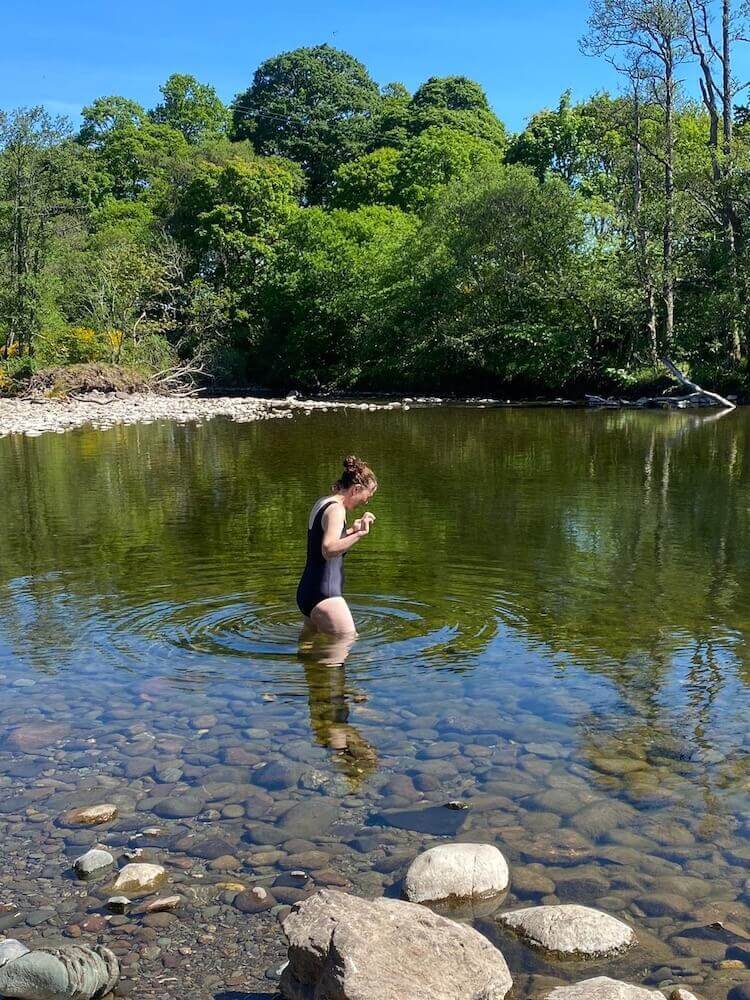
Experiencing the Perthshire Landscape
This photo was taken just before stepping into the water.
It’s one of those places you wouldn’t find as a visitor. Locals know it, and there are a few spots like this in the area.
You don’t have to go wild swimming with me.
But I do tend to attract people who enjoy exploring the landscape in different ways, and sometimes that includes a dip in a river, or even the sea.
For those less drawn to cold water, we have a local woodland sauna that we visit as part of the week.
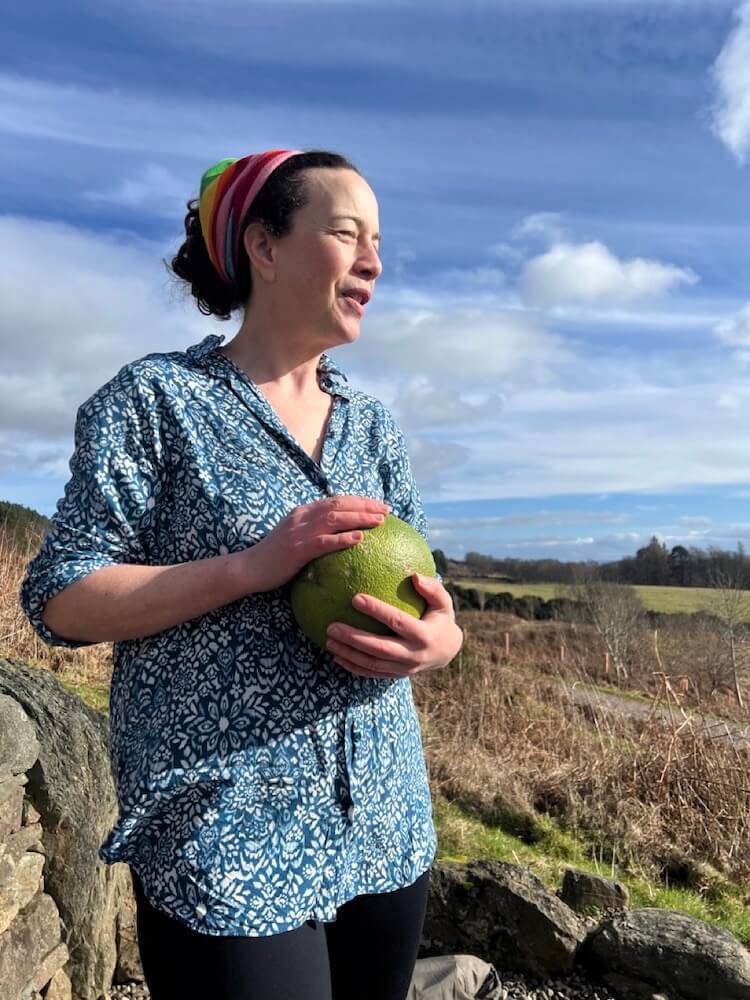
English, Unscripted
On this day, we had planned activities, including a guided tour of a tree-planting rewilding project, followed by a woodland sauna.
Lots of time outdoors, in nature, with purposeful conversation.
However, the evening before I’d had a visit from someone I used to give English lessons to here in Crieff. She now lives in Glasgow, but she popped in to give me this amazing fruit. I’d never seen one before.
When we paused for our picnic, I brought it out of my backpack, along with a knife.
We sat in a row in the early sunshine, guessing what colour it would be inside, sharing what we knew about Vietnam. Not much, if I’m honest, but we each had stories — friends who had travelled there, or who are from there.
The point isn’t that we are eating exotic fruit on a hillside. Anyone can do that.
The point is that there’s no recipe.
Only curiosity, and a way of being in English that has no stress, no pressure, and no right answers.
English Learning with Ruth Pringle
These are each small moments, but they add up to something quite different.
This is real-world English — not something separate from life, but something that develops as you move through it.
You’re not practising for a situation. You’re already in one.
And over time, that changes how you use English.
You become more at ease with what you don’t expect.
More able to respond, rather than prepare.
Fluent in the unexpected, and ready for anything.
That’s where your English becomes something you can carry with you, wherever you are.
A Real World English Language School
Real-world English isn’t something separate from life.
It’s the language that develops while you’re in the middle of doing something — choosing what to say, responding to what’s happening, staying with a conversation a little longer than you usually would.
It doesn’t come from being given the right phrases in advance, but from having the space and support to notice, respond, and adjust in real time.
That’s why it’s often missing from traditional courses: the focus is on getting it right, rather than being able to use it.
When English develops this way, it becomes more flexible, more personal, and far easier to carry with you beyond the moment you learned it.
