
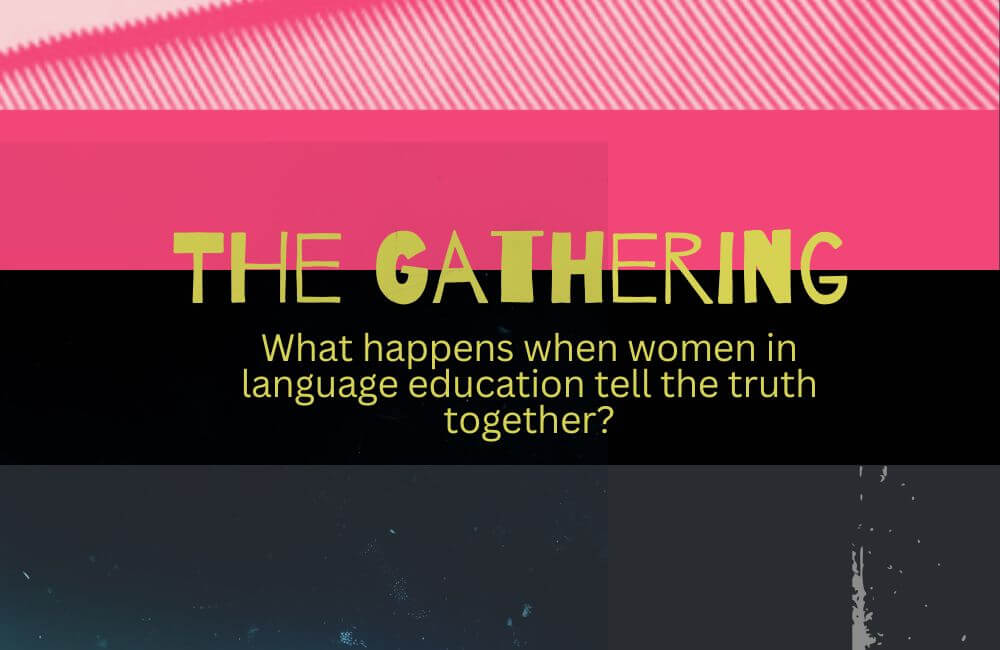
The Gathering was an experiment in one question: what happens when women in languages stop performing and start telling the truth together? What happened is that we found each other.
Ola Kowalska, The Gathering, 2026
What a Gathering of Female Language Educators Made Me Realise About My Own Work
I rarely attend language teaching conferences.
Not because I don’t value professional development, but because I don’t trust the gatekeepers.
Over the years, I’ve trained myself through conversations outside the language teaching world.
Some of the biggest influences on Blue Noun have come from artists, business coaches, psychologists and people asking broader questions about how humans learn, connect and travel well. (For example, the Latitude Responsible Tourism Conference.)
So when Ola Kowalska announced The Gathering—an event for female-energy-led language coaches and teachers—it immediately felt different.
I commented:
“I’m really excited that we are not having to speak on other people’s stage, but building our own.”
And later:
“I never attend language teaching conferences, but I feel this one has been built to connect people working outside the systems together. Finally!”
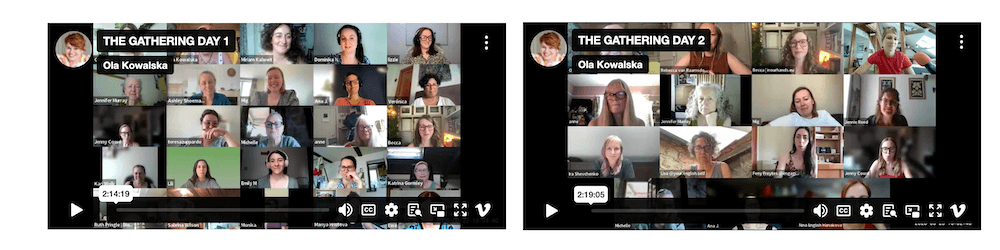
The Gathering was about women openly sharing what they’ve built after stepping away from systems that failed to reflect their values.
There were conversations about wellbeing, burnout, visibility, creativity and professional identity.
Listening to everyone else made me realise I was less unique than I thought.
Heart-led experiences in language are happening all over.
But it pushed me into freshly articulating a vital question (and one that needs to be revisited frequently).
What are the language outcomes of my work?
3. The system isn’t broken by accident and it isn’t yours to carry.
Native-speakerism. The conveyor belt. Contracts that quietly take your rights. Naming it out loud is the first act of freedom.
Ola Kowalska, The Gathering, 2026
Where Blue Noun Sits
Listening to everyone else made me realise my own position is perhaps a little more nuanced.
Many of the coaches at The Gathering have also developed heart-led, creative and playful approaches that help learners build an identity in their new language, not just technical language skills.
In some ways, Blue Noun sits even further along that spectrum.
I let go of textbooks and fixed lessons a long time ago, to create language experiences that people can simply absorb themselves into for a week.
But I don’t see my work as replacing rigour, expertise, hard work, dictionaries, books or thoughtful teaching.
Those foundations matter.
I build on them.
Once the foundations are in place, language education can become more about learning to live, think, connect and create through English.
It’s a bit like the moment in art school when, after years of technical exercises, someone finally says,
“Now go and make something that matters to you.”
Nothing about that rejects anatomy, perspective, colour theory or life drawing.
It assumes them.
But for one week, we don’t do more of them.
A Richer Ecosystem for Language Learners
I don’t believe there is a single language system that optimally suits everyone.
As Lizzie Hug eloquently said, I believe damage is done when we treat individuals as if they all learn the same way, or as if it doesn’t matter what the lesson is about because it simply delivers the grammar, leaving learners to find the personal connections for themselves.
Most of us at the Gathering spend our working lives helping people recover from those systems.
But I also think the best language experiences don’t try to do everything.
They do one or two things superbly well.
My holiday guests often want more classical English lessons when they get home.
They’ve tasted fluency and self-expression and want their technical skills to support their voice.
But that does not mean I should squeeze classical education back into my weeks: that I am failing to teach.
To me, that’s a healthy relationship with language learning. To be a component.
Learners deserve a rich ecosystem full of quality choices.
When I promote my work, it is not because I believe everyone should teach like me.
It is because I think every learner should have the chance to be inside a conversational and cultural experience as rich as mine.
There are many good ways to do that.
And right moments and wrong moments.
Perhaps that’s why team teaching and collaboration matter so much to me. We don’t all have to solve the same problems. We can each become specialists, helping learners at different stages of their journey and passing people on when someone else is better placed to help.
This isn’t just a theory. It’s one of the principles behind the way I work with other teachers at Blue Noun.
What I Brought Home
I’ve always believed in showing my workings.
I’m happy to be transparent about what I do, what I don’t do, and how my own thinking continues to evolve.
→ Notes on Independent English Teaching | About Building Blue Noun
That’s one of the things I appreciated most about The Gathering.
People were generous with their ideas, honest about the challenges of working independently, and willing to share what they were learning.
I think we help learners most when we know exactly which part of the journey we’re best placed to support—and when we’re happy to point people towards someone else when they need something different.
Educators should always ask:
For whom is your approach the right one, at this point in their life?
There was one thing I found myself wishing we’d talked about more. Maybe it is something this new community can grow into.
Language educators don’t all need to solve the same problems.
It is only when we know exactly where our work sits within the learner’s whole English journey that we know exactly what outcomes to set.
1. We’re not lonely in life. We’re lonely in the work.
The relief in that room when everyone realised “oh, it’s not just me” was worth more than most courses.
Ola Kowalska, The Gathering, 2026
I came away feeling less alone.
It was reassuring to spend time with people asking many of the same questions I’d been asking myself.
During The Gathering, Nina Hanáková spoke about the importance of growing strong relationships and challenged us to think about how we would grow our own.
I realised that, for me, this article is part of that answer.
But because I want to find the people solving different parts of the same puzzle.
The people who know their strengths, care deeply about their learners, and are happy to collaborate rather than compete.
If you’re a language teacher or coach, I’d love you to explore my website, my digital garden of ideas.
You’ll get a sense of how I help, who I help, and where Blue Noun fits within a learner’s wider journey. You’ll also find more about how I approach collaboration and team teaching.
I don’t just want to build relationships with people solving the same problems as I do.
I want to connect with excellent independent language professionals helping people in all kinds of ways.
Textbooks and all.
Because I think learners deserve a rich ecosystem—and Blue Noun is only ever one small part of it.
If you like how I help people, you can explore the ESOL Teachers section of my website.
→ Go to the ESOL Teachers page
You’ll find information about my affiliate scheme, classroom resources inspired by Scottish culture, and ideas you can use to give your own learners a taste of real-world English Scotland (without leaving your classroom).
Designing Language Education for Women
Thinking about healthier language education also brought me back to something I’d written previously about designing English holidays for women.
The same principle applies in both cases: people deserve experiences designed around who they are, not assumptions about the groups they belong to.
→ Why language holidays for women shouldn’t be “shrink it and pink it.”
About the Host, Ola Kowalska
I’d first met Ola Kowalska through one of her programmes supporting emerging independent language professionals.
→ You Can Read About My Early ESOL Business Training Here
Seeing her create a space specifically for female energy-led language education businesses was I wanted to be part of.
You can find her help here:
HOW OUR ACTIVITIES HELP
Attending the Gathering | Language Education Summit
⬛ Supports mental and physical well-being
⚪ Benefits our local community
⚪ Helps preserve craft skills, historic machinery and monuments
🔲 Supports Scottish microbusinesses or eco-agriculture
⬛ Fosters diverse conversation opportunities
⚪ Supports cultural skills and traditions
⚪Supports arts and artists
⚪ Explores Scottish wildlife in non-invasive ways
⚪ Introduces guests to Scottish culture
⚪ Contributes financially to preserving culture
🔲 Creates opportunities for fun and feeling good in English
⬛ Clear contribution
🔲 Partial contribution
⚪ Not a priority of this activity
⭕ Works against this criterion
Each activity contributes in different ways, with the bigger picture emerging across the whole holiday.
Forthcoming Event
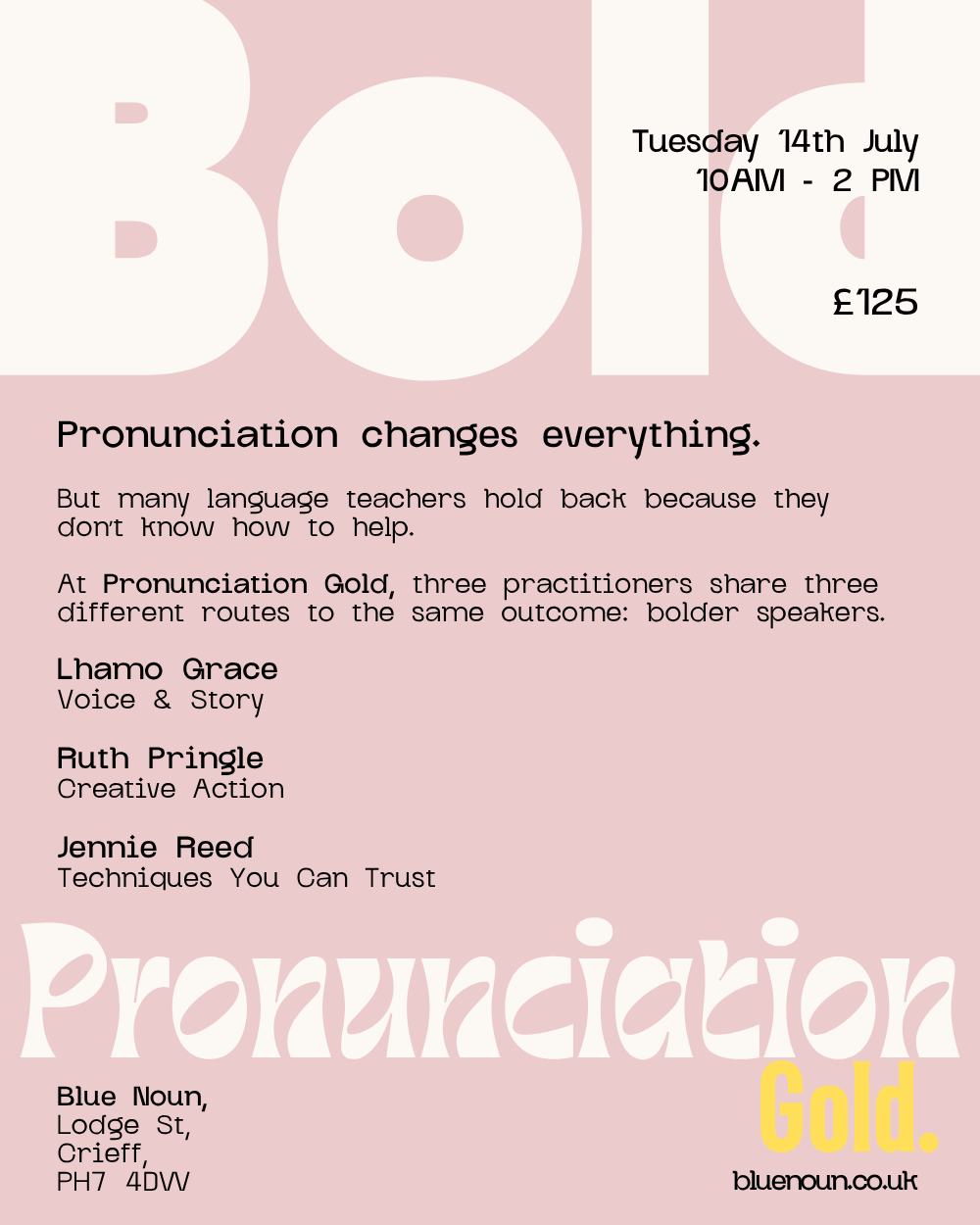
Blue Noun brings together specialist teachers for carefully designed language interventions, each focused on a different aspect of language development. Pronunciation Gold is one example—combining pronunciation coaching, voice and creativity in a single collaborative experience.
→ Pronunciation Gold | A Collaborative Workshop for ESOL Teachers


Good to Know
What’s a Hub?
Social Action Policy
Frequently Asked Questions
Free English Resources
Need to Know
Privacy Policy
Terms and Conditions

Blue Noun Language Hub
St Ninian’s Lodge,
Lodge St, Crieff PH7 4DW
01764 654377
email: ruth@bluenoun.co.uk
All photographs are by the author unless otherwise stated and permission is always obtained.
© Ruth Pringle 2026