Conversation Walls: When the World Around Us Becomes the Language Resource

Blue Noun does have a space where we can sit down and work together. But it doesn’t look much like a conventional language classroom, and it isn’t filled with the usual classroom resources.

That’s deliberate.

Classrooms have books, worksheets, pictures, prompts and whiteboards.

I have places.

I do give people the impression that we spend our days wandering around Scotland looking at trees — which, to be fair, we do quite a lot of.

But that freedom works because language development is happening throughout the day.

If I’m not going to fill a classroom with materials and build the holiday around lessons, I need to be very good at recognising the language-learning potential in the places we visit.

I need to know where to take you. What’s there. What might get us talking. When to linger. When to intervene. And how to turn something we happen upon into useful language work without making the experience suddenly feel like a lesson.

One of the resources I use is something I call a Conversation Wall.

What is a Conversation Wall?

Conversation Wall is my own term for something I look out for in public spaces: photographs, drawings, objects, notices or other displays that give us plenty to respond to without completely explaining themselves.

They don’t actually have to be walls.

What matters is that there is something there for us to navigate.

I love sharing a Conversation Wall as much as an exhibition with my language guests. In an exhibition, we are often being led as observers. At a Conversation Wall, we have to find our own way in.

We linger. Notice things. Choose favourites. Spot patterns. Speculate about what’s happening. Make comparisons. Disagree. Make connections. Tell our own stories, inspired by what’s in front of us.

A Conversation Wall can invite a thousand possible conversations, beginning with someone else’s story — a photograph, a poster, a handwritten note — and ending in your own.

And because neither of us knows exactly where the conversation is going, you have to find the English for what you actually want to say.

That’s where they become particularly interesting to me as a language professional.

So where is the English teaching?

Meanwhile, I’m listening.

While you’re deciding which photograph you prefer, trying to explain why something bothers you, telling me what a display reminds you of, or disappearing down an unexpected conversational rabbit hole, I’m also paying attention to your English.

But a Conversation Wall is about fluency. I’m not standing beside you correcting your mistakes.

You’re doing something much more important at that moment: keeping a conversation going while your brain has six other jobs. Finding another way to say something when the word you want isn’t there. Holding onto your story. Responding to me. Changing direction when I surprise you. Getting your meaning across.

I can help when you need me — perhaps with a word or phrase you’re reaching for — but I want you to stay inside the conversation.

That doesn’t mean I stop being a language professional while we talk. I’m noticing what you can do, where you get stuck, the language you reach for and what might be useful to revisit later.

A Conversation Wall is only one part of that process. What emerges here can feed into the other ways we work with your English throughout the holiday. My Four Stems approach explains how I balance those different kinds of language work.

And when it comes to mistakes, I’ve written separately about why I don’t correct every mistake.

The Conversation Wall gives us the stimulus. What follows is sustained, unpredictable, meaningful language use.

And that is language work too.

I Keep Track of Conversation Walls

I have Conversation Walls dotted around Scotland.

I keep track of where they are because knowing where to take people, what a place offers, and how I can shape what we find there into useful language work is part of my work.

They aren’t activities I manufacture in advance and then take outside.

That’s part of designing a Blue Noun holiday: knowing the language potential of the places around me, and how to use it without making the experience feel like a lesson.

→ Learn More About My ESOL Training and Experience

Five Conversation Walls in Scotland
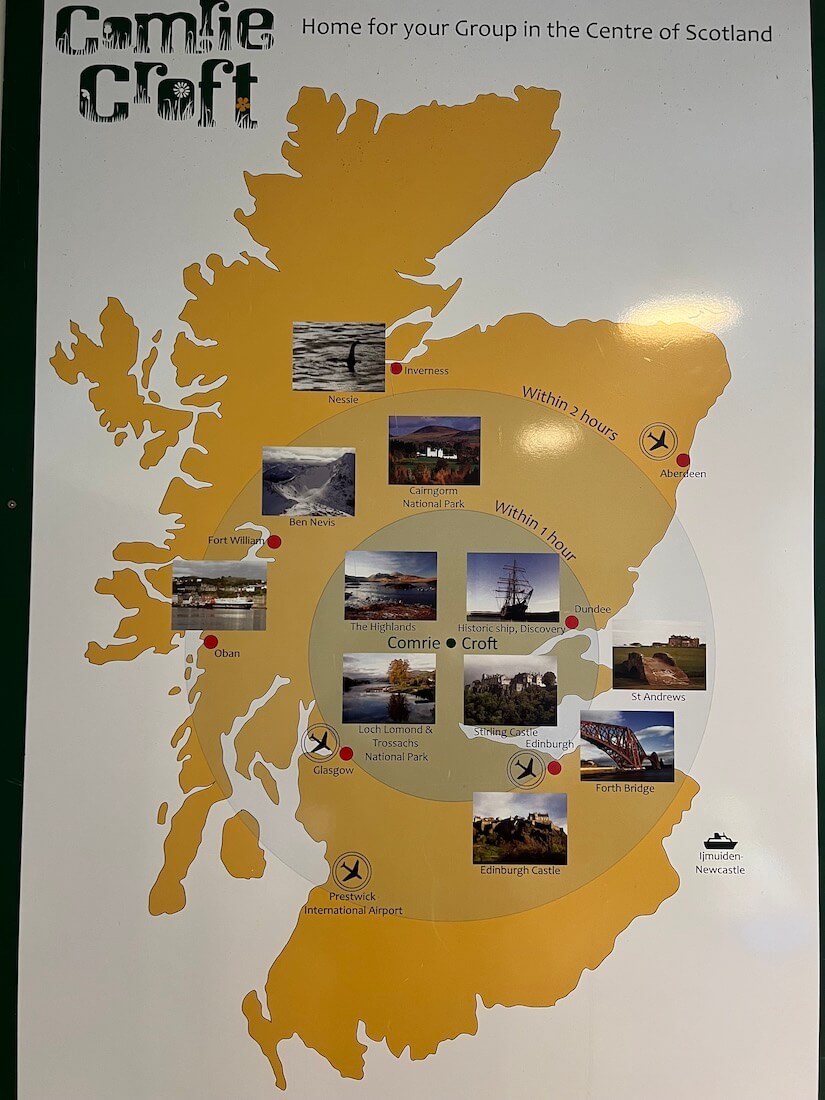
Comrie Croft poster showing places to visit and things to do in Scotland within one or two hours’ drive of Crieff.

1. Designing Your Holiday at Comrie Croft
This one isn’t quite a Conversation Wall, but it’s such a useful language resource that if Comrie Croft hadn’t designed it, I would probably have had to make one myself.

It shows things to see and do in Scotland within one or two hours’ drive of their eco campsite, just a few miles from Crieff.

We can stand in front of it and explore possibilities. What appeals to you? What absolutely doesn’t? What have you already experienced? What are you curious about?

It gives you a quick overview of what’s around us.

And it gives me a very good way to start getting to know you — which matters when I’m designing the rest of your holiday.

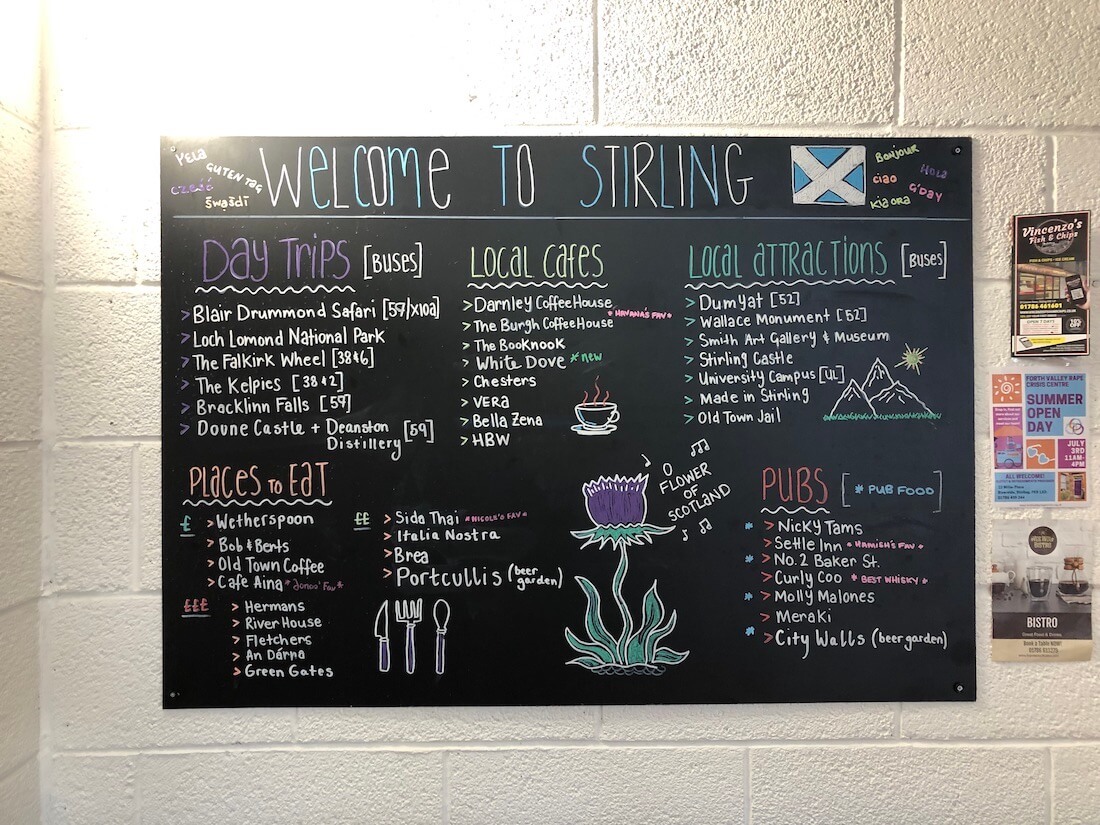
Blackboard at Stirling Youth Hostel listing things to do, places to eat, bus information and typical restaurant prices for visitors to Scotland.

2. Helping travellers navigate Scotland
This one is a blackboard in Stirling Youth Hostel, with suggestions for things to do, places to eat, bus information and typical restaurant prices.

We wandered into the hostel because it’s set in a fine old building, and stopped at the board.

Unlike the Comrie Croft poster, I’m not primarily using this one to find out what you’d like to do.

Here the interesting question is: how is this helping travellers navigate Scotland?

What has someone decided a visitor needs to know? What information is genuinely useful? What assumptions are being made about the people reading it? What would you add?

We’re looking at Scotland from the visitor’s point of view — while you are one.

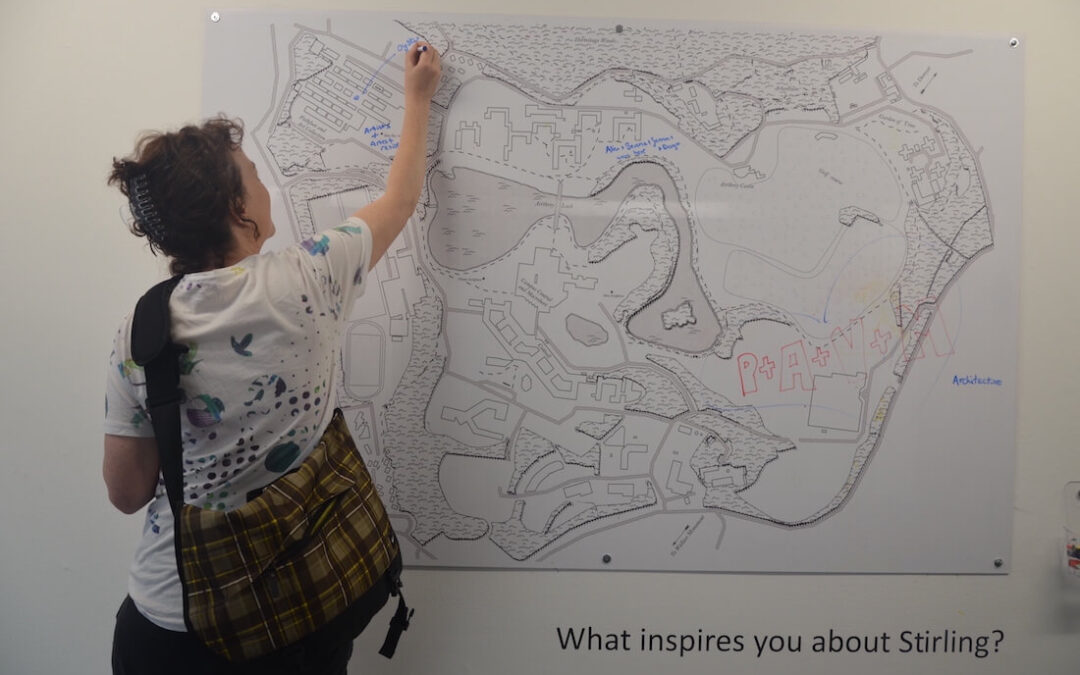
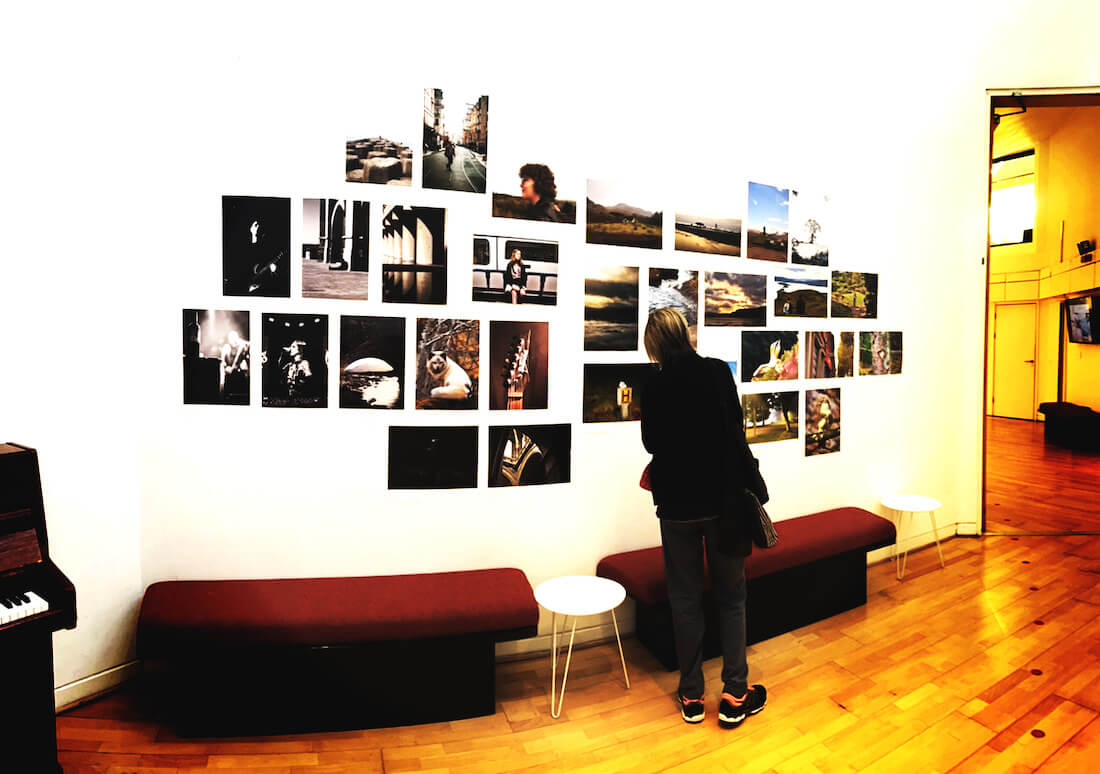
Photography students’ work displayed together on a wall at the University of Stirling, used as a Conversation Wall for English discussion.

3. A more traditional Conversation Wall
This one is perhaps the most obvious example of a Conversation Wall: work by a photography class displayed together at the University of Stirling.

There’s no single route through it. We choose where to look and what catches our attention.

We noticed recurring themes, compared images and talked about the choices the photographers had made.

And then the conversation wandered somewhere else entirely: our own student days.

That’s what I like about a good Conversation Wall. Someone else’s stories give us a way into our own.

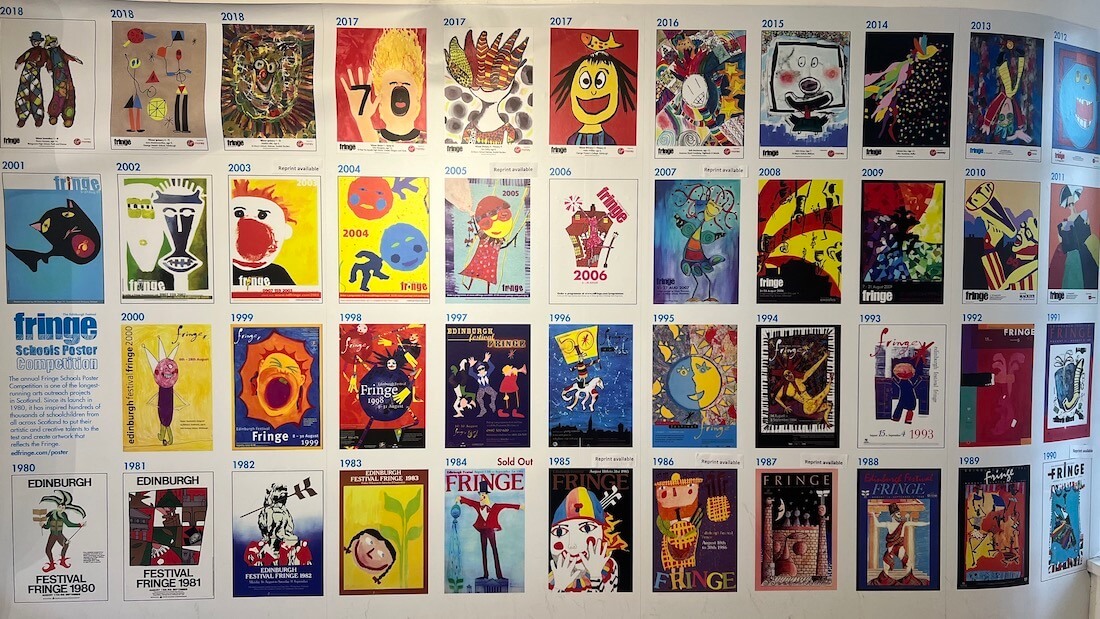
Display of Edinburgh Festival Fringe poster designs, used as a Conversation Wall to compare favourites and discuss design choices.

4. Choosing a favourite at the Edinburgh Fringe
For many years, the Edinburgh Festival Fringe invited schoolchildren to design its poster. Today, the posters are designed in-house by the Fringe team.

When we’re in Edinburgh, we can pop into the Fringe office and look through the designs.

Which do you prefer? Why? What makes a good festival poster? What would you have chosen?

It’s a wall full of other people’s creative decisions, which gives us plenty of our own to make.

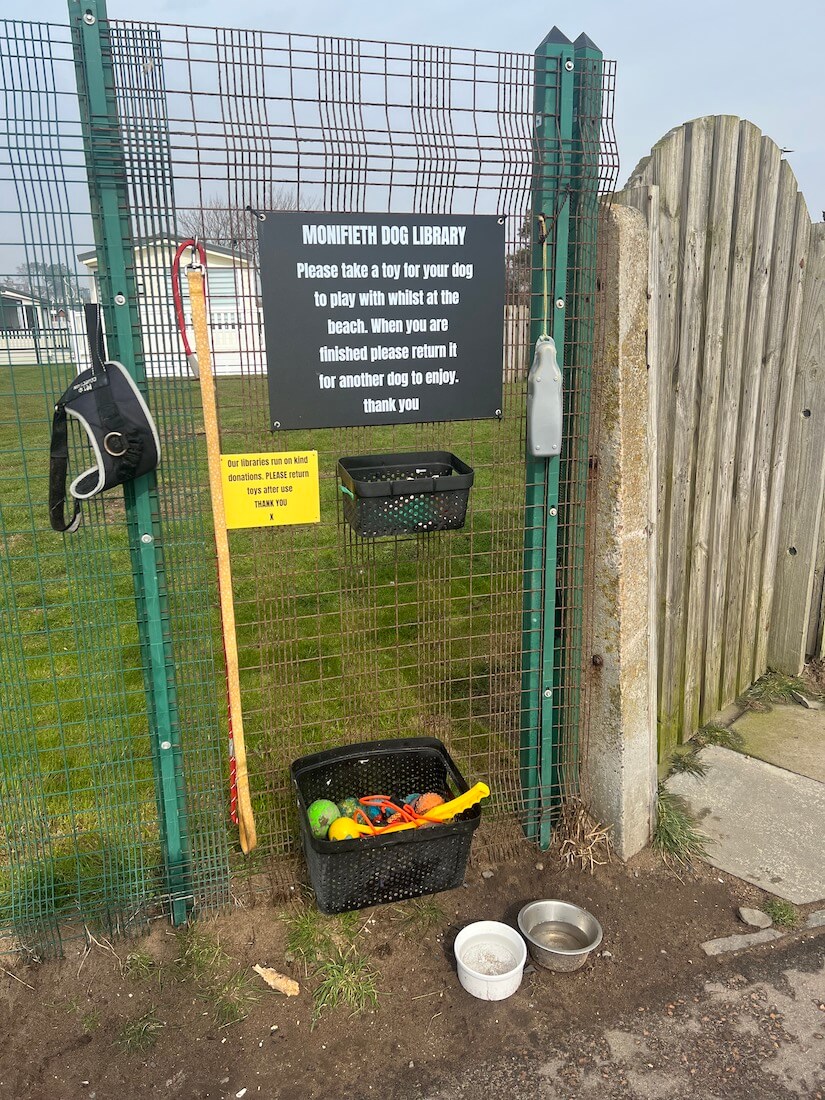
Beach toys left for dogs to use at Monifieth, Scotland, discovered while walking from Broughty Ferry to Carnoustie.

5.Unplanned Conversation Walls

Not every Conversation Wall is somewhere I’ve carefully stored away for a future visit.

Some we simply discover.

This one is an assortment of beach toys left for dogs at Monifieth. We found it while walking from Broughty Ferry to Carnoustie. We weren’t there to see it. We certainly hadn’t set off to look at some dog toys.

But there it was.

So we stopped, looked, and the question became: what does this tell us about this part of the UK?

That can take us into dogs, community, trust, public space, generosity, or the assumptions we make about a place from the small things we find there.

Part of using Scotland as a language resource is planning. Another part is being alert enough to respond spontaneously to the gifts a place gives us.

→ Read about an Example Coastal Walk on our Autumn Adventure Holiday.

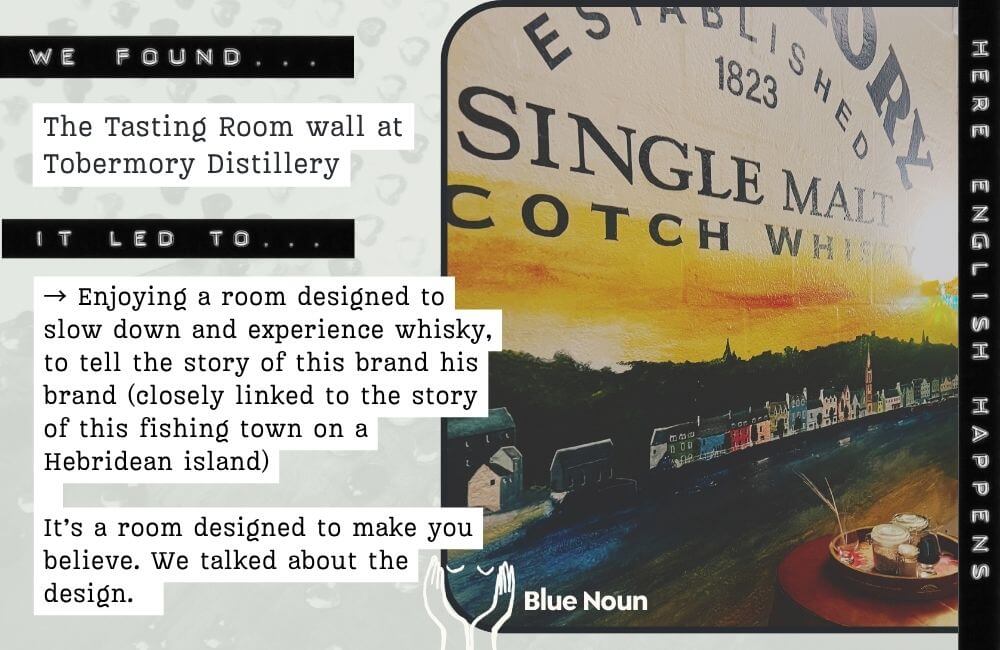
Painted tasting room wall at Tobermory Distillery on the Isle of Mull, designed around the whisky brand’s connection to the colourful fishing town.

A Blue Noun Field Note

My Blue Noun Field Notes make visible some of the conversations and language work that grow out of the places we visit — often from things we couldn’t have planned in advance.

This is probably our furthest-away Conversation Wall yet: the tasting room at Tobermory Distillery on the Isle of Mull.

The whole wall is designed to slow you down and draw you into the story of the whisky, closely linked to the story of this fishing town on a Hebridean island. We talked about the design: what it was asking us to notice, what it wanted us to feel, and how a room can persuade you to believe in a story.

How We Use Our Hub

It’s not a typical classroom, but it is a comfy space for relaxing and learning. 

→ Discover the Blue Noun Language Hub Learning Space 

Learn English in Scotland

Conversation Walls are only one example of how I use the places around us.

Some I know and deliberately build into a visit. Others appear unexpectedly while we’re doing something else. The skill is in recognising what a place offers, knowing when it might lead somewhere interesting, and then giving the conversation enough space to develop.

That’s what learning English outside the classroom looks like on a Blue Noun holiday. We have a space to work in when we need it, but the world beyond it provides an enormous part of our material.

If you’ve found this article because you’re an English teacher, you might also enjoy our teacher resources.

We publish class plans and lesson ideas, and we have opportunities for teachers to earn money by introducing Blue Noun holidays to learners who would enjoy this way of using English.

→ Go to the Language Teachers’ Page

Further Information

For another glimpse of how language work happens when the holiday isn’t organised around classroom lessons, this article follows one private language coaching holiday through the wonderfully unglamorous evidence of my bookkeeping.

→ Follow the Receipts of a Blue Noun Holiday