

I often get asked, “What’s the best way to learn English?”
The problem is, there isn’t one best way.
Adults arrive at English from completely different starting points. They have different language-learning histories, different strengths, different pressures and different reasons for wanting English in their lives. What helps one person make enormous progress might be completely wrong for someone else — or simply wrong for them right now.
So rather than asking “What’s the best way to learn English?”, I think there’s a much more useful question:
“What does my English need next?”
Mindset, Motivation and Language Learning
How you feel about English matters.
You might genuinely have to improve your English. Perhaps you need it for work, a move, relationships, study or a change in your life. Telling yourself to simply turn that “have to” into “want to” doesn’t make those pressures disappear.
But somewhere in your English-speaking life, it helps to have something you genuinely want to return to.
That might be conversations, books, travel, films, friendships, creative work, professional opportunities — or simply the growing pleasure of being able to express more of yourself in English.
Enjoyment isn’t a frivolous extra in language learning. It’s one of the things that can keep you going when progress feels slow, confidence takes a knock or learning becomes difficult.
The best way to learn English therefore isn’t only about choosing the most effective method. It also means finding ways of learning and using English that you can realistically sustain.

It’s About Falling in Love
I still think one of the most powerful things that can happen in language learning is that you fall in love with the language — or with something your new language gives you access to.
It might be a person (the classic language-learning advice!), but it could just as easily be a place, a group of friends, books, music, films, work, humour, culture or a version of yourself that you discover when using another language.
That’s one reason experiences matter so much.
When English becomes connected to things you genuinely care about, you’re no longer relying entirely on discipline to keep learning. You have reasons to use it, notice it, return to it and want more of it.
A good language immersion experience can create many of these connections very quickly. English becomes wrapped around places, people, conversations, discoveries and memories.
That’s much more powerful than simply making learning “fun”.
Enjoyment gives your English somewhere to live.
A Blue Noun Field Note
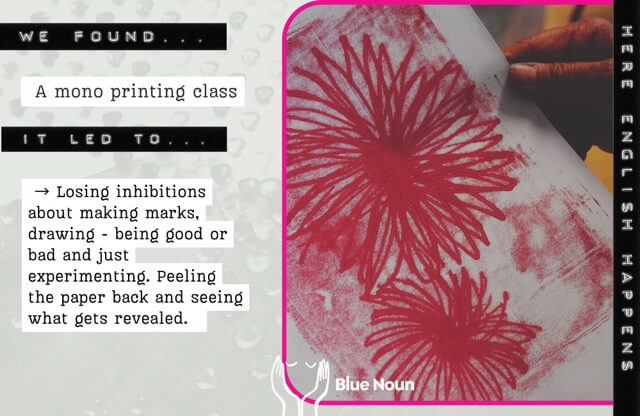
This Field Note came from a monoprinting workshop we joined in the local community.
What interested me wasn’t the vocabulary of printmaking. It was what happened when we were invited to make marks without worrying about whether they were good or bad — to experiment, peel back the paper and see what appeared.
That kind of permission matters in language too.
My Blue Noun Field Notes capture small moments from our English holidays because there is often a gap between what it looks like we’re doing and the language work happening inside it.
Here, it looked like we were making prints. We were also experiencing what it feels like to experiment without needing to get everything right.
→ Read the Story of this Perthshire Art Workshop
Choose Your Immersion Experience with Care
Deciding that you’d like to try language immersion is only the first decision. Immersion experiences aren’t interchangeable either.
Some people love the energy of learning alongside other people. Others know they won’t speak freely in front of strangers and would get far more from a private experience.
Some want several days where English is their complete focus. Others want to improve their English without disappearing from a family holiday or leaving a non-English-learning partner behind.
There are classroom-based immersion courses, homestays, large-group programmes, small-group experiences and highly personalised alternatives.
Blue Noun deliberately offers different options because the format needs to fit the person, not the other way around.
What matters isn’t choosing the most intensive experience you can tolerate. It’s choosing one that gives you enough challenge, support and opportunity to use English — while allowing you to participate fully in the experience.
Choosing an immersion holiday can be surprisingly complicated. Group size, teaching style, accommodation, location, intensity and how much genuine contact you’ll have with the language can all make a difference. I’ve put together a collection of resources to help you compare language immersion holidays and work out what kind of experience will suit you.
→ Explore my guide to choosing the right English immersion holiday

Why Language Immersion Can Be So Powerful
When immersion is the right fit, it gives your English something ordinary lessons often struggle to provide: time, continuity and context.
Instead of switching into English for an hour and then returning to the rest of your life, you spend several days encountering it in different places, conversations and situations.
That creates opportunities to:
-
use English for real purposes, not only practise it;
-
meet vocabulary and expressions in contexts that help them stick;
-
discover where your English flows and where you struggle to access it;
-
become more comfortable responding without having time to prepare everything;
-
connect English with people, places, culture and experiences you care about;
-
notice just how much English you can already use.
And because you’re away from many of your normal demands and distractions, your English gets sustained attention without necessarily feeling as though you’re studying all day.
That’s a very different proposition from simply squeezing more lessons into your week.
When You’re Time-Poor
For many adults, the problem isn’t a lack of commitment to their English. It’s a lack of time.
Work, family and everyday life make it difficult to give English sustained attention. An hour-long lesson has to compete with everything else — and then another week can pass before you use English properly again.
An immersion holiday changes that rhythm. Instead of trying to find more hours for English in your normal week, you give it a concentrated period of your time while also having a holiday.
And concentrated doesn’t have to mean intense.
It can look like this: stacking stones on Dysart Beach, talking as we wander, noticing what is around us, finding words when we need them and letting English be part of the experience rather than the purpose of every minute.
Working on your English can feel good. It can even feel relaxing.
That’s one of the particular advantages of immersion: English gets far more of your time without necessarily demanding more of your energy.

Can’t Travel? You Can Still Create Immersion
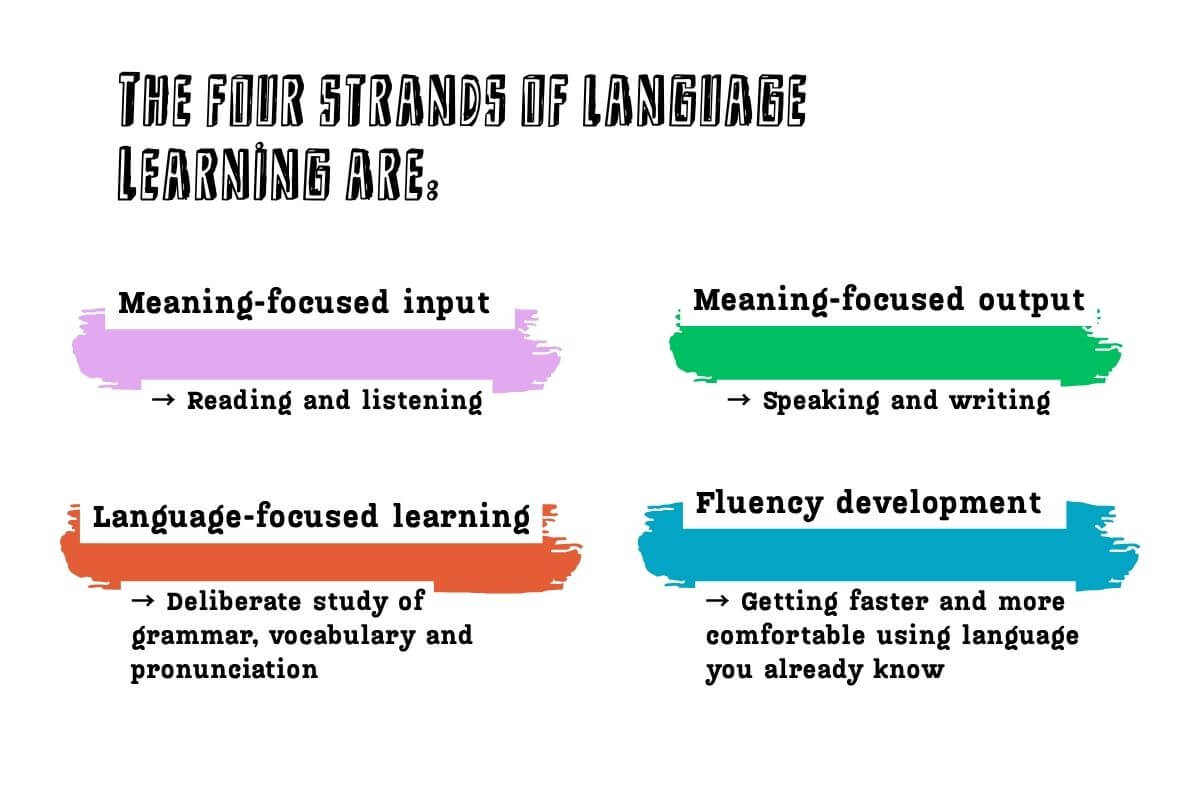
You don’t need to travel to another country to give your English more of that fourth strand.
Look for ways to make English part of something you already enjoy or genuinely want to do. Join an online community around an interest. Take a creative workshop in English. Follow a podcast down a rabbit hole. Read for pleasure. Cook from an English-language recipe. Find people you actually want to talk to.
The aim isn’t to fill every spare minute with more English.
It’s to create experiences where English gives you access to something you want.
Start with what is realistic for you now. A small amount of meaningful, enjoyable English that you want to return to can be far more valuable than forcing yourself through hours of supposedly “perfect” immersion.
Not Sure What Would Help Your English Most?
This is also something we can explore in a Review & Revive consultation.
We can look at how your Four Strands are currently balanced, what English already exists in your life, what feels missing, and what kind of change would be realistic and useful for you now.
That might mean finding a particular kind of teacher or course. But it might also mean using the English you already have differently — finding better opportunities to speak, creating your own forms of immersion, bringing English into an interest you already love, or simply giving an underused part of your English-speaking life more attention.
You don’t necessarily need more English learning.
You may need a better idea of what your English needs next.
So, What’s the Best Way to Learn English?
The best way to learn English is the one that responds to where you are now, what your English needs next and the kind of English-speaking life you want to have.
Sometimes that will mean lessons or focused study. Sometimes it will mean more practice. Sometimes you need to get out into the world and experience what your English can already do.
And sometimes, the most useful thing you can do is stop adding more — and work out which strand needs your attention next.
Further Information
See how we create small, personalised English immersion experiences in Scotland.
Free English Guides
Help Positioning
If you feel stuck, frustrated, or worn down by English, start with recovery.
Before strategy or decisions, focus on rest, steadiness and emotional reset. When you feel regulated, direction becomes clearer.
→ Help with English — Where Steadiness Comes Before Strategy
Help to Ensure Your Choice is Good
Already close to choosing?
Pause briefly before committing your time, money and energy. A few focused questions can help you confirm that your next step genuinely fits.