
Responsible Travel at Blue Noun
Information for people who care about how their travel choices affect place and people
At Blue Noun, we believe travel should be good for the people and places you visit.
That’s easy to say — so easy that almost everyone says it.
This page shows how we put responsible travel into practice through our English holidays, especially how business impacts our local community and environment.
Responsible travel, for us, is about scale, care, and restraint.
It’s about designing experiences that respect place, people, and wildlife — and accepting that not everything should be promised, packaged, or repeated.

Nature and Wildlife
One of the ways this shows up most clearly is in how we think about nature.
Responsible travel, for us, starts with non-invasive encounters.
The moments that stay with people are rarely the ones that are planned or promised. They happen because you are quiet enough, patient enough, and lucky enough to be there.
Experiences like swimming in Loch Earn at dusk and watching deer come down to drink are genuinely extraordinary. Scotland still offers moments like this — fleeting, unscripted, and alive.
But when tourism tries to package, guarantee, or scale these encounters, pressure builds quickly. Wildlife becomes something to perform, and the environments that make these moments possible begin to suffer.
Our approach to travel is shaped by this understanding. We choose to work in ways that respect wildlife, accept limits, and prioritise the long-term health of the places we move through.
Here in Perthshire, we’re fortunate to work with local partners who share this commitment — people who value restraint, care, and responsibility over spectacle.
A Healthy Way to Learn
We source fresh, organic produce from local growers whenever possible — not just because it tastes better, but because it supports small farms, reduces food miles, and keeps money in the local economy.
Sharing seasonal Scottish ingredients with our guests is part of the cultural exchange we’re proud to offer.
Local Community
Responsible travel isn’t only about landscapes and wildlife. It’s also about how tourism affects the people who live and work in the places we visit.
At Blue Noun, our approach to community impact is set out clearly on our Social Action page — including how we work with local partners, support local livelihoods, and avoid extractive or high-volume tourism models.
You can read more about this here:
→ Our Social Action approach
Impact of Accommodation
Where people stay matters.
Accommodation shapes how visitors move through a place, who benefits economically, and how much pressure is placed on local infrastructure. It also shapes the feel of a holiday — whether it’s rooted in everyday life, or insulated from it.
For our English holidays, we prioritise small-scale accommodation and homestays over purpose-built campuses or large hotels.
Staying in real homes helps keep tourism at a human scale. It avoids the concentration of visitors in a single site, spreads economic benefit locally, and reduces the need for new or intensive development. Money spent on accommodation stays within the local community, rather than leaving the area through corporate chains.
It also changes how people experience a place. Living alongside local hosts encourages respect for routines, neighbourhoods, and shared spaces. Guests are part of daily life, not set apart from it.
This approach isn’t about creating a “homestay experience” as a product. It’s about choosing accommodation that supports local life, minimises disruption, and fits naturally into the places we work in.

Small Groups Size
Responsible travel isn’t only about where we go. It’s also about how many people we bring, and how often.
At Blue Noun, your holiday is shared with only 1 or 2 other English learners.
That’s the sweet spot for rapid language growth – and for visiting places without overwhelming them.
A Small class size reduces pressure on accommodation, local services, and natural spaces. It also allows us to return to the same locations without contributing to saturation or overuse.
Choosing to stay small means accepting limits — on growth, frequency, and repetition. It’s a trade-off we make intentionally, in order to protect the places and relationships our work depends on.
Caring
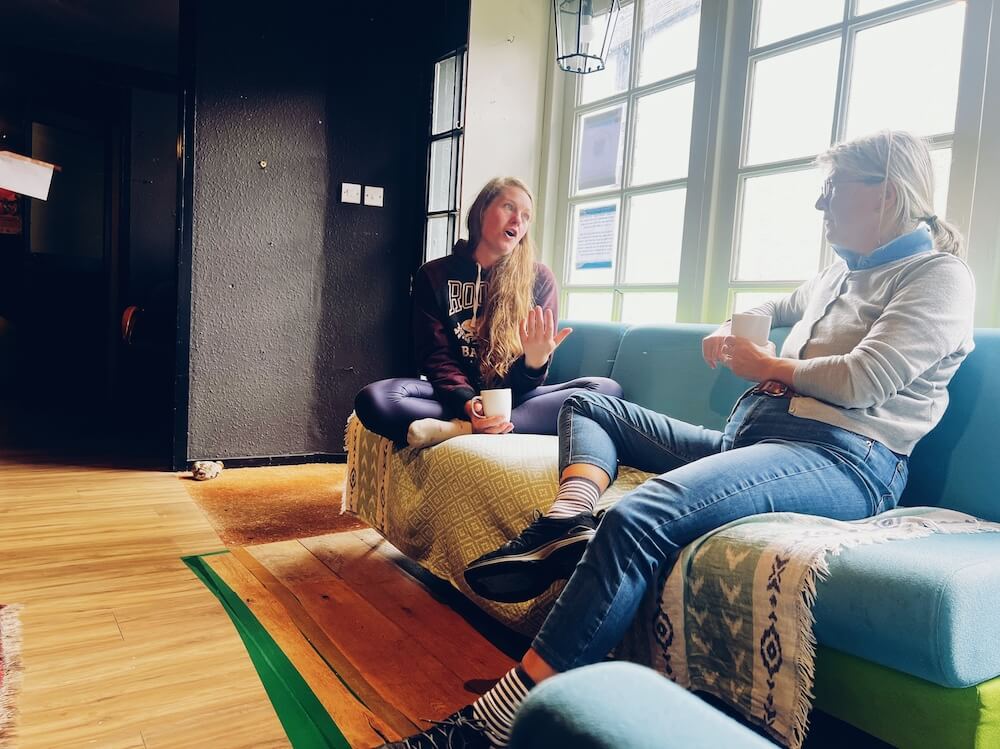
Our approach to responsible travel isn’t separate from the way Blue Noun thinks about language learning. It comes from the same starting point: caring.
If I care about the experience I create for a guest, I also have to care about the people and places that make that experience possible — where the money from a holiday goes, what we use and waste, how we travel, how we treat the landscape, and whether our presence contributes something to the community we’re temporarily part of.
For me, responsible travel isn’t an extra set of good practices added to a language holiday. It’s one consequence of designing the whole thing from a position of care.
Regenerative Travel Labelling
Claims about responsible and regenerative travel are easy to make. We prefer to show the individual choices behind them.
We developed this framework several years ago, long before recent changes to European rules around environmental claims. Its purpose was simple: to make more of the thinking behind our activities visible to our guests.
That idea feels even more relevant now. New EU rules and UK rules are designed, among other things, to tackle vague environmental claims and sustainability labels that can give consumers the impression of independent standards or certification where these don’t exist.
This isn’t a sustainability certification, accreditation or seal of approval. It’s Blue Noun’s own framework for examining and sharing our choices.
We use the same criteria across our activities to show where each one contributes — to our guests and their English, to local people and businesses, to Scottish culture, and to the places and environment around us.
Not every activity needs to contribute in every way. A museum visit does something different from a wildlife walk, a workshop, a meal or a conversation with a local business owner. We can show a clear contribution, a partial contribution, something that isn’t a priority of that activity — and, importantly, something that works against one of our criteria.
We’re a tiny independent business working across language learning, travel and local experiences. This framework wasn’t designed to award ourselves a badge.
It was designed to give our guests more information about what we’re doing and why, so they can decide whether the way we work matters to them.
The bigger picture emerges across the whole holiday.
HOW OUR ACTIVITIES HELP
Perth Museum Visit
⚪ Supports mental and physical wellbeing
⬛ Benefits our local community
⬛ Helps preserve craft skills, historic machinery and monuments
⚪ Supports Scottish microbusinesses or eco-agriculture
⬛ Fosters diverse conversation opportunities
⬛ Supports cultural skills and traditions
🔲 Supports arts and artists
⚪ Explores Scottish wildlife in non-invasive ways
⚪ Introduces guests to Scottish culture
🔲 Contributes financially to preserving culture
🔲 Creates opportunities for fun and feeling good in English
⬛ Clear contribution
🔲 Partial contribution
⚪ Not a priority of this activity
⭕ Works against this criterion
Each activity contributes in different ways, with the bigger picture emerging across the whole holiday.
Responsibility towards guests
Responsible travel isn’t only about landscapes, wildlife, or local communities. It also includes how people are treated as guests.
We work with adult learners who are often investing significant time, money, and emotional energy into their English. We believe responsibility includes being transparent, fair, and respectful in how our holidays are described, priced, and delivered.
That means avoiding inflated promises, unclear claims, or pressure-based selling. It also means designing experiences that respect people’s energy, boundaries, and reasons for travelling — not just what looks good on a programme.
We see this as part of the same ethical framework as environmental and community care: people are not resources to be extracted from, and travel should not come at the cost of dignity or agency.
→ Small Cat, Big Picture: Your Right to Comfort in Language Learning

Sincerity Matters
Responsible travel doesn’t just affect the places you visit — it affects how you experience them. When the people around you care, when the environment feels genuine and well held, your English responds. You’re more open, more at ease, and more willing to use it.
→ Sincerity in Language Education | Why You Need it to Progress
A Blue Noun Field Note
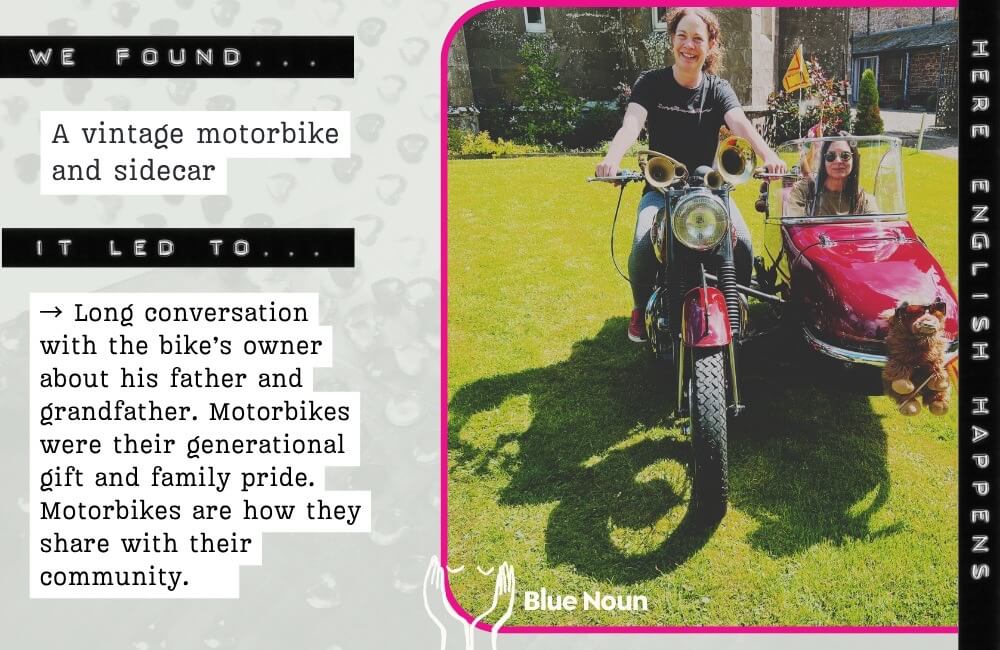
My Blue Noun Field Notes make visible some of what happens on a Blue Noun language holiday that a photograph alone can’t really explain.
This one started with finding a vintage motorbike and sidecar. I encouraged us to stop and talk to its owner, and we ended up hearing about his father and grandfather, and how motorbikes had become part of his family’s story.
One small encounter became a long conversation about family, inheritance, pride and community — with someone we hadn’t known a few minutes earlier.

Responsible Travel Articles
→ What Kind of Economy Do We Want to Build for Perthshire?
About attending the Perth Economic Forum to speak up for small businesses with alternative definitions of success, including businesses that regard safeguarding land, wildlife, heritage and culture as part of their remit.
→ Want to Practise English on Holiday? Agritourism is the Key
Agritourism is a second-language English speaker’s best friend.
We know — we use it every week on our English language coaching holidays exploring Scotland.
→ Regenerative Tourism in Perthshire | A New Model for Crieff?
Could regenerative tourism bring new footfall to Crieff while strengthening the town? This article explores pioneering local initiatives and a new model for tourism.
→ Imagining ‘What if’ for your English
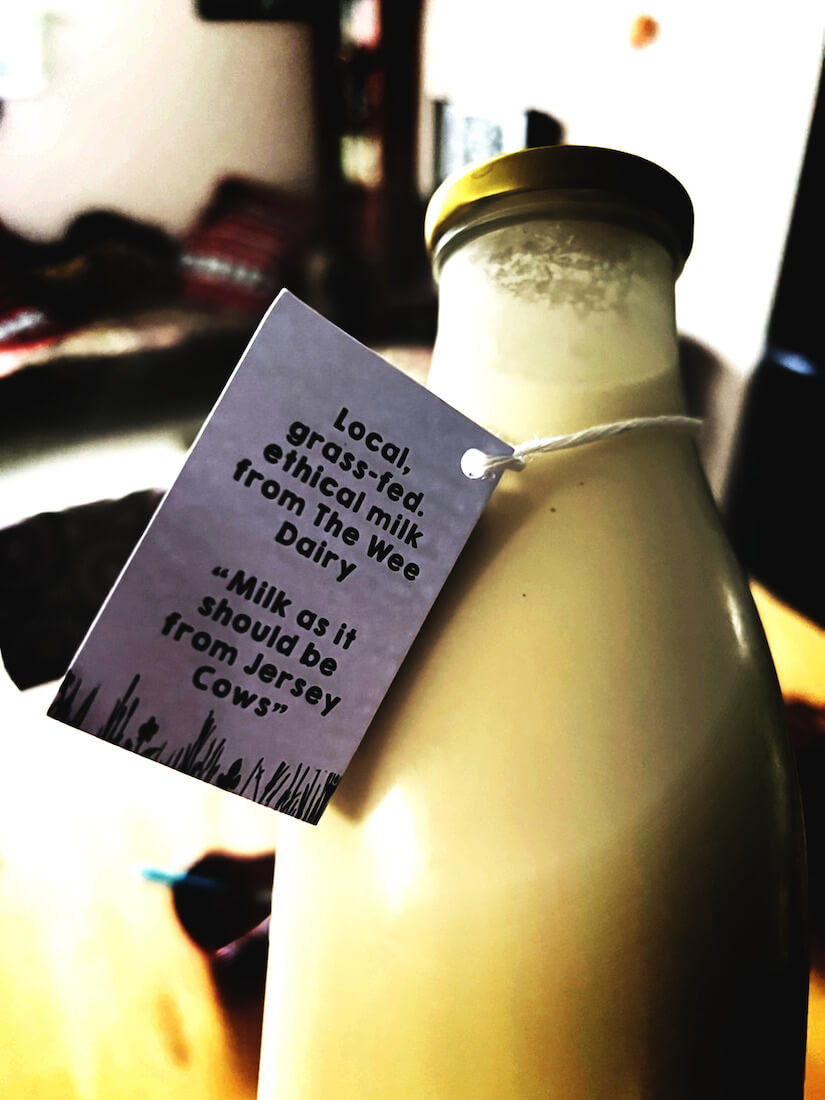
This blog looks at one detail of our holidays: free-range milk, and how respecting that detail sets the tone for respecting your health and wellbeing and the ecosystem we reside in.
→ Unseen | The Victims of Scotland’s Bloodsport Industry
This blog tells the remarkable story of finding an injured golden eagle on one of our guided walks.
