Do you know the expression “to be dropped like a hot potato”?
It means to suddenly get rid of someone or something you no longer want to deal with.
And that’s increasingly how I feel at the end of a course.
Over the last six years, I’ve invested in at least one course or membership per year. Some were to build the business skills I needed to reach clients, some were self-work around growing an ethical business in a healthy way, and a couple were precise blocks of training to develop skills directly around how I help clients.
I don’t expect an ongoing relationship with everyone I’ve learned from.
I actually don’t want text messages from the provider of my SEO course, Nikki Pilkington nice as she is.
That was a clear transaction between the information in her head and what I needed to learn.
But language learning is rarely so clinical.
Language learning builds a particular, sometimes fragile, kind of trust.
We have moments of vulnerability. We struggle to say things we could express easily in our own language. We need reassurance. We let another person see what we don’t know. We can become dependent on their patience while we find our way through something.
And when we’ve been encouraged to lean into a relationship like that, then suddenly get dropped at the end, it can feel cold.
I know how that feels.
And I think it matters, because the way one language-learning experience ends can follow us into the decisions we make about the next one.
Learning a language is unlike other kinds of learning.
This is because knowing a language is not like knowing other things.
As a result, the tools and strategies you have used to learn other things (like brute force repetition of facts) may not apply, and the best way to learn a language will look quite unlike the best way to learn anything else.
The ending affects what comes next
When I first wrote about this on my LinkedIn newsletter, responsible travel writer Genevieve White was first to comment:
“Yup, I’ve had that hot potato feeling too! And it’s not nice. Silver lining – we know how crappy it feels so we can make sure our clients get the opposite experience.”
I replied:
“Thanks for saying so, Genevieve. It made me feel needy writing this. I would never expect this from you, but saying to you that I had course fatigue was at the back of my mind while writing this. As usual, the bad experiences shadow the potential ones. How we leave our clients matters to their future success.”
The bad experiences shadow the potential ones.
That’s the important realisation.
When an English course is ending, of course there should be a conversation about what comes next.
Do you need another teacher? Another course? A break? More grammar? More opportunities to speak? Do you need to learn more English at all, – or how can you start using what you’ve already got?
But most of all, at some point afterwards, shouldn’t somebody simply check in and say:
How’s it going?
→ Did that thing you were working towards happen?
→ Did you use your English in the way you hoped you would?
→ Did something become easier?
→ Did something unexpected happen because of the work you did?
And not because they want to sell you the next course.
Because you worked on something together, and when you took their money, you said their progress mattered.
The results of language learning aren’t in the classroom.
They’re in what happens afterwards.
Don’t you want to know?

I think it can feel different
It’s why I have conversations about next steps with English during all my holidays.
It’s why I will always pass on a couple of names of people who are well suited to the particular way someone wants to work on English when they ask, sometimes years later.
It’s why I get messages from former guests, years after their course, sharing news about a new job or a new moment of success in English.
It’s why I get quick WhatsApp messages asking me to remind them of the best way to learn with podcasts.
It’s why I send photos from the tops of mountains, or straight after a wild swim, or when the heather is turning purple: it made me think of them.
It’s why I get photos from their next holidays, or a video of their kids speaking English, and quite often photos of dogs. Sometimes I’m asked to send updates about my cats or people they met in the community.
It’s why I spend much of the Christmas period chatting with former guests, getting their news while we all have a bit of time to turn towards friendship.
It’s why I am still sending podcast links to one person five years after she joined me for a two-week holiday. She loves a funny podcast, so when I find myself laughing out loud, I quickly send the link.
In case you can’t tell, for me, a little bit of continued contact is a real pleasure.
And it’s one of many tangible differences in a language offer built on caring.
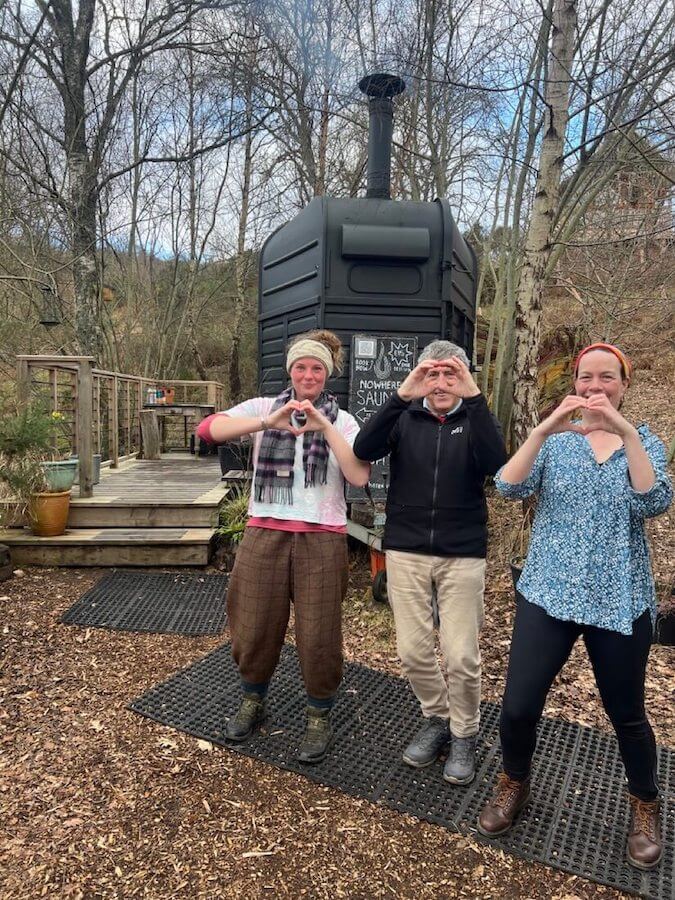

But doesn’t that get exhausting?
It goes against most advice, but I don’t find it draining; I’m not flirting with burnout.
This kind of sharing gives me joy.
I’m a traveller at heart, and for me, this is a way of being on a journey with you.
I love getting a nice sunset picture from Andorra, or news from the cop car on night shift in Madrid. Or hearing that a whole classroom of kids are now pronouncing the ‘J’ sound well, because of my work, my holiday.
I’m not saying teach everyone for free, indefinitely.
I’m saying care about the progress you unlocked and the ripple effect of the results of their investment.
Blue Noun is built on a foundation of loving helping travellers.
I explore its inspiration in my article:
→ An Inspiration for Blue Noun Came from a Traveller’s Apple Pie

What are you choosing next?
If you’ve ever had that hot potato feeling at the end of an English course, ask yourself what it did to your next decision.
Maybe you’re reluctant to work with another teacher because you don’t want to build that relationship again, only for it to suddenly disappear.
Maybe you keep choosing another course because nobody helped you work out what you actually need next.
Maybe you’re looking for more grammar, more vocabulary, another certificate — when what you really need is somewhere to start using the English you already have.
→ The Key to Authentic English Practice Is Not More Lessons
Or perhaps you’ve simply stopped.
The bad experiences often shadow the potential ones.
Am I Bad at English?
You may think you’re bad at English because you’ve spent years measuring yourself against how much you’ve been taught, how much you can remember, how many exercises you can complete, or what “level” you’re at.
The truth is, we’ve seen evidence of a lot of bad teaching that makes failure not your fault.
You may be kicking yourself for stopping, but a better use of your energy would be to get a little help working out what went wrong and what you would need to get back into it.
But those aren’t the same thing as being able to use English.
Help with Your Next Step in English
Before you choose your next English course, teacher or learning goal, it might be worth asking:
Am I choosing this because it’s what I need now — or because of what happened last time?
We have some free resources to help you figure things like this out. You can find them all on our page:
→ Help with English — Where Steadiness Comes Before Strategy
Or maybe you need a gentle way back in
If your confidence in English — or in English learning — has taken a knock, you don’t necessarily need to launch yourself straight into another course.
Our English Amnesty Holiday is our safest, gentlest way back in.
You don’t have to prove what you remember, explain why you stopped, or arrive ready to be a good language learner.
You can just start using English again, with support, and see what comes back.
An English Course has to End.
Caring about what happens to the person afterwards doesn’t.
That’s all I’m asking for: don’t drop people like hot potatoes.
Be interested in what happened next.
Because that’s where the results are.
Closing the Gaps Traditional Language Learning Leaves Behind
A lot of what I create at Blue Noun exists because of the gaps language learning leaves behind.And feeling abandoned when a course ends is one of those gaps.
Being taught something, being encouraged to trust the person teaching you, making progress together — and then being left alone with that progress as soon as the course is over. No How’s it going? No interest in whether it worked. No help understanding what comes next.
Blue Noun’s holidays, English Amnesty, next-step support and continued relationships with former guests are all, in different ways, responses to gaps like these.