
The Blue Noun Learning Space in Scotland
Designed for Great Conversation
When people step inside our space, they often pause and ask:
“What is this place?”
You see, we invite our community into the hub for workshops and events. People who don’t know we are a language school.
Our hub isn’t immediately identifiable as a classroom, or even as a place of learning — and that’s by design.
What they remark on is how the space feels.
Comfortable.
Held.
Cared for.
When people describe a language classroom, they rarely describe it in these terms.
That gap matters.
That gap matters.
It affects how you feel learning English.
This page explains why we have shaped the space this way — and how it supports real, confident English learning rooted in comfort, trust, and everyday use.

A learning space shaped by experience
We ask ‘What if’ about every single element of your language learning holiday.
As a result, English learning at Blue Noun unfolds through conversation, movement, pause, and shared attention.
The space has been experience-designed to support learning in a holistic way — allowing language to develop through real interaction, rhythm, and connection.
Learning happens across the day:
in conversation
in moments of ease and focus
through walking, cooking, resting, and reflecting
in shared time as well as private time
The structure is present throughout the experience, subtle but strong.

Rooted in Community
Our space sits inside a converted church, just a minute from Crieff High Street.
For six years, this has been our base — a place we have invested in carefully and continuously. Every small root we’ve put down has taken time to develop: relationships, routines, shared use of the space, and a steady presence in the life of the town.
Because of that continuity, guests step straight into local life. When they walk out of the door and into nearby shops or cafés, vendors can often recognise what they are here for.
Conversations begin easily and naturally, without being staged or arranged.
Blue Noun is in Crieff, Perthshire for the long term, committed to bringing cultural and economic value to our community and region in ways that grow slowly and sustainably — and that directly support meaningful, real-world English for the people who learn with us.

Designed to feel lived in
The space is shaped by corners.
By comfortable places to sit.
By good light.
There are books you can pick up and browse.
Original artworks by local makers and artists we’ve supported over time.
Objects gathered through travel, work, and shared history.
Everything here serves a single purpose:
to help people feel at home, cared for, and unguarded.
That feeling changes how people speak.
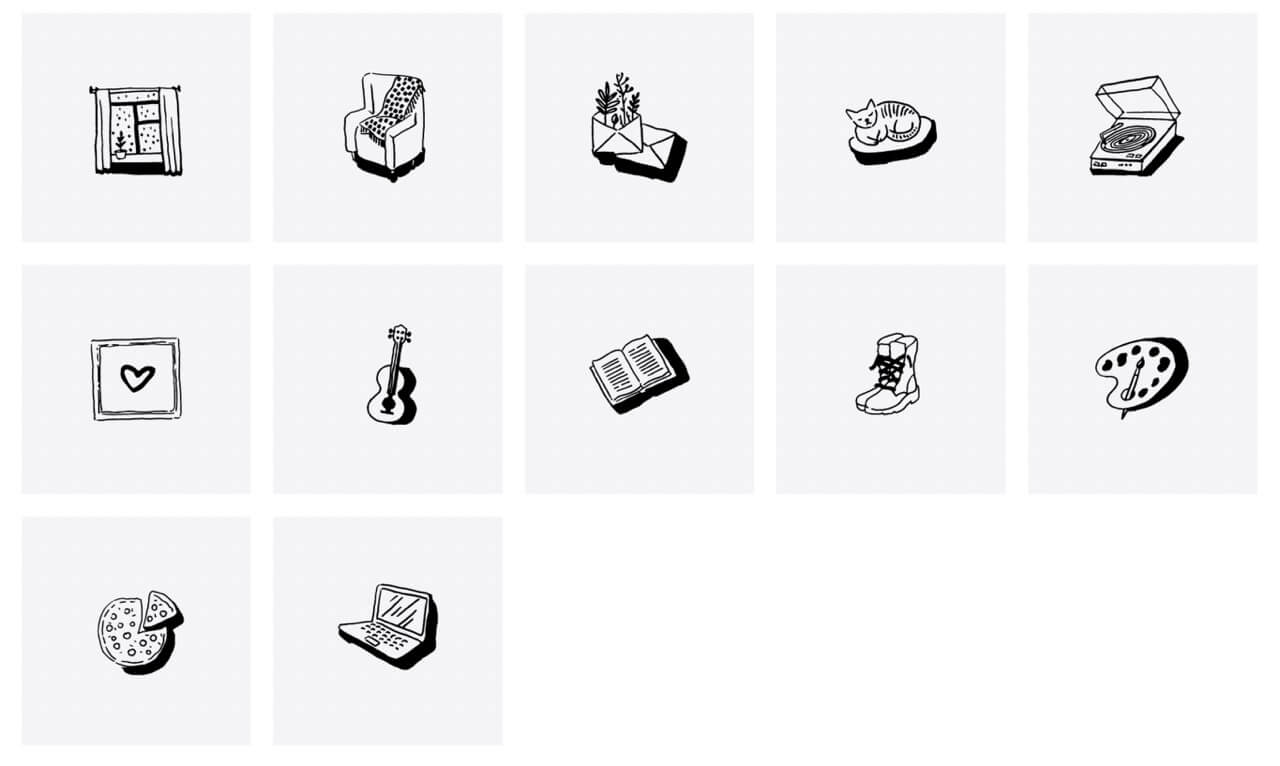
Cosy Things
You may have noticed these icons across our website.
They are an entire set by designer Alice Noir, called Cute hugge cosy things comfort mood and relax time on the Noun Project website.
I found them by chance, but love how every icon represented something already present in the Blue Noun space.
Built on trust
Guests are trusted with real things.
Original artworks, my grandfather’s grandfather clock (I used to hide inside when I was a child).
My vinyl is here for you to play.
When adults are trusted, bodies soften. Attention settles. Conversation becomes easier.
Trust here isn’t stated as a value.
It’s practised.

Learning through trust and alignment
The way this space supports learning is subtle, but intentional. Books, cards, artworks, and everyday objects are carefully chosen and thoughtfully placed, not to direct people, but to invite connection. People engage at their own pace, sit with what resonates, and leave what doesn’t. The space reflects how I think and work, so being here is a bit like stepping inside my head. That matters. When expectations are visible and human, people don’t have to perform or guess what’s wanted of them. They’re allowed to align instead.
I know the space works because, quite often, people leave something of themselves behind here. Sometimes as a gift, occasionally sneaking it into a display.
A story added to an object, a book returned with a note inside, a small artwork placed quietly in a corner. It’s never asked for, and it’s never planned. It happens because people feel recognised, at ease, and involved. Language grows in the same way. Not through pressure or instruction, but through attention, response, and the confidence that comes from being yourself in the presence of someone who is doing the same.
When you arrive
When guests arrive for a Blue Noun holiday, they’re welcomed into a space with its own rhythm.
Each guest is given their own key.
For the duration of the stay, this becomes a place you can come and go from freely — to make tea, read, stretch, pause between activities, or simply sit somewhere comfortable with the language around you.
We live upstairs, and the space belowan extension of our home.
That continuity allows learning to settle naturally into the day.

The door
Although we have gorgeous church windows, the best thing about our space is the door.
We go out whenever we feel the desire to explore, and in when we feel the need to regroup and recover.
This outward and inward rhythm shapes how our holidays unfold, and how learning takes place here.
And just in case you need to know, our Language Hub is fully accessible.

Gezellig
This sense of ease doesn’t happen by accident. It’s close to what the Dutch call gezellig — a shared atmosphere of warmth, safety, and presence that allows conversation to unfold naturally.
My ability to design and hold this kind of space is grounded in eight years of formal arts education, including two Master’s degrees, where learning to work with uncertainty, attention, and meaning is core. That training informs how English is held here: calmly, deliberately, and with care.

Learning on two scales
The Blue Noun hub works comfortably at more than one rhythm.
It supports small, focused coaching sessions, and it can also be a place where guests meet local people and join workshops.
We can even host small, private music events (we are lucky to have amazing musicians in our community).
English is used as part of everyday life, not separated from it.
Across our holidays, the space is used throughout the day and into the evening. Some nights are quiet. Others include shared food, conversation, or informal social time. Participation is always by choice.
Learning here supports the whole person — thinking, resting, moving, changing pace, and finding ease as well as focus.
Explore more
-
Find out about our communal kitchen
How shared meals and everyday rituals support language development. -
Small Cat, Big Picture: Your Right to Comfort in Language Learning
Officially, our cats live upstairs with us, but when we have cat-friendly guests, they come downstairs to take part. They are always up for a cuddle.
A final note
People don’t leave this space wondering what it is.
They leave knowing how it felt to be here.
For some, that feeling comes from a quiet conversation over tea.
For others, from stretching on an exercise ball during a language-and-movement session, or staying late with a glass of whisky and a story.
It might come through shared food, a workshop, live music, or a moment of confidence that arrived unexpectedly.
Because the work we do here changes — different kinds of language coaching, different people, different rhythms — each experience of the space is personal.
Quite often, guests leave something of themselves behind:
an artwork they’ve made, a plant added to a corner, a vase that quietly becomes part of the room.
If there’s one downside, it’s this: after spending time here, people often become more aware of spaces that don’t care. Places that feel interchangeable are harder to tolerate once you’ve experienced what attention, trust, and presence feel like.
People may describe this space differently.
What they recognise is the same thing:
that they felt safe, present, and at home while using English as part of real life.


Good to Know
What’s a Hub?
Social Action Policy
Frequently Asked Questions
Free English Resources
Need to Know
Privacy Policy
Terms and Conditions

Blue Noun Language Hub
St Ninian’s Lodge,
Lodge St, Crieff PH7 4DW
01764 654377
email: ruth@bluenoun.co.uk
All photographs are by the author unless otherwise stated and permission is always obtained.
© Ruth Pringle 2026