
Stuck Choosing Online English?
Making sense of the chaos of finding online English help

Whether you’re exploring online English options for the first time, or trying to choose an online English teacher after months of searching, this page is here to make the choice easier.
Online English has opened up extraordinary possibilities. You can learn with teachers and specialists all over the world, choosing by skill, profession, interests, methodology, culture, schedule, personality — and much more.
That amount of choice is one of the best things about learning English online. It can also be completely overwhelming.
Online, English advice is everywhere — and much of it sounds urgent, useful and convincing.
But when everything is presented as important, it becomes hard to tell what’s relevant, what can wait, and what might actually help.
So you research. Compare teachers. Follow recommendations. Save posts. Watch free videos. Discover another method, another specialist, another course you hadn’t considered.
Many people end up doing more while feeling less sure they’re moving in the right direction.
Worse, the business of searching can start to drain the momentum that brought you here.
Time and energy you wanted to put into your English gets spent trying to decide how to improve your English.
There is a reason choosing feels difficult.
“I need help with my English” simply isn’t enough information to make a good choice anymore.
A conversation teacher, pronunciation specialist, English coach, structured course, language-learning app and online school can all offer excellent support — but they aren’t offering the same thing.
This guide will help you make sense of those differences, work out what matters to you, and narrow the enormous online English market into a much more useful set of choices.
What Kind of Online English Help Is Out There?
When you search for help with your English online, you’re not comparing hundreds of versions of the same thing.
You’re looking at an enormous and increasingly specialised landscape.
You might find:
- Independent English teachers — from general English teachers to people specialising in pronunciation, grammar, exams, professional English, writing, particular first languages or particular groups of learners.
- English coaches — often working less through a conventional lesson structure and more around goals, habits, communication, performance or how English fits into your life.
- Conversation teachers, partners and groups — where the emphasis may be less on learning new language and more on speaking, interaction and using what you already know.
- Structured online courses — from live group programmes with a teacher to self-paced courses built around videos, exercises and other materials.
- Large teaching platforms and online language schools — giving you access to many teachers, lesson types or courses within one system.
- Specialist programmes — one of the real advantages of online English is that support can be built around needs that might be too specific to be met locally.At Blue Noun, for example, we offer English support for people with disabilities, created around the individual communication needs and situations that conventional English courses may not cover.
- Self-study programmes, apps and subscriptions — allowing you to work independently, often with a structured path, library of materials or regular practice.
- Communities, language exchanges and conversation events — ways to make English something you actually use with other people rather than something you only study.
- Free English content — podcasts, YouTube, newsletters, social media, websites and other resources. There is an extraordinary amount of good material available without paying for lessons at all. Blue Noun also has a collection of free English language help and resources if this is the direction you want to explore.
And perhaps you don’t need more online English
It’s easy to begin with “I need to improve my English” and assume the answer must be another online teacher, course or programme.
It might not be.
Perhaps what would help most is using your existing English more: travelling, joining something in English, reading, making friends, volunteering, taking part in an immersion experience, starting a project, or finding another reason for English to exist in your everyday life.
That’s still part of this map.
Because the aim isn’t to find the best thing being sold as online English.
It’s to understand the possibilities well enough to recognise which part of the landscape is worth exploring for you.
And if that landscape feels surprisingly complicated, there’s a good reason for it.
Why Are There So Many Online English Options?
Online English learning has been something of a revolution.
Not so long ago, your choices were largely determined by where you lived. You went to a local language school, joined one of the courses available, found a private teacher nearby, or studied on your own with whatever resources you could get hold of.
Online learning changed that.
It didn’t simply give us more English teachers to choose from. It created entirely new ways to learn, practise and use English.
You can work independently or with other people. Join a course or book individual sessions. Learn with a general English teacher or find someone with very specific expertise. Practise conversation, focus intensively on one skill, join a community, follow a self-study programme, use an app, work with a coach — or build your own mixture from all of these.
That’s an enormous advantage. It also means that choosing “online English” is no longer one simple decision.
The possibilities branch in almost every direction — which can make the search feel like one of those old Choose Your Own Adventure books, where every page sends you towards three more decisions.
If that sounds familiar, I made a visual version of exactly that experience:
→ Choose Your Own English Adventure

One of those branches is the enormous world of independent English teachers.
You can choose someone because they understand your profession, specialise in pronunciation, share your interests, work with people preparing for a particular life change, teach through books or films, focus on conversation, use a particular methodology, or simply offer a way of learning that fits comfortably into your week.
English teachers are not interchangeable.
Their expertise, training, methods and particular strengths can make a real difference to whether someone is right for what you need.
If you’ve decided that working with an independent teacher is the route you want to explore, I’ve written a separate guide to making that choice:
→ Online English Teachers: How to Find the Right One for You
But an independent teacher is only one route.
A weekly conversation with an independent teacher, an intensive Business English course, a pronunciation programme and a large-platform subscription may all appear in the same search results, but they solve different problems and create very different learning experiences.
That means your first question probably shouldn’t be:
Which option is best?
A more useful place to begin is:
What do I want this English support to do for me?

Start With What You Want Help With
It sounds obvious, but “I want to improve my English” can lead you towards almost every teacher, course and platform on the internet.
Getting more specific makes choosing much easier.
You might want to:
- speak more easily with the English you already know
- improve your pronunciation
- expand your vocabulary or strengthen your grammar
- prepare for English at work
- feel more comfortable joining conversations
- write more effectively
- prepare for an exam or a specific event
- create more opportunities to actually use your English
- bring English back into your life after a long break
These aren’t interchangeable goals, and they don’t necessarily need the same kind of English help.
There’s another question worth asking here too:
Want a Quick Way to Explore Your Options?
If you’re at the beginning of your search — or you’re still not sure how the different kinds of online English support might fit you — I’ve made a short quiz to help.
It won’t tell you the answer. It’s designed to help you notice which kinds of support might be worth exploring before you invest more time, money or energy in your search.
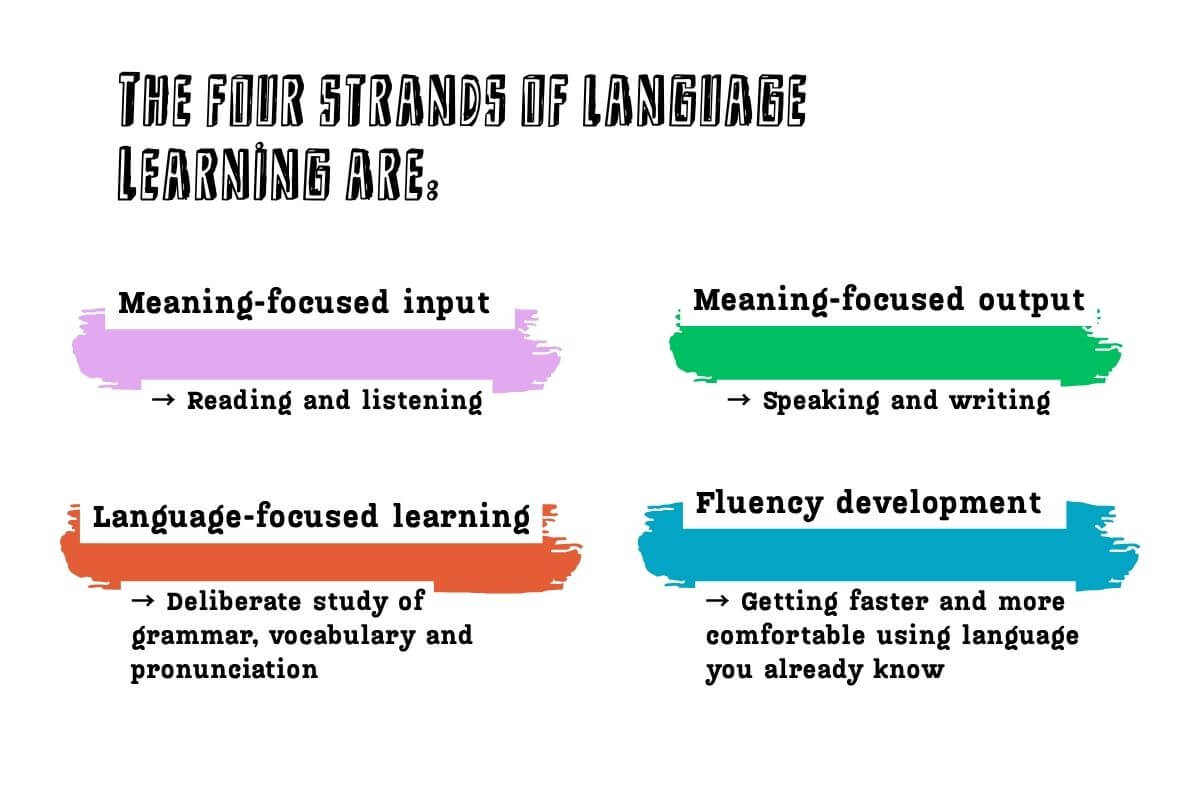
What kind of English learning have you already had plenty of?
Many experienced English learners have spent years learning vocabulary, grammar and other features of the language. What they have had much less of is time spent using that knowledge — speaking, reading, listening and communicating for a real purpose.
For someone else, the imbalance may be completely different.
This is where the Four Strands can be useful. It’s a simple way of looking at the balance of different kinds of language learning and noticing what may have been missing from yours.
You don’t need to diagnose your English perfectly before choosing some help. You’re simply trying to make the search more specific.
Instead of searching for “online English teacher”, you might now be looking for “online English conversation practice for advanced learners”, “pronunciation help for work”, “Business English presentation course”, or simply more opportunities to use the English you already have.
That gives you a much more useful place to start searching from.
Give Yourself Time to Choose
Once you’ve narrowed the possibilities, give yourself enough time to look properly at what’s left.
You don’t need to decide the future of your English today.
But the choice you make does matter.
English support that isn’t a good match doesn’t only cost you money and the time you spend on it. It can cost you momentum.
You start with energy and good intentions. Then the course doesn’t quite work for you. Perhaps you stop attending, don’t finish, or complete it without feeling that much has changed.
And now starting again is harder.
You’ve spent time and money. Your original enthusiasm has faded. You may be more doubtful about what will work, less willing to invest again, and faced with the exhausting prospect of beginning another search.
A poor choice can leave you further away from taking action than you were before you made it.
That’s a good reason to choose carefully. It isn’t a reason to make the decision enormous.
You don’t need to find the teacher who will take care of your English for the next five years, or create the perfect learning plan now. You need to decide what would be useful for now, choose something that seems a good match, and see where it takes you.
What About Price?
Online English prices vary enormously, and comparing them isn’t always straightforward.
Two offers can use almost identical words — personalised, confidence, fluency, tailored to you — while providing very different levels of expertise, preparation, feedback and support.
Equally, a higher price doesn’t automatically mean better teaching, and the cheapest option isn’t necessarily good value if it doesn’t help you do what you came for.
Price makes more sense once you understand what you’re actually comparing.
If you’re trying to work out what quality English teaching looks like, what you may actually be paying for, and how to think about value rather than lesson price alone:
Online Language Learning
Because Blue Noun is all about travel and real-life language experiences, people sometimes expect us to be anti-online English learning.
We’re not.
For many people, online English is the most realistic and effective option — especially when time, money or location are limiting. And, as this page shows, learning online gives you access to an extraordinary range of teachers, specialists, courses, communities and resources.
What we are against is poor-quality support, unnecessary pressure, and learners being pushed towards a solution before they’ve had a fair chance to work out whether it suits them.
This page exists to slow things down before you’re asked to choose.
By now, you might have a clearer idea of which part of the online English landscape you want to explore. If you do, follow that direction. You don’t need to keep researching all the others.

If you want to step outside the online-English market altogether, I’ve also put together a broader guide to finding help with your English.
It includes online and offline possibilities, things you can do independently, and different ways of bringing more English into your life.
What If You Still Don’t Know What Kind of English Help You Need?
Perhaps you’ve looked at all these possibilities and realised that choosing between them isn’t actually your problem.
You’re not sure what you should be looking for in the first place.
Maybe you’ve learned English for years. You know some things work well and others don’t. You may have tried courses, teachers, apps or self-study already. You know you want something to change, but you can’t clearly say what kind of support would be useful now.
That’s a different question — and it’s exactly what Review & Revive is designed to explore.
Review & Revive is a 60-minute one-to-one online session where we step away from the marketplace and look at your English, your learning history, what you need English for, what you’ve already tried, and what might make sense to explore next.
It isn’t another English lesson, and the aim isn’t to steer you towards a Blue Noun service.
It’s a chance to get clearer before you choose.




Good to Know
What’s a Hub?
Social Action Policy
Frequently Asked Questions
Free English Resources
Need to Know
Privacy Policy
Terms and Conditions

Blue Noun Language Hub
St Ninian’s Lodge,
Lodge St, Crieff PH7 4DW
01764 654377
email: ruth@bluenoun.co.uk
All photographs are by the author unless otherwise stated and permission is always obtained.
© Ruth Pringle 2026