
Address your English Trauma
You are not ‘bad at English‘ – at worst, your English isn’t great – yet (and it’s probably not half as bad as you think it is!)
How do I know?
Just as dentists have to listen to lots of dental horror stories, I hear a lot of stories about English teachers.
I help people who have their own English horror stories almost every day.
This page has tips to help you understand why you feel this way – and how to free your English!
Understanding Your Learning Mix
If you’ve spent years learning English but still feel that you’re ‘bad at English’, it may be worth looking at the kind of learning you’ve been doing.
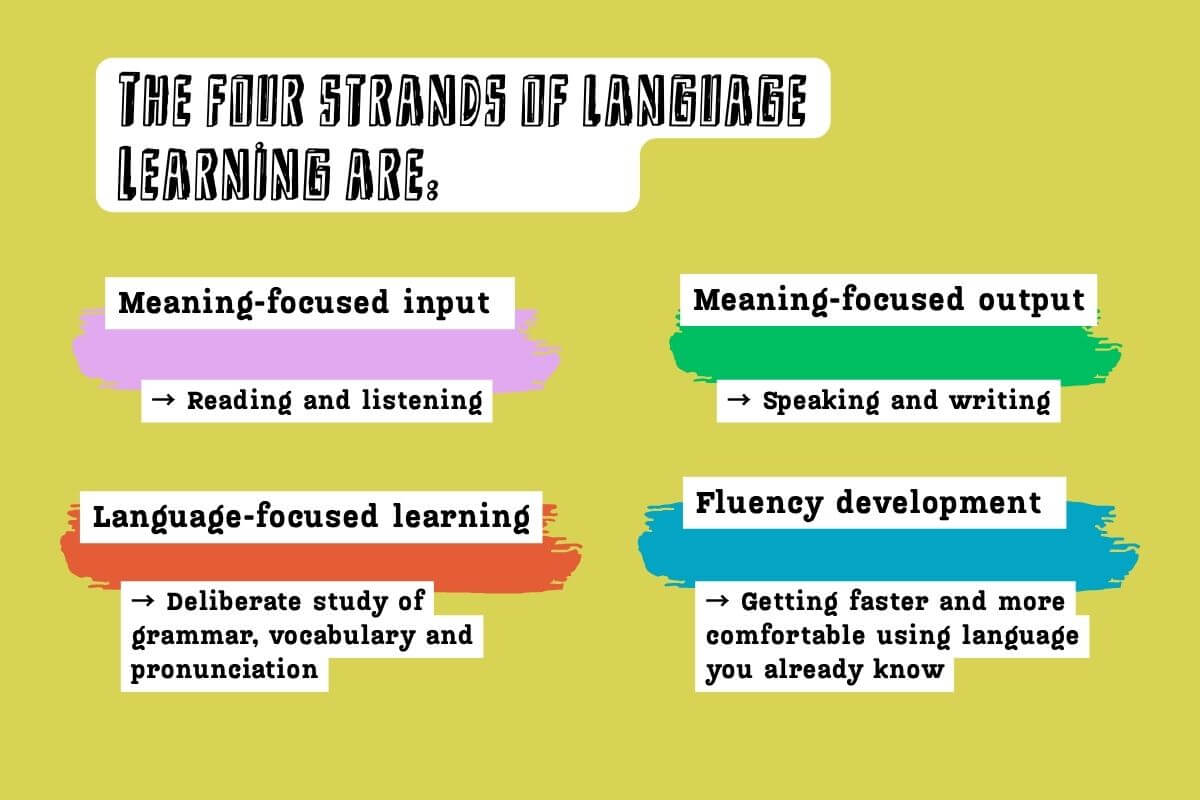
Language learning has four different strands, and most of us don’t get them in equal measure.
If you’ve spent years learning English but still feel that you’re ‘bad at English’, it may be worth looking at the mix of learning you’ve had.
Language learning has four strands: meaning-focused input (reading and listening), meaning-focused output (speaking and writing), language-focused learning (deliberate work on grammar, vocabulary and pronunciation), and fluency development (getting faster and more comfortable using language you already know).
Most of us don’t get all four in equal measure, and until we rebalance, it can feel like our English isn’t working.
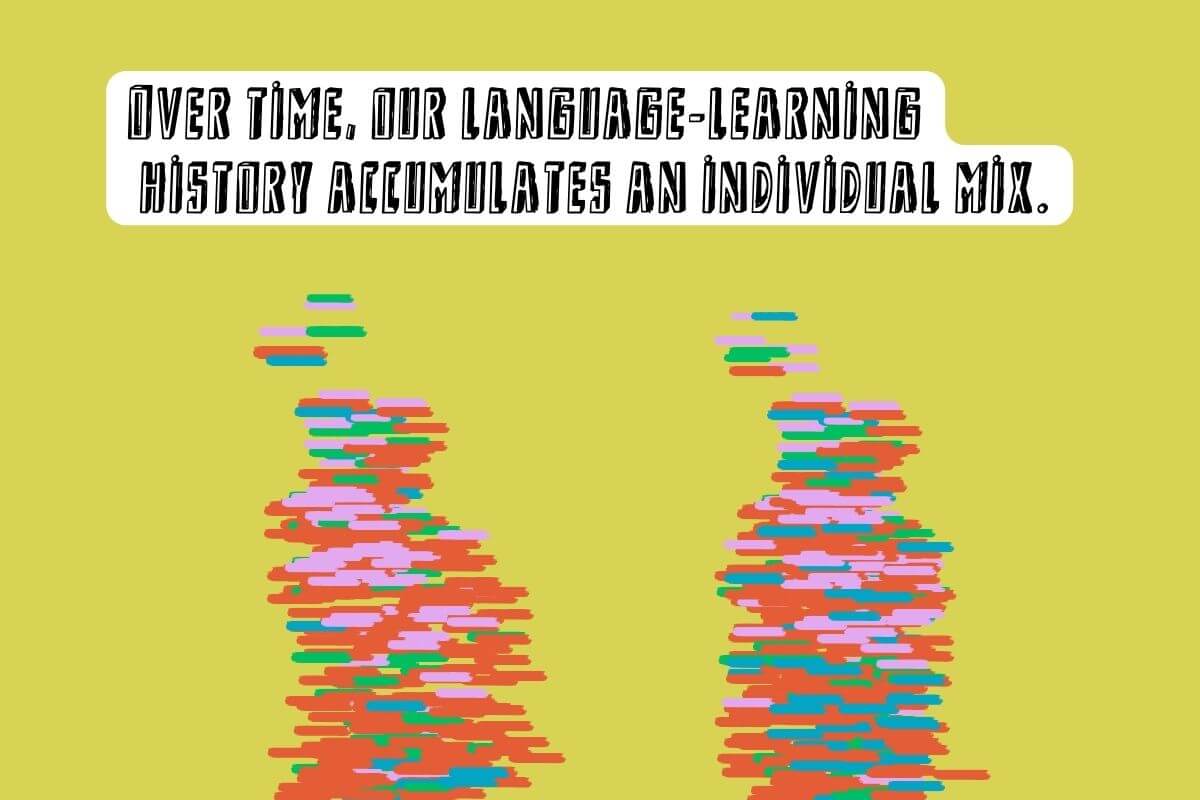
If English makes you anxious, your brain is busy trying to keep you ‘safe’ by avoiding it.
That’s not going to get you to your dreams.
There ARE Bad English Teachers

There ARE Bad English Teachers
I hear shocking stories about language teaching at school, at college, and even in expensive private classes.
Recently, a woman I’m helping showed me the hundreds of worksheets she had completed during four weeks at a language school in Cambridge.
She had arrived in the UK with almost no English and was placed in a mixed-level class, where she was given photocopy after photocopy of material that often wasn’t remotely appropriate for a beginner.
She had been working incredibly hard, but she was frustrated by her progress. She was struggling to remember everything she had been taught. English wasn’t making sense.
Then I looked at the worksheets.
One was called Booking a Train Ticket.
Great. That’s exactly the sort of practical English a beginner visiting the UK might need.
Except before getting anywhere near buying a train ticket, she was expected to learn ten idioms: flight of fancy, any port in a storm, drive someone round the bend, in the same boat, go off the rails, shape up or ship out, off the beaten track…
These are not beginner phrases. Most aren’t particularly useful for travelling either.
But what really gets me is what happens next.
After matching all these idioms to their definitions, the worksheet suddenly asks her to imagine she is buying a ticket at a train station and write down the phrases and vocabulary she might expect to hear or say.
The language she has just been taught does not help her do the task.
Knowing what any port in a storm means does not help her buy a return ticket. Go off the rails does not help her understand the person behind the ticket desk. Flight of fancy does not prepare her to answer a question about where she is going.
The connection seems to be simply that the idioms contain transport words and trains are transport.
For an experienced English speaker, that might just be a slightly odd worksheet. For a beginner trying desperately to work out how English works, it can be profoundly confusing.
And yet she thought she was the problem.
That’s the bit that makes me angry.
Put something inside a language school. Give it a lesson title. Hand out an official-looking worksheet. Fill it with vocabulary, definitions and exercises. Do that in a city famous for education, and of course a learner assumes this is what good language teaching looks like.
So when she can’t make sense of it, she doesn’t think, Hang on. Perhaps this lesson doesn’t make sense.
She thinks:
I have a bad memory.
I’m not making enough progress.
Maybe I’m just bad at English.
“Sorry for my English”
There are excellent language schools, excellent teachers and excellent worksheets.
There are also exploitative systems that can keep selling learners more classes, more levels and more material while leaving the learner believing that the failure belongs to them.
A huge quantity of teaching is not the same thing as good teaching. A worksheet doesn’t become useful because somebody photocopied it in Oxford or Cambridge. And learning more and more English is not necessarily what you need in order to become better at using English.
So many people have experienced tuition that wasn’t remotely engaging. Even worse, it was smug, self-congratulatory – even humiliating.
‘I’m a bad learner,’ people apologise to me. ‘English isn’t for me.’
‘I’m sorry, I’m so bad at languages,’ they say.
‘Maybe you just haven’t had the right teacher,’ I say in return.

#01 Find Out What’s Holding You Back
While some people clearly absorb language more easily than others, this does not make anyone a lost cause – or irrevocably ‘bad at English’.
Let’s take a quick look at your hangups.
If you were not a ‘natural’ during high school English, perhaps it’s because you were comparing yourself to kids getting invisible extra help and incentives – (coaching, holidays, nannies, parents).
Maybe you weren’t engaged by the content, or the teacher couldn’t control the class.
Perhaps you hated speaking in front of class – even in your own language – so much that doing it in a second language felt like torture.
Maybe you went through a crappy time as a teenager, at school – so many of us did.
Maybe you were just in love with the girl in front of you and didn’t hear a word.
Of course, it’s very possible you didn’t try, but ask yourself why? You hate the sound of English? Your brother was better at it? You were in a huff because they got to sing songs in Spanish class? There are thousands of valid(ish) teenage vision reasons not to have cared, which may still be influencing how you approach learning.
#02 It’s Not Too Late
Whether it’s your ‘fault’ or not, your English now needs an investment of time and love.
With a only small mindset shift, bad experiences in the past do not necessarily make it more difficult to advance your English in the present.
What bad experiences do mean is that it’s EXTRA important to get your choice of teacher right.

#03 There is Now An Online English Teacher for Every Learner
For years I’ve been admiring from a distance all the splendid online English teaching options that now exist: independent teachers and ELT professionals with different skills, specialisms and ways of helping people learn.
When I began EFL teaching, online classes often felt like a compromise — a poor substitute for being face-to-face. That has changed enormously.
Online learning can now connect you with excellent teachers anywhere in the world. You can find someone who understands your profession, specialises in pronunciation, works brilliantly with advanced learners, shares your interests, or simply teaches in a way that works particularly well for you.
That choice is a wonderful thing. But choosing an English teacher isn’t like choosing a pair of trousers you can return if they don’t quite suit you.
Nor is it like choosing a restaurant in a new city. One might be better value, or have more of the food you like, but the consequences of getting it wrong aren’t particularly grave.
We’ve all had a disappointing meal. It doesn’t put us off eating.
A disappointing experience learning English can put you off trying again for years. Sometimes for good.
So if you’ve decided you want to work with an independent teacher, it’s worth looking beyond price, availability and a polished profile, and thinking about what kind of teacher is actually right for you.
→ Online English Teachers: How to Find the Right One for You

#04 Choosing the Right Teacher Matters
It really, really matters.
If you are a bad match with your new course, then you don’t make progress, you miss a couple of classes then all of a sudden, you’ve stopped going without ever deciding to quit. That’s another failure insidiously reinforcing your myth that you are bad at English, and making it even less likely you will ever try again.
Ultimately, that means you not getting the job/opportunity/boyfriend/holiday that inspired you to search for a course in the first place…
#05 Learn What You Don’t Know
I’m sure you know that as adults we all have different learning needs, energy cycles, and learning environments in which we respond well and poorly. (It’s helpful to be aware of yours).
We also have different pedagogic styles and preferred time/intensity periods: not to mention subjects that will engage us.
You need to discover what will switch you on.
Think about it, how COULD you possibly know what your English learning preferences are?
So how CAN you make the right choice of Online English service?
We can help.
#06 Ask an Expert
If this is what you’ve learned to recognise as ‘proper’ language learning — classrooms, levels, seas of worksheets, long vocabulary lists, grammar exercises and lots of new material — then something like a Blue Noun English holiday can look suspiciously light by comparison.
Where are all the worksheets? When does the serious learning start?
But looking like learning and creating learning are not the same thing.
If we prepare some useful language before you go into a shop, and then you actually go into that shop and use it, that is language learning.
If you already know the words but freeze when someone speaks to you, then practising that interaction, trying it for real and discovering that you can cope is language learning.
If you spend time talking with me while we walk, cook or explore somewhere, you are listening, retrieving language, responding, noticing gaps, repeating familiar language and becoming more fluent with English you already have.
None of that produces a pile of completed worksheets to take home.
It is still serious language learning.
Good language learning doesn’t have to produce a mountain of paper.
Sometimes you don’t need more English poured into you.
You need well-designed opportunities to use, retrieve and trust the English you already have.
That’s not the easy option. It’s a real one.
→ Not Just Talking in English. Why Real-World English isn’t a ‘Lite’ Learning Option
Still Think You Are ‘Bad at English?’
You haven’t had the right teacher yet!
And before you waste any more time searching for them online, be clear:
- You don’t need to fit into a teacher’s* methods or courses.
- Somewhere, online, there is the perfect course/learning community/teacher to help YOU.
Further Information
The most valuable language learning doesn’t just add more English. It changes your relationship with the English you already have.
Moving the needle from “I hate English” to “it’s mostly harmless” might be the small change that brings more and more English into your life.
Free English Guides
Help Positioning
If you feel stuck, frustrated, or worn down by English, start with recovery.
Before strategy or decisions, focus on rest, steadiness and emotional reset. When you feel regulated, direction becomes clearer.
→ Help with English — Where Steadiness Comes Before Strategy
Help to Ensure Your Choice is Good
Already close to choosing?
Pause briefly before committing your time, money and energy. A few focused questions can help you confirm that your next step genuinely fits.