

How to Feel Confident in English
If you are searching for how to feel confident in English, there’s a catch.
Despite a lot of advice out there, real confidence isn’t something you can manufacture by positive thinking or repeating affirmations. (These can briefly bolster you at best).
Language confidence isn’t even won by more language acquisition.
Confidence grows when your brain has enough evidence that something is true.
If you believe your English isn’t understandable, the solution isn’t to tell yourself it is (or have a coach telling you that it is!)
It’s to collect evidence that it already is.

We Need to Show Our Brains
Many language learners do not struggle because of a lack of vocabulary or grammar. They hold a deeply embedded belief:
“My English doesn’t work.”
That belief is incredibly resistant to being argued with. Experiments in cognitive neuroscience show that beliefs don’t change because someone tells us something different.
They change when we accumulate new, positive first-hand evidence that contradicts the old belief.
Foreign Language Anxiety
At Blue Noun, we often have people arriving who deep down believe that their English is terrible.
It’s not fear of making mistakes. They doubt whether another person can genuinely understand them.
Anxiety about using a foreign language is so common it even has a name: Foreign Language Anxiety (FLA).
The problem is that beliefs like these are remarkably stubborn.
And it makes people with it endlessly vulnerable to being sold ‘solutions’ that will ‘fix’ their English, and get stuck in a cycle of needing more and more lessons.
This is a vicious circle I go into detail on here:
→ Confident English: Why Feeling Good Speaking Matters More Than Progress

Neuroscience Gives Us an Alternative
Professor Tali Sharot, a cognitive neuroscientist at University College London, has shown that people rarely change deeply held beliefs because someone tells them to. They change when they become direct witnesses to new evidence.
“If you want to change someone’s belief, don’t attack it. Make them a direct witness to positive new evidence that will both inspire them and counteract the negative effects of their old beliefs.”
That is exactly what happens during a week of real conversation with a Blue Noun language holiday.

A Different Kind of Language Progress
Imagine deciding what to eat for lunch, chatting with an artist, asking questions during a guided visit, spending an evening talking with your homestay host.
Imagine dozens of conversations where people respond naturally because they have understood.
Every day, each interaction becomes another piece of evidence.
Your English worked.
Well enough to connect, laugh, ask questions, tell stories and be understood.

How to Lose the Fear
As Dale Carnegie famously wrote:
“Do the thing you fear, and keep on doing it. That is the quickest and surest way ever yet discovered to conquer fear.”
For people with FLA, speaking English isn’t just fluency practice; its most important role is evidence gathering.
Every successful conversation weakens the old belief and allows a new one to take root:
“Perhaps my English really is understandable.”

About Language Travel and FLA
People with FLA can’t just hope that if they travel inside their target language, they will improve (as language users with a similar level but no fear might more reasonably hope).
Your evidence has to be collected in conditions where the brain feels safe enough to learn.
That means:
-
-
- away from work, where mistakes carry consequences
- with a language coach or teacher who can act like a lifeguard (not a judge).
- through conversations that feel natural.
- through approaching conversation in ways that feel gentle and easy, not difficult tenses first (language coaches know how to do this; the general public do not: classic question: for how long have you been in Scotland?).
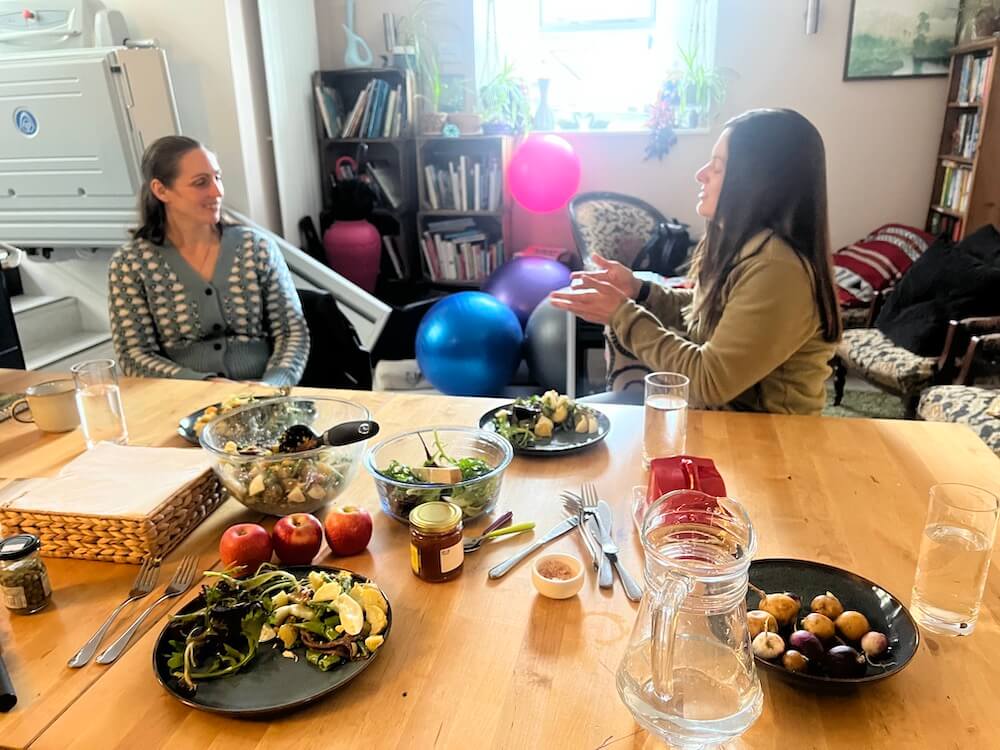
- while cooking, walking, making things or exploring Scotland, where part of the brain is occupied by the activity rather than self-monitoring (like this header image from a pronunciation workshop demonstrated).
- in calm, welcoming spaces with comfortable chairs, plants, coffee (sometimes even cats), instead of noisy public places where everything feels unpredictable and temporary.
→ Small Cat, Big Picture: Your Right to Comfort in Language Learning
-

Game Changers
If you have anxiety around speaking, these conditions aren’t luxuries; they make the difference. They reduce the cognitive load of speaking.
When anxiety falls, people stop monitoring every sentence and start communicating instead.
That gives you the only thing capable of really changing your language beliefs: repeated, first-hand evidence that your English works.
English Conversation Practice Options
It can be difficult to see what a skilled language coach is doing during what appears to be an ordinary conversation.
This article explores the invisible support that sits beneath effective conversation practice, comparing free conversation with a native speaker, guided language development and designed language experiences.
About Blue Noun Conversation Holidays
During Blue Noun conversation holidays, my coaching role is not to convince people that their English is good enough. (Coaches who do this are not fixing any problems in the long term).
It is to engineer repeated moments of disconfirming evidence.
We do this strategically.
We have a system that practices English alongside nature, crafts, well-being support and slow travel (all proven anxiety reducers).
Ultimately, every successful interaction chips away at the belief that one’s English isn’t understandable, until you no longer need outside reassurance: the world has already provided the evidence.
You can’t get this authentically inside an English classroom.
You can only get this through guided language encounters, ones that happen outside a language classroom – and with real-world conversations.
The English Amnesty Option
If you’ve spent years feeling anxious about speaking English, you don’t have to jump straight into an intensive language holiday.
Our English Amnesty Holiday is designed to help you gradually discover what your English can already do in a gentle, supportive environment. With a language coach by your side and fewer real-world interactions, it’s an ideal starting point for people who experience genuine stress or anxiety when speaking English.
If you’re unsure which holiday is right for you, book a Zoom call. We’ll talk about your English, your goals and your concerns, and help you choose the option that feels right for you.
Further Information
All quotes on this page are from Steven Bartlett‘s book, The Diary of a CEO, Chapter 4: You Do Not Get to Choose What You Believe
Related Pages
Learn how we have designed our space for great conversations:
→ Discover the Blue Noun Language Hub Learning Space
This podcast can help you with English language learning.